In shortStart with Jogyesa, the Jogye Order's head temple in central Seoul, free and open around the clock; add Bongeunsa, across the road from COEX, for an older temple among trees. Enter halls by the side doors with shoes off and socks on, and keep your voice low. If you want more than a walk-through, book a one-day Templestay; save the overnight, with its 4 a.m. start, for travelers who actively want monastic routine.
Key facts
- Jogyesa
- 조계사, 55 Ujeongguk-ro, Jongno-gu; Jonggak (Line 1) Exit 2 or Anguk (Line 3) Exit 6
- Bongeunsa
- 봉은사, 531 Bongeunsa-ro, Gangnam-gu; Bongeunsa Station (Line 9) Exit 1
- Admission
- Free at both temples
- Bongeunsa grounds
- 05:00–22:00, open all year
- Yeondeunghoe (lantern festival)
- UNESCO Representative List, inscribed 2020
- Buddha's Birthday 2027
- Thursday, May 13 (8th day of the 4th lunar month)
- Templestay formats
- One-day (2–3 hours), experience-oriented (overnight), rest-oriented
- Booking
- eng.templestay.com; Templestay center at 56 Ujeongguk-ro, near Jogyesa
Checked Oct 20, 2026 against the official sources listed at the end of this guide.
Jogyesa: a head temple squeezed into a city block
조계사 (Jogyesa) is the chief temple of the Jogye Order, the order that represents mainstream Korean Seon (Zen) Buddhism. By the temple's own account the order has around 3,000 temples nationwide and some 15,000 monks and nuns, including the three great 'jewel temples' of Tongdosa, Haeinsa and Songgwangsa. The order's administrative headquarters, a training center and the Central Buddhist Museum share the compound, so many of the people crossing the courtyard briskly are staff, not visitors.
Its history explains the urban setting. Monks founded it in 1910 as Gakhwangsa, the first temple built inside the boundary of old Seoul's four main gates, as a center for an independent Korean Buddhism. It was renamed Taegosa in 1938 and became Jogyesa in 1954, part of an effort to clear away colonial-era influence on the religion. The main hall is open 24 hours a day, and the temple presents itself as a place anyone can walk into, local or foreign, believer or not.
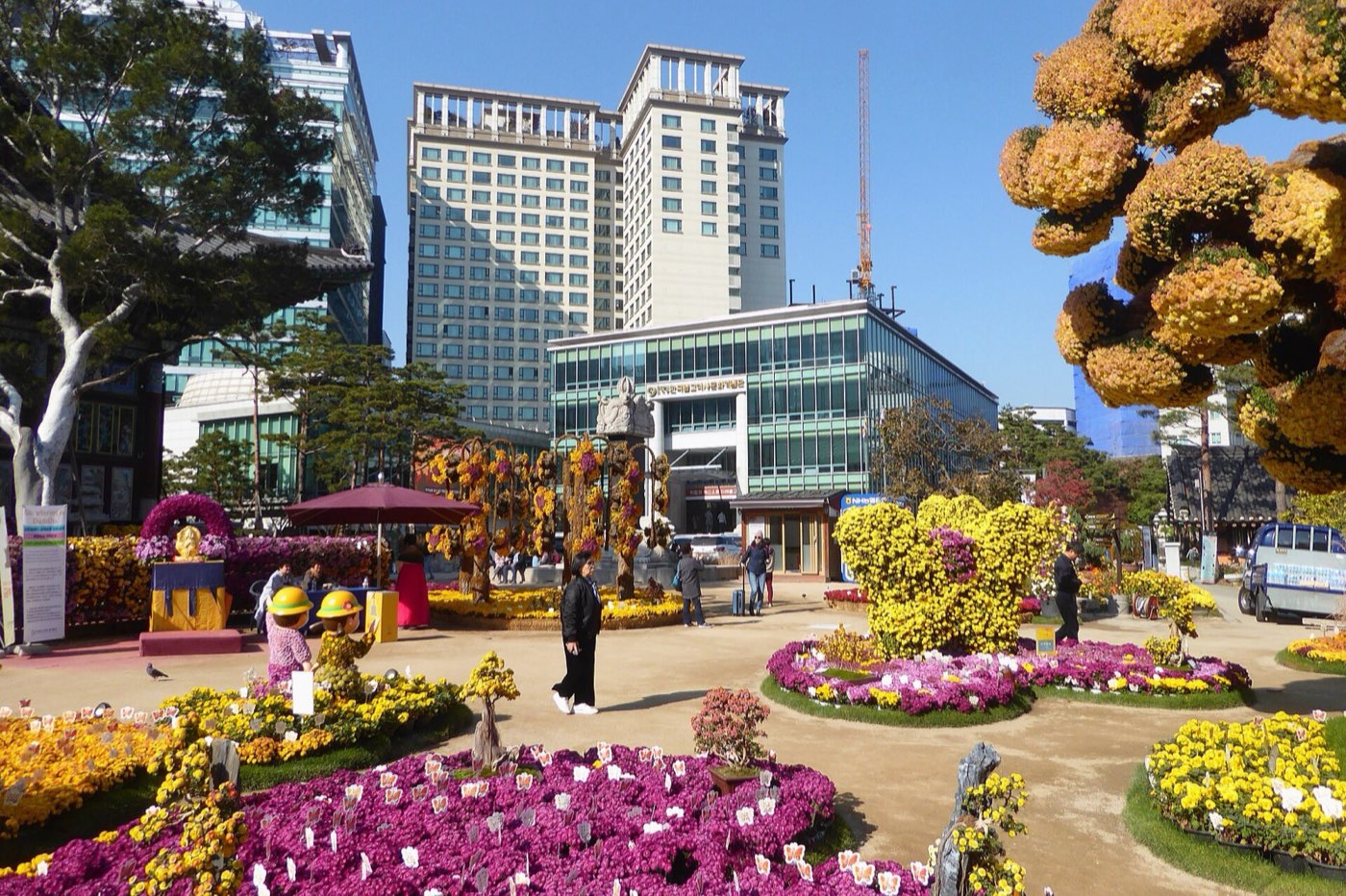
Jogyesa changes with the calendar, which is the best reason to time a visit. Lotus lanterns hang from roughly March to June ahead of Buddha's Birthday, lotus plants fill the courtyard in July and August, and a chrysanthemum festival runs through September and October. Look for the lacebark pine (baeksong) and the old pagoda tree near the main hall, and note the Information Center for Foreigners on the temple map if you have questions.
Bongeunsa: twelve centuries across the road from COEX
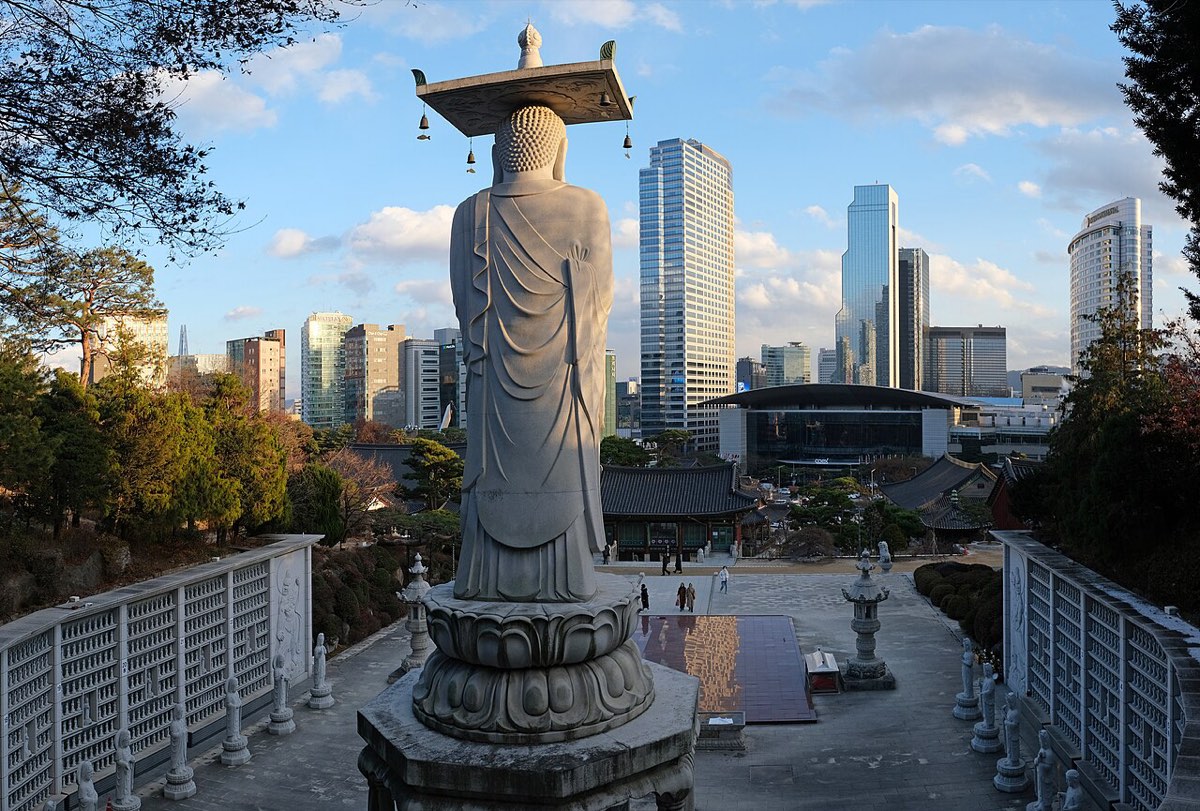
봉은사 (Bongeunsa) is much older, and its setting is the point: a wooded slope of halls and pines directly across the street from the COEX complex and the glass towers of Samseong-dong. Korea's national tourism organization dates its founding to 794, in the reign of King Wonseong of Silla, under the name Gyeonseongsa. In 1498 Queen Jeonghyeon restored it and gave it its present name, and it was moved to its current site during the reign of King Myeongjong in the sixteenth century.
The temple is known for its carved scripture woodblocks, including those of the Avatamsaka (Flower Garland) Sutra; VisitKorea counts 3,479 scripture pieces in 13 types. What most visitors remember, though, is the towering standing Maitreya Buddha on the upper terrace and the sight of office towers framed by temple eaves, which makes Bongeunsa the more photogenic of the two. The grounds are open from 05:00 to 22:00 every day, admission is free, and early morning is the calmest time to walk them.
Choosing between them is straightforward. Pick Jogyesa if you want to see Korean Buddhism as daily institutional life, a short walk from Insadong and the palaces. Pick Bongeunsa if you want architecture, trees and space, or if you are already staying in Gangnam. With time for only one, choose Jogyesa during lantern season and Bongeunsa for the rest of the year.
Reading a temple from the first gate to the main hall
Korean temples are laid out as a journey, and knowing the sequence turns a stroll into something you can read. The first gate is usually the iljumun (일주문), the one-pillar gate. Its posts stand in a single line, so from the side it appears to rest on one pillar, an image of the single-minded path to enlightenment. Passing through it marks the step from ordinary ground into the temple precinct, which is why some Koreans pause and bow there.
Larger mountain temples then lead you through a cheonwangmun (천왕문), a gate housing the Four Heavenly Kings, guardians of the four directions whose glaring faces and trampled demons are meant to keep harm out. Some add a final gate of non-duality, the burimun (불이문), before the courtyard opens. City temples compress the sequence: Jogyesa has its one-pillar gate on the street and goes straight into the courtyard, while at Bongeunsa you enter through a gate called Jinyeomun (진여문).
At the head of the main courtyard stands the principal hall. When it enshrines Shakyamuni, the historical Buddha, it is called daeungjeon (대웅전), the Hall of the Great Hero; halls for other Buddhas carry other names, such as geungnakjeon for Amitabha, which Jogyesa also has. In front you will often find a stone pagoda, and nearby a bell pavilion (beomjongnu) whose great bell is struck at the dawn and evening services. The painted eaves in green, red and blue, called dancheong, both protect the wood and mark the building as sacred.
Inside the hall: doors, bows and where not to sit
Most visitors only look in from the doorway, which is perfectly fine. If you go inside, the rules are few and they all express one idea: the hall is in use. Enter by a side door, because the large central door faces the main altar and is reserved for monks and nuns. Take your shoes off on the step and leave them neatly with the toes pointing outward, so you can step back into them without turning around. Wear socks; bare feet are not welcome on hall floors.
On entering, a half bow toward the altar with palms pressed together at the chest (hapjang, 합장) is the courteous minimum. Buddhists follow it with three full prostrations, which visitors may join or skip. If you sit, take a cushion to one side rather than the central space directly before the main Buddha, which is kept for the officiating monk. Never walk between someone and the altar while they are bowing; pass behind them. Keep your voice low and your phone silent, and do not touch statues or offerings.
Photography is where visitors most often misstep. Many halls post signs asking you not to photograph the altar, and no hall welcomes close-up photos of people at prayer. Photograph the architecture from the courtyard, and if you want an interior image, ask at the information desk first. Dress modestly, with shoulders and knees covered, and remember that smoking, alcohol and meat have no place on temple grounds.
- Use the side doors; the center door is for monks and nuns
- Shoes off on the step, toes pointing out; socks on
- Half bow with palms together when entering and leaving
- Sit to the side, never center-front of the main Buddha
- Pass behind people who are bowing
- No photos of worshippers; ask before photographing interiors
- Phone silent, voice low, no food or drink in the hall
Lanterns, Buddha's Birthday and Yeondeunghoe
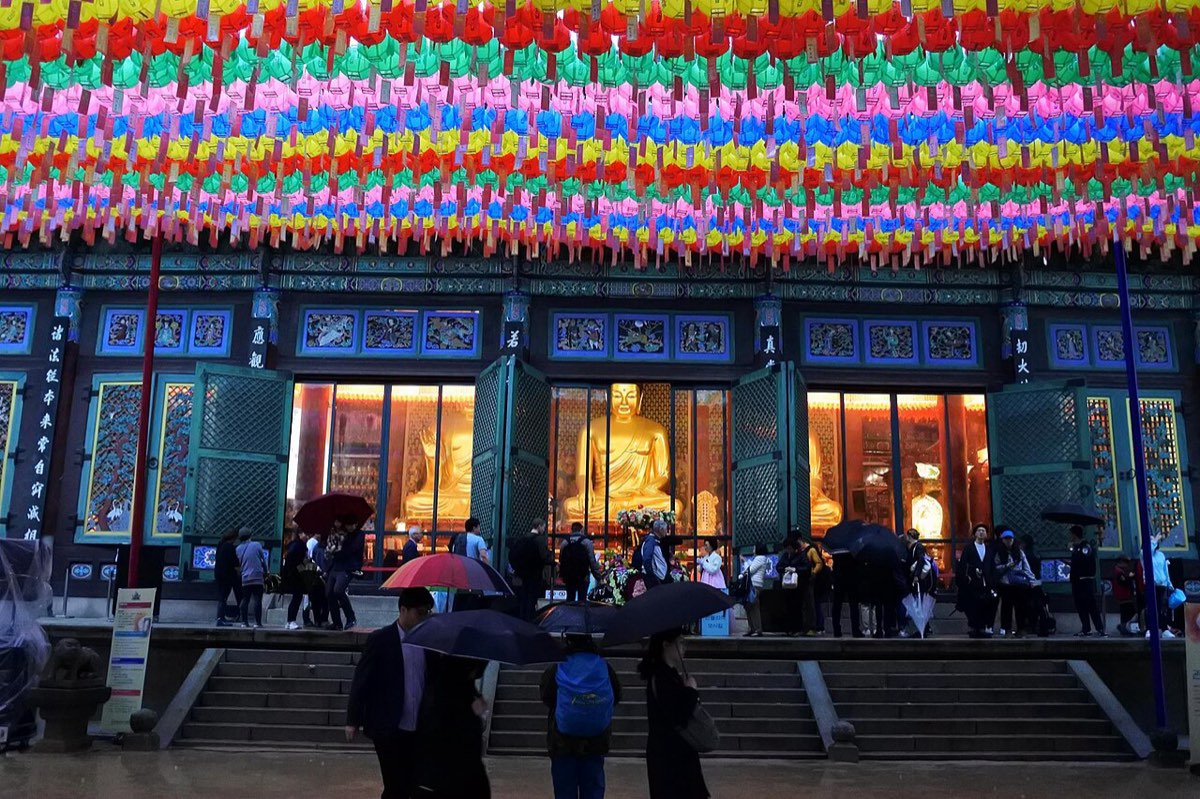
Buddha's Birthday (부처님오신날, Bucheonim Osin Nal) falls on the eighth day of the fourth lunar month and is a national holiday; in 2027 it lands on Thursday, May 13. For weeks beforehand, temples hang lotus lanterns by the thousand, and many carry a paper tag naming the family that offered it. That is why the canopy over Jogyesa's courtyard is thick with slips of paper: each lantern is a prayer for someone specific.
The lantern festival itself, Yeondeunghoe (연등회), was inscribed on UNESCO's Representative List of the Intangible Cultural Heritage of Humanity in 2020. UNESCO's description gives its shape: it opens with a ritual bathing of an image of the infant Buddha, moves into a procession of handmade lanterns, and ends with communal games. Lighting a lantern stands for spreading the Buddha's wisdom to the individual, the community and society, and anyone can take part regardless of faith, which is a large part of why it was recognized.
In Seoul the festival falls on a weekend shortly before the holiday. In 2026 it ran like this: lantern exhibitions from April into May at Gwanghwamun Square, Jogyesa and Bongeunsa; a rally with the infant-Buddha bathing rite at Dongguk University Stadium on Saturday afternoon; the main lantern parade along Jongno from Heunginjimun to Jogyesa from 19:00 to 21:30; a street celebration at Jonggak afterward; and on Sunday a traditional culture fair in front of Jogyesa, ending with an evening procession through Insadong. The 2027 schedule had not been posted as of October 20, 2026, so check llf.or.kr in spring.
For the parade, arrive at least half an hour before the start and stand along Jongno between Jongno 3-ga and Jonggak, where the route ends near the temple. The Sunday fair is the easier choice for families, with lantern making, traditional crafts and temple food to try. In 2026 the organizers also ran a lantern-making session and parade places for international guests, announced in English on the festival site; those notices were closed by the festival weekend, so watch for them early.
One-day, experience or rest: choosing a Templestay
Templestay is the program that opens Korean temples to lay visitors for a few hours or a few nights, and its official booking site, eng.templestay.com, sorts everything into three types. One-day programs last about two to three hours and usually combine a temple tour, meditation and tea. Experience-oriented programs are typically weekend overnights built around temple routine: services, 108 prostrations, formal monastic meals and a craft such as lantern making. Rest-oriented programs keep the schedule light and leave you time to sit, walk and sleep.
The booking site has a 'Temples for Foreigners' filter, the quickest way to find programs that work for non-Korean speakers. In Seoul, Jogyesa listed a one-day tea and meditation program called 'Seon of Tea', and Bongeunsa listed BONG-PASS, an open-format temple day every Tuesday from 10:00 to 16:00, alongside its weekend overnight. Program names, days and fees change by season, so treat these as examples of what was listed in October 2026. The site's FAQ also names Geumsunsa, Hwagyesa, Jinkwansa, Myogaksa and the International Seon Center as Seoul temples within easy reach by bus or subway. If you are already near Jogyesa, the Templestay information center is on the same road, at 56 Ujeongguk-ro.
Our judgment: most first-time visitors should book a one-day program. It delivers what is hard to get alone, a monk or trained guide to ask questions, meditation with instruction and a proper tea ceremony, without the dawn alarm. Choose an overnight only if the routine itself appeals to you. If what you actually want is silence and scenery, a rest-oriented stay at a mountain temple outside Seoul will serve you better than any city program.
| Format | Length | Typical content | Best for |
|---|---|---|---|
| One-day | About 2–3 hours | Temple tour, meditation, tea | Short trips and a first encounter |
| Experience-oriented | Overnight, usually weekends | Services, 108 bows, monastic meal, crafts | Travelers curious about monastic routine |
| Rest-oriented | Length varies by temple | Light schedule, free time | Rest and quiet, often at mountain temples |
What an overnight at Bongeunsa actually asks of you
Bongeunsa's regular weekend Templestay, as listed for its 2025–2026 season, shows the real shape of an overnight. Check-in and a change into the temple uniform, a vest and loose trousers, start at 13:50 on Saturday, followed by an etiquette lesson and temple tour, a monastic dinner, the evening service, quiet meditation and lights out at 21:00. The wake-up comes at 04:00 for the 04:20 dawn service, then 108 prostrations from 05:00 to 05:50, breakfast, tea with a monk at 09:00 and check-out by 11:00. The listed fee was 120,000 won per person.
The terms are part of the program. Reservations open one month before the date and close the day before. Cancel 14 or more days ahead for a full refund, seven days ahead for 70 percent, and later for nothing; no-shows are discouraged firmly. Bring your own towel, toiletries, socks, a change of clothes and a reusable tumbler; wear modest clothing and skip strong perfume. Rooms are shared and men and women do not room together. You may sit out a session if you feel unwell, but tell the staff.
Whether to do it comes down to attention, not comfort. A thin floor mattress, the 4 a.m. start and 108 full bows are hard on knees and sleep. The reward is the dawn service in near darkness and a meal eaten in complete silence, neither of which a day visit can give you. If both sound like an ordeal rather than a curiosity, take the one-day program and enjoy it without guilt.
Temple food, from the four bowls to a city half day
Korean temple food (사찰음식, sachal eumsik) follows the precept against taking life, so it uses no meat or fish, and it also leaves out the five pungent plants known as osinchae. Lists vary slightly, but they usually include garlic, green onion, chives and wild chives. The traditional reasoning is that their strong flavors agitate the mind and disturb meditation. What remains is cooking built on fermented soybean paste and soy sauce, mountain greens, mushrooms, perilla and whatever is in season.
At a Templestay you will likely eat at least one meal as balwoo gongyang (발우공양), the formal monastic meal. Each person uses a nested set of four bowls for rice, soup, side dishes and water. Food is served in a fixed order, you take only what you will finish, and the meal is eaten in silence. At the end you rinse each bowl, traditionally wiping it with a reserved piece of pickled vegetable, and drink the rinse so that nothing is wasted. It is austere by design, and it is the clearest lesson a temple offers about eating with attention.
Without a Templestay, try the temple-food stalls at the lantern festival's Sunday fair, or search 사찰음식 on Naver Map for temple-cuisine restaurants around Jogyesa and Insadong; book lunch ahead. A half day can cover both temples: Jogyesa in the morning via Anguk Station, lunch nearby, then roughly 40 minutes by subway to Bongeunsa Station for a late-afternoon walk as the light drops behind the COEX towers.
Questions visitors ask
Do I need to be Buddhist to visit a temple or join a Templestay?
No. Both Jogyesa and Bongeunsa welcome visitors of any faith, and Templestay programs are designed for lay people, many of them non-Buddhist. You are asked to follow the etiquette, such as bowing on entering a hall, but joining prostrations or chanting is optional.
Is there an entrance fee at Jogyesa or Bongeunsa?
No. Admission to both temples is free. Jogyesa's grounds and main hall are open around the clock, and Bongeunsa's grounds are open from 05:00 to 22:00. Donation boxes are common in halls, and giving is entirely voluntary.
Can I take photos inside a temple?
Photographing courtyards, pagodas and the outside of halls is fine. Inside halls, many temples ask you not to photograph the altar, and close-up photos of people praying are never appropriate. When unsure, ask at the information desk or simply photograph from the doorway.
When is the Lotus Lantern Festival in 2027?
Buddha's Birthday falls on Thursday, May 13, 2027, and Seoul's lantern parade is normally held on a weekend shortly before it. In 2026 the parade ran eight days before the holiday. The 2027 dates had not been announced as of October 20, 2026; check llf.or.kr from early spring.
Can I watch a Buddhist service as a visitor?
Yes, quietly and from the back or the side. Jogyesa lists a Sunday Dharma service at 10:00 and services on set days of the lunar month. Stand or sit at the edge, follow the bows if you wish, keep your phone away, and leave by a side door.
Sources and method
Written for: Visitors to Seoul who want to see a working Buddhist temple, behave correctly inside it, and decide whether a day program or an overnight Templestay is worth their time.
Method: Researched from the official sources listed below, checked on October 20, 2026. Hours, fees and booking rules can change; the linked official pages are the final word. Spotted something out of date? Tell us.
- Jogyesa (official English site) — HistoryHead temple of the Jogye Order; founded 1910 as Gakhwangsa; renamed Taegosa 1938 and Jogyesa 1954; main hall open 24 hours; order of about 3,000 temples and 15,000 monastics.
- Jogyesa (official English site) — Map of facilitiesIljumun, Daeungjeon, Geungnakjeon, Beomjongnu, lacebark pine, Information Center for Foreigners, Templestay building.
- Jogyesa (official English site) — EventsLantern decoration March–June, lotus festival July–August, chrysanthemum festival September–October, Sunday 10:00 Dharma service, lunar-month service days.
- VisitKorea — Seoul Bongeunsa TempleAddress, 05:00–22:00 hours, free admission, founding in 794 as Gyeonseongsa, 1498 renaming, relocation under King Myeongjong, 3,479 scripture pieces in 13 types.
- UNESCO Intangible Cultural Heritage — Yeondeunghoe, lantern lighting festival in the Republic of Korea2020 inscription (15.COM); bathing the infant Buddha, lantern procession, communal games; meaning of lighting lanterns; open participation.
- Lotus Lantern Festival (Yeon Deung Hoe) — official English site and 2026 program pages2026 schedule: exhibitions April–May, Eoulim Madang at Dongguk University Stadium, parade Heunginjimun to Jogyesa 19:00–21:30, Sunday events; directions (Jonggak Exit 2, Anguk Exit 6, Bongeunsa Station Exit 1); international guest notices.
- Templestay — What is TemplestayOne-day, experience-oriented and rest-oriented formats; typical elements; balwoo gongyang principles; what to bring; temple uniform provided.
- Templestay — Reservations list'Temples for Foreigners' filter; Jogyesa 'Seon of Tea' one-day program; Bongeunsa BONG-PASS on Tuesdays 10:00–16:00; Templestay center at 56 Ujeongguk-ro.
- Templestay — Bongeunsa Regular Templestay (Sat–Sun) listingOvernight schedule (13:50 check-in, 04:00 wake-up, 108 bows), 120,000 won fee, booking window, refund rules, what to wear and bring.
- Templestay — FAQShared rooms; men and women do not share rooms; skipping sessions; what to bring.