In shortWalk Insadong-gil from Naminsa Madang at the Jongno end north to Buginsa Madang near Anguk Station, ducking into side alleys for galleries, brush shops and teahouses, then add Jogyesa, Tapgol Park and the 1920s hanok lanes of Ikseon-dong. Allow about three and a half hours. For genuine craft, look for a named maker, a material the seller can explain, and a price that reflects handwork.
Key facts
- Korean names
- 인사동 (Insa-dong), 익선동 (Ikseon-dong)Naver Map
- Status
- Insadong became Korea's first Cultural District in 2002
- Insadong north end
- Buginsa Madang, beside Anguk Station (Line 3)
- Ikseon-dong access
- Jongno 3-ga Station Exit 6, then walk north
- Ikseon-dong hanok
- 118 houses built before the 1930s remain
- Map search terms
- 인사동길, 쌈지길, 탑골공원, 조계사, 익선동Naver Map
- Tapgol Park pagoda
- Ten-story pagoda of Wongaksa, completed 1467
Checked Oct 20, 2026 against the official sources listed at the end of this guide.
Painters, antique dealers and a street that writes its own rules
Insadong (인사동) takes its name from two Joseon-era wards, Gwaninbang and Daesa-dong, and its identity from art. Seoul's hanok portal notes that the Dohwaseo, the royal painting bureau of the early Joseon court, stood in this area, which made it a working quarter for painters long before it was a shopping street. Its location between the palaces to the north and the commercial avenue of Jongno to the south also made it a natural corridor for officials and their households.
The antiques came later and for a sadder reason. During the colonial period, many families in Bukchon and Insadong sold their houses and heirlooms, and in the 1930s dealers clustered along the road that led from Bukchon down to Jongno. Workshops, antique furniture shops and folk craft stores followed in the 1980s, while commercial galleries arrived from 1970, when the Hyundai Gallery opened here. By the end of the 1980s the name Insadong had become shorthand for Korean tradition.
Success brought rising rents, and the businesses that gave the street its character began to leave. In 2002 Insadong became Korea's first designated Cultural District, and a management plan later barred cosmetics shops, bakeries, mobile-phone dealers, massage parlors and several other trades from the main street, while giving folk craft, antique, mounting and brush shops a certification route and marketing support. When the street feels more curated than other parts of Seoul, that is policy, not accident.
What the Hangul signs do, and do not, tell you
Visitors often hear that Insadong requires shop signs in Korean only. The most famous example is real: the Starbucks branch that opened here in 2001 put its name up in Hangul. A 2003 Korea JoongAng Daily report, however, presented that as the company's own design choice for the location rather than a legal requirement, and we found no current rule that bans foreign-language signs outright. What does exist is the district's business-type control described above, which shapes the street more than lettering does.
The practical point is that a few Korean words make Insadong far more useful. Many of the best small shops sit up a flight of stairs or down an alley, marked only by a Hangul sign or a short Korean word on a door. Learn the handful below and you will spot a brush shop or framer at a glance, and you can type the same word into Naver Map or Kakao Map to find more nearby.
| On the sign | Say it | What you will find |
|---|---|---|
| 필방 | pilbang | Brush shop selling brushes, ink sticks, inkstones and paper |
| 한지 | hanji | Traditional Korean paper and paper goods |
| 표구 | pyogu | Mounting and framing for paintings and calligraphy |
| 화랑 / 갤러리 | hwarang / gaelleori | Gallery, usually free to walk in |
| 고미술 / 골동품 | gomisul / goldongpum | Antique art dealer / antiques |
| 찻집 / 전통찻집 | chatjip / jeontong chatjip | Teahouse / traditional teahouse |
| 공예 | gongye | Craft, often a maker's own shop or studio |
Insadong-gil from Naminsa Madang to Buginsa Madang
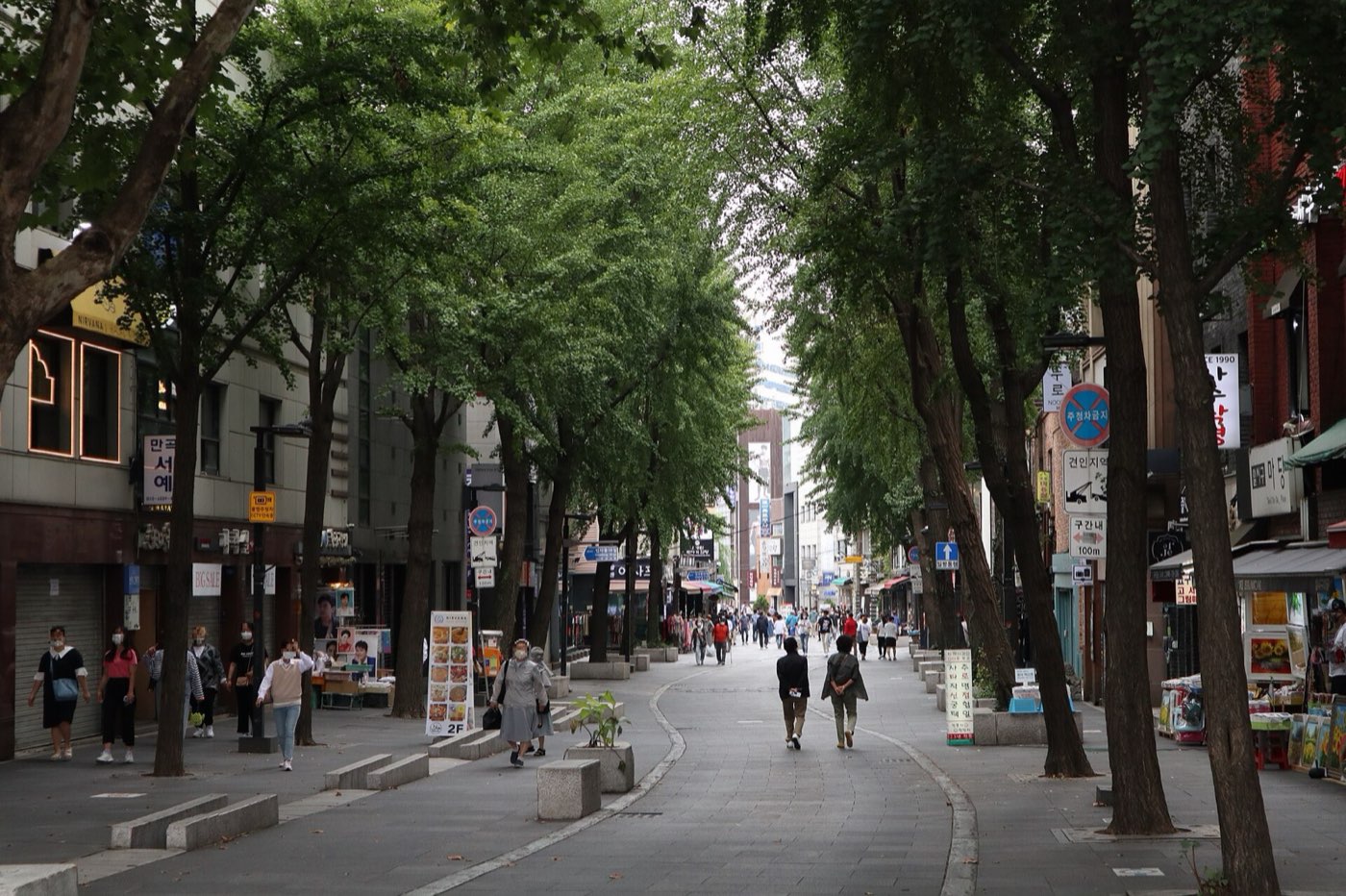
The main street, Insadong-gil (인사동길), runs roughly north from Jongno to Anguk Station, with a small plaza and tourist information point at each end. Naminsa Madang, the south plaza off Jongno 2-ga, is where you enter if you come from Tapgol Park. Walking north, you pass street stalls selling snacks and trinkets before the shops thicken into dealers in old paintings, frames, brushes and ceramics.
At Insadong Negeori, the main crossroads, a right turn heads toward Nagwon Arcade, Seoul's long-established musical instrument market, and a left turn leads in a few minutes to Jogyesa temple. Along this stretch stand the Tong-in Store, a multistory craft and antique emporium in business since 1924, and Insadong Maru, a 2014 complex with craft shops, cafés and the kimchi museum Museum Kimchikan on its upper floors.
Farther north, past Sudo Pharmacy (open since 1946 and listed as Seoul Future Heritage), is Ssamziegil (쌈지길), opened in 2004. Its four floors are linked by a continuous ramp, so you browse small design and craft shops as if you were still walking up the street. It is busy and youthful, good for contemporary Korean design rather than antiques. The street ends at Buginsa Madang, marked by a giant brush sculpture beside Anguk Station, where you can cross to Bukchon.
Hanji, brushes and ceramics: telling craft from souvenir stock
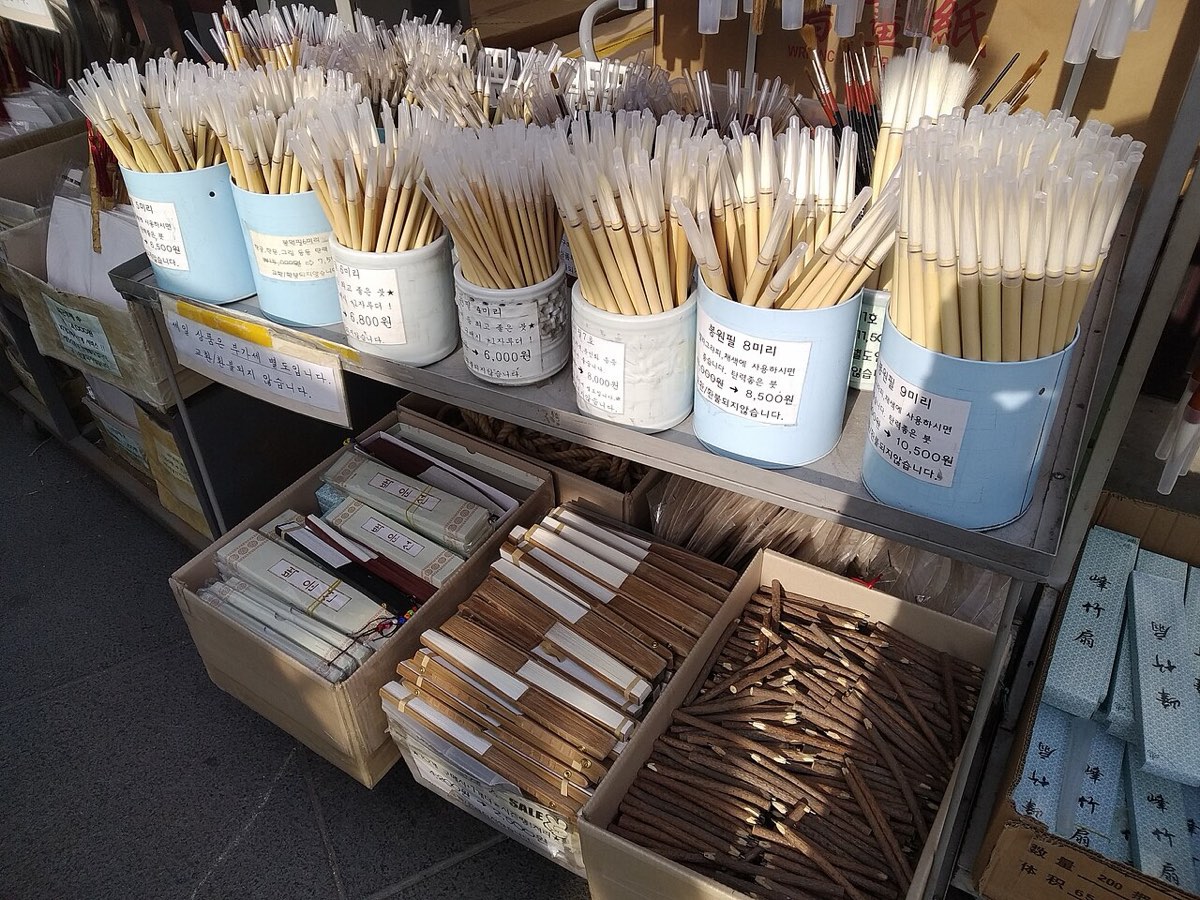
Insadong has always mixed serious craft with tourist filler, and the two often share a shelf. Your best protection is to know what a material should look and feel like. Hanji (한지) is made from the inner bark of the paper mulberry, called dak (닥). Hold a sheet up to the light: handmade hanji shows long, irregular fibers and slight variations in thickness, while machine paper printed with a hanji texture looks uniform. Korea has nominated the knowledge and skills of hanji-making for UNESCO's list of intangible heritage, with a decision due at the UNESCO committee session that opens on November 30, 2026.
Brush shops sell the four treasures of the scholar's study: brush, ink stick, inkstone and paper. Guhasanbang, a Seoul Future Heritage brush shop dating to around 1913 and said to have supplied brushes to the palace, is the kind of specialist that can explain hair types and why one brush costs ten times another. For ceramics, turn a piece over: a maker's seal or signature on the foot, a box signed by the potter, and small differences between cups in a set suggest handwork. Identical items stacked in five neighboring shops suggest a factory.
- Ask 직접 만든 거예요? (jikjeop mandeun geoyeyo, did you make this?) or 어디서 만들었어요? (eodiseo mandeureosseoyo, where was it made?).
- Look for a maker's name, stamp or workshop card; real craft shops are proud to tell you who made a piece.
- Check the country-of-origin label (원산지, wonsanji) on fans, bags and trinkets.
- Compare prices for the same item across two or three shops before buying anything costly.
- Be wary of anything sold as an antique without written provenance, and ask the dealer about paperwork for taking it home.
- Buy hanji in sheets or simple stationery if luggage is tight; it is light, flat and genuinely useful.
Galleries, old books and a poet's teahouse in the side alleys
The slower Insadong lives off the main street. Commercial galleries rotate exhibitions frequently and generally let you walk in without a ticket; climbing one flight of stairs is often the difference between souvenir stalls and contemporary ink painting. Tongin Gallery, a Seoul Future Heritage space, has shown leading Korean artists including Park Seo-bo and has held hundreds of exhibitions alongside its trade in antique art.
Tongmungwan (통문관), founded around 1934 and run by the same family for three generations, is regarded as the oldest bookshop in Korea and deals in rare books, old manuscripts and out-of-print titles; it has also published scholarship in Korean studies. Even if you cannot read the spines, the shop is a window into the bibliophile culture that once filled this street.
For a pause, Cafe Gwichun continues Gwichun, a teahouse long associated with the poet Cheon Sang-byeong, and visitors still come to read his verses over tea. Traditional teahouses throughout the alleys serve infusions such as jujube, ginger or quince, a good way to rest your legs between galleries.
Tapgol Park, where the March 1st Movement went public
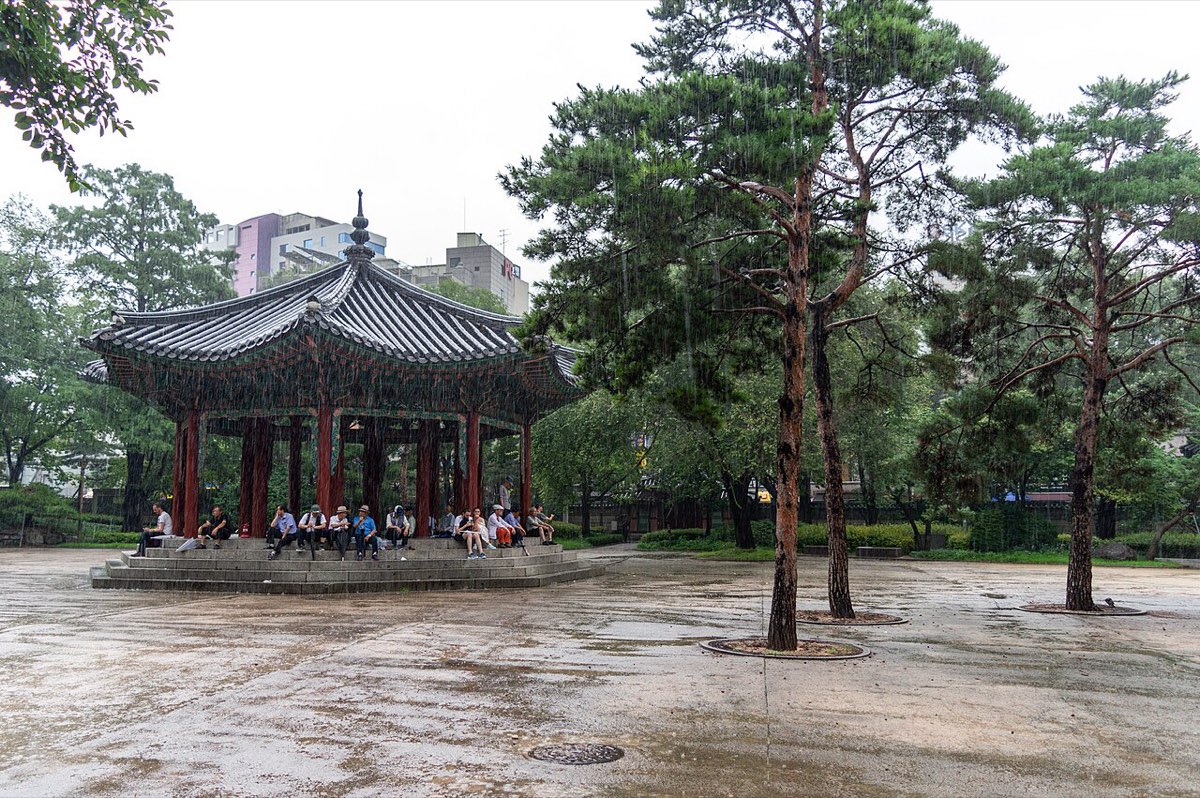
At the south end of Insadong, on Jongno, Tapgol Park (탑골공원) carries more history per square meter than anywhere else on this walk. In 1465 King Sejo dedicated the temple Wongaksa here; its ten-story stone pagoda, completed in 1467, still stands, now protected inside a glass shelter. The temple fell into ruin under later kings, and in 1897 the site reopened as Pagoda Park, Korea's first Western-style modern park. It took its present name in 1992 from the old local name, Tapdong, the pagoda neighborhood.
On March 1, 1919, the Declaration of Independence was read aloud here, by tradition from the octagonal pavilion, Palgakjeong, and the crowd poured out along Jongno shouting for independence from Japanese rule. The March 1st Movement spread across the country in the following weeks and is commemorated every year as a national holiday. Look for the main gate, Samilmun, named for the date, and the relief panels that depict scenes from the protests.
Today the park is also a gathering place for older Seoul residents, many of whom spend long afternoons here. Walk through quietly, treat it as a memorial first and a sight second, and do not expect a manicured attraction. Fifteen to twenty minutes is enough to see the pagoda, the pavilion and the reliefs.
Jogyesa, a working temple a few minutes from the antique shops
Turn west at the Insadong crossroads and within minutes you reach Jogyesa (조계사), head temple of the Jogye Order of Korean Buddhism. It was founded in 1910 as Gakhwangsa, renamed Taegosa in 1938 and given its present name in 1954, a change intended to clear away traces of the colonial era. The large main hall, Daeungjeon, faces a courtyard shaded by old trees, including a lacebark pine whose pale, flaking bark is easy to spot.
Unlike a palace, this is a place of daily worship, with lay believers bowing in the main hall at almost any hour. Enter the hall through the side doors rather than the central one, remove your shoes, keep to the back if a service is under way, and do not photograph people while they pray. In the weeks before Buddha's Birthday the courtyard is roofed with rows of lotus lanterns, the temple's best-known look, but an ordinary weekday visit shows its daily rhythm more clearly.
Ikseon-dong: Jeong Se-kwon's small houses, now cafés
Ikseon-dong (익선동) is smaller and plainer than Bukchon, and that is the point. The name dates from 1914, when the colonial administration merged several wards. In the 1920s the developer Jeong Se-kwon (정세권, 1888–1965), whose company Geonyangsa is often called Korea's first modern real estate developer, bought large lots here, including the site of a former royal-relative mansion, subdivided them and built rows of small hanok for ordinary Korean households. Seoul's hanok portal says this created the layout you walk today; most houses are under 30 pyeong, roughly 100 square meters.
Jeong was more than a builder. He used his profits to support Korean nationalist causes, donating a building to the Joseon Language Society, the scholars' group that defended and studied the Korean language under colonial rule. Building Korean-style houses for Koreans in central Seoul was, in that context, a political act as well as a business.
The neighborhood nearly vanished. It was slated for redevelopment in 2004, but the plan collapsed in 2014, and cafés, restaurants and vintage shops moved into renovated hanok instead. In 2018 Seoul designated it a hanok-concentrated area; 118 houses built before the 1930s remain. One loss marks the change: Ojinam, a historic hanok restaurant where talks before the 1972 South-North Joint Statement were held, was demolished in 2010 and its parts moved to Buam-dong.
Expect narrow, crowded lanes on weekends and a café-district atmosphere rather than a heritage site. Go on a weekday before the lunch rush to see the rooflines and lane pattern clearly, and remember that some of these small houses are still homes. From Jongno 3-ga Station, take Exit 6 and walk north into the alleys.
A three-and-a-half-hour walk that strings it together
This sequence works on most days and keeps backtracking to a minimum. At 10:00, start at Buginsa Madang beside Anguk Station and walk Ssamziegil while it is still quiet. From 10:30, work south down Insadong-gil, climbing into galleries and visiting a brush shop and Tongmungwan in the side alleys. At 11:15, turn west at the crossroads for twenty minutes at Jogyesa, then return to the main street.
Around 12:00, exit at Naminsa Madang and cross to Tapgol Park for the pagoda and the March 1st memorials. Have lunch in the alleys south and east of the park, then walk east along Jongno to Jongno 3-ga Station Exit 6 and turn north into Ikseon-dong at about 13:30. Finish with tea or coffee in a converted hanok, looking up at the eaves and tile ends on the way.
If you prefer an afternoon start, reverse it: Ikseon-dong first, then Tapgol Park and Insadong northward, ending at Anguk Station with Bukchon a short walk across the road. Shoppers should note that serious buying takes time; if you plan to choose ceramics or hanji carefully, allow an extra hour and skip Jogyesa for another day.
Questions visitors ask
Is everything sold in Insadong made in Korea?
No. The street mixes genuine craft shops, galleries and antique dealers with stalls selling mass-produced souvenirs, some of them imported. Check origin labels, ask who made a piece, and favor shops that can explain materials and makers. Specialist brush shops, hanji stores and gallery shops are the safest places for Korean-made goods.
Does Insadong really ban signs in English?
The famous Hangul-only Starbucks sign was described at the time as the company's own choice for the location, and we found no current blanket ban on foreign-language signs. The district's formal rules restrict which kinds of businesses can open on the main street. Many shops still use Korean signs, so learning a few words helps.
Can non-Buddhists visit Jogyesa?
Yes. The temple welcomes visitors who are not Buddhist, and you may look into the main hall. Remove your shoes before entering, use the side doors, stay quiet, keep to the back during services and avoid photographing people at prayer. If you want to go further, temples in Seoul offer short templestay and temple-life programs.
When is Ikseon-dong least crowded?
Weekday mornings, before the lunch crowd arrives. Weekends and evenings are busiest, when the narrow lanes can feel packed. If you want photographs of the rooflines rather than the cafés, come early on a weekday and walk the side alleys rather than the main café lane.
Is Insadong worth visiting if I am not shopping?
Yes, if you use it as a walk through art and history rather than a market. Free galleries, Tongmungwan's old books, a traditional teahouse, Jogyesa and Tapgol Park's 1919 memorials make a satisfying half day without buying anything. Skip the main-street stalls and spend your time upstairs and in the alleys.
Sources and method
Written for: Visitors who want traditional crafts, art and early-modern hanok in one central walk, and who want to buy Korean-made pieces with some confidence.
Method: Researched from the official sources listed below, checked on October 20, 2026. Hours, fees and booking rules can change; the linked official pages are the final word. Spotted something out of date? Tell us.
- Seoul Hanok Portal — Insa-dongName origin, Dohwaseo, 1930s antique shops, 1980s workshops, Hyundai Gallery (1970), Naminsa and Buginsa Madang, Tong-in Store (1924), Insadong Maru (2014), Ssamziegil (2004), 1919 Declaration reading at Pagoda Park.
- Seoul Hanok Portal — Ikseon-dong1914 naming, Jeong Se-kwon's subdivision of lots, house sizes, 118 pre-1930s hanok, 2004 redevelopment and 2014 cancellation, 2018 hanok-concentrated area, Ojinam, Jongno 3-ga Exit 6.
- Seoul Mediahub — The story of 'architecture king' Jeong Se-kwon (Nov. 2025)Jeong Se-kwon's dates, Geonyangsa around 1920, Ikseon-dong development, support for the Joseon Language Society.
- Seoul Shinmun — Insadong cultural district management plan (Jan. 7, 2014)Businesses barred from the main street; certification and support for folk craft, antique, mounting and brush shops.
- Encyclopedia of Korean Culture — 서울 원각사 (Wongaksa, Seoul)Wongaksa built by King Sejo on the old Heungboksa site, consecrated in 1465; ten-story pagoda completed in 1467; temple abolished under Jungjong; pagoda remains in Tapgol Park.
- Korea JoongAng Daily — It's American, if you can read Korean (Mar. 26, 2003)Insadong Starbucks opened 2001 with a Hangul sign, presented as the company's design choice.
- Seoul Mediahub — Seoul Future Heritage in Insadong (July 2020)Tongmungwan (c. 1934), Guhasanbang (c. 1913), Sudo Pharmacy (1946), Tongin Gallery, Cafe Gwichun.
- Seoul Mediahub — Tapgol Park, where cries for independence rang out (Feb. 2021)1897 Pagoda Park as Korea's first Western-style park, 1992 renaming, Samilmun, relief panels, glass-enclosed pagoda, 1919 Declaration reading.
- Jogyesa Temple — HistoryFounded 1910 as Gakhwangsa, renamed Taegosa in 1938 and Jogyesa in 1954; main hall open 24 hours to all visitors.
- UNESCO Intangible Cultural Heritage — Files 2026 under process (hanji nomination, file 2264)Republic of Korea's nomination 'Traditional knowledge and skills associated with the production of hanji and related cultural practices', to be examined at the Committee's twenty-first session in November/December 2026.