In shortRent hanbok if you want photographs and a slower, more deliberate palace visit, not for the free ticket, which saves an adult foreign visitor 3,000 won at Gyeongbokgung. To qualify, wear a wrap-collar jeogori with a separate skirt or trousers. Book a block of two to four hours near Gyeongbokgung Station, avoid Tuesdays when Gyeongbokgung is closed, and be out of Bukchon's red zone by 5 p.m.
Key facts
- Korean name
- 한복 (hanbok); rental shops: 한복대여 (hanbok daeyeo)Naver Map
- Free entry applies at
- Four palaces, Jongmyo Shrine and Joseon royal tombs; Korean and foreign visitors alike
- What counts
- Wrap-collar jeogori plus a separate skirt or trousers; a durumagi alone does not
- Gyeongbokgung adult fee
- 3,000 won (foreign visitors aged 19–64)
- Gyeongbokgung closed
- Tuesdays (open if a public holiday; closed the next non-holiday instead)
- Gyeongbokgung hours, Nov–Feb
- 09:00–17:00, last entry 16:00
- Bukchon red zone
- Tourist visits 10:00–17:00 only; fine of 100,000 won
- Nearest station
- Gyeongbokgung Station, Line 3, Exit 5 (about 2 minutes on foot)
Checked Oct 20, 2026 against the official sources listed at the end of this guide.
A jacket, a skirt or trousers, and a coat for going out
Hanbok (한복) is the umbrella word for Korean dress, and it is built on a simple two-piece logic: an upper garment and a separate lower one. The jacket, jeogori (저고리), is worn by men and women alike. Learn its parts and you can read any hanbok at a glance: the collar band (git), the strip of white trim laid along it (dongjeong, a symbol of cleanliness), the overlapping front panel (seop), roomy sleeves (somae) and the long ties (goreum) knotted at the chest. Women's jeogori are short and fitted; men's are longer and looser.
Below the jacket, women wear the chima (치마), a pleated skirt tied high on the body that falls to the ankles, while men wear baji (바지), wide trousers. Over everything goes the durumagi (두루마기), a full-length coat that both sexes put on for formal occasions or simply to go outdoors. During the Joseon dynasty (1392–1910), fabric, color and ornament signaled rank: commoners wore hemp and cotton in plain colors, while fine silk and embroidered motifs belonged to the court and the aristocracy.
This is not a museum costume. In July 2022 the Cultural Heritage Administration designated hanbok saenghwal, the whole practice of making, wearing and enjoying hanbok, as a National Intangible Cultural Heritage, noting that Koreans still wear it to show respect at Seollal and Chuseok, at weddings and at ancestral rites. That context is worth carrying with you. When you walk a palace path in hanbok, you are borrowing a living dress code, and the people around you will read it that way.
Why the rental rack looks nothing like a wedding hanbok
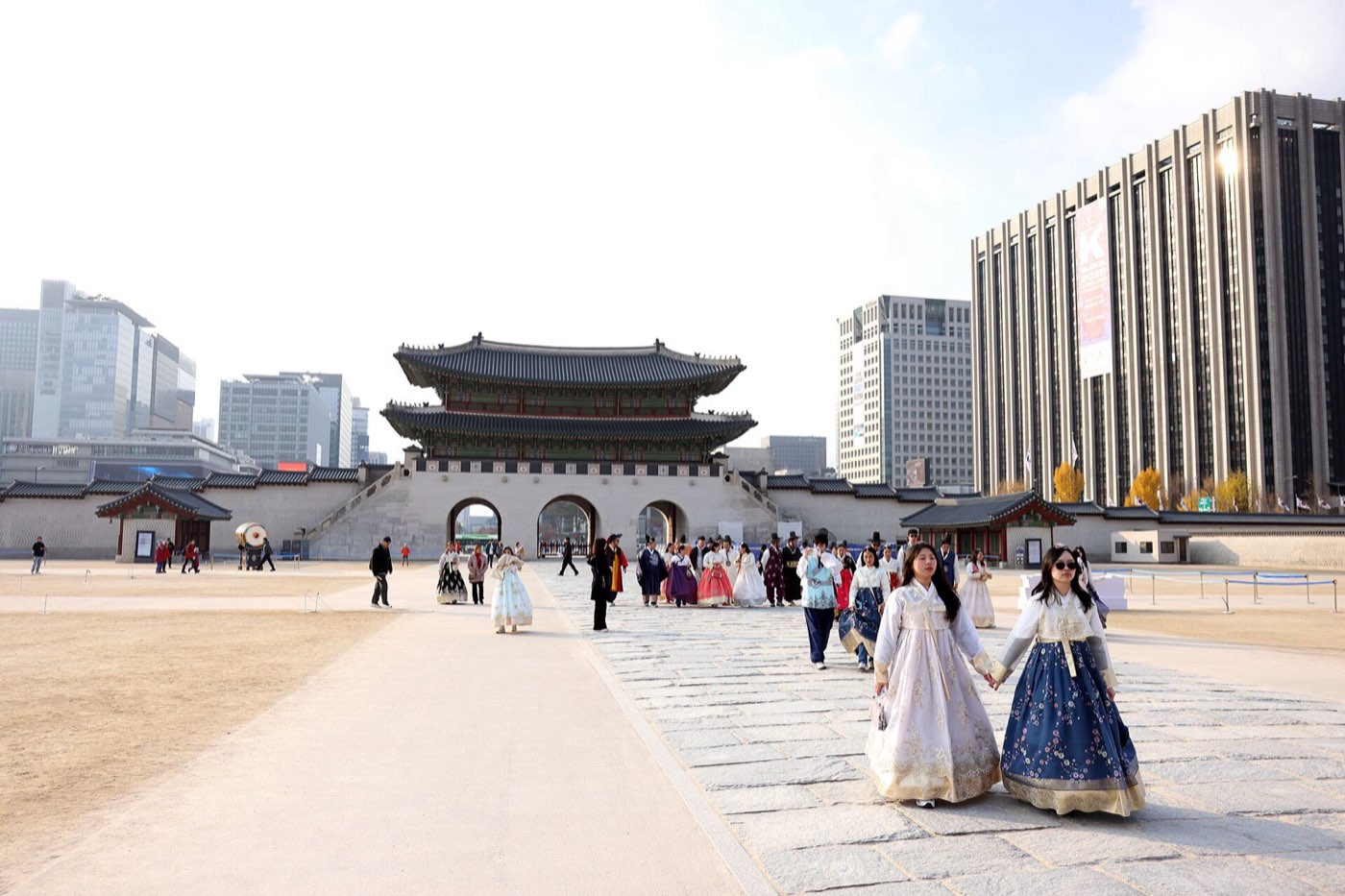
Walk into a rental shop near Gyeongbokgung and most of what hangs on the rails is what Koreans call fusion hanbok: polyester satin in saturated colors, gold-foil prints, lace sleeves, tulle overlays and skirts lifted by a hooped petticoat. Some racks also carry imitations of royal robes or military uniforms. These outfits are designed to photograph brightly and to go on and off quickly, which is exactly what a two-hour rental needs.
A traditional hanbok works differently. It is usually silk or ramie, cut in quieter colors, and its beauty lies in the curve of the collar and the way the skirt moves rather than in surface decoration. Everyday saenghwal hanbok sits at the other end of the scale: simplified cotton or linen pieces meant for daily wear. None of these is wrong to rent. The distinction that matters on the day is that palace staff judge the structure of an outfit, not its taste, and the free-entry rule excludes some of the most theatrical options.
Our advice is to choose restraint. If you want photographs that still look good in ten years, ask for the plainest well-cut set the shop has, in one or two colors, and skip the costume crown. A muted jeogori over a contrasting skirt reads as hanbok in every frame; a glittering one-piece gown reads as a party dress and may not count at the gate. Let accessories carry the tradition instead: a norigae pendant hung from the jacket ties, or a binyeo hairpin, are the details Koreans notice.
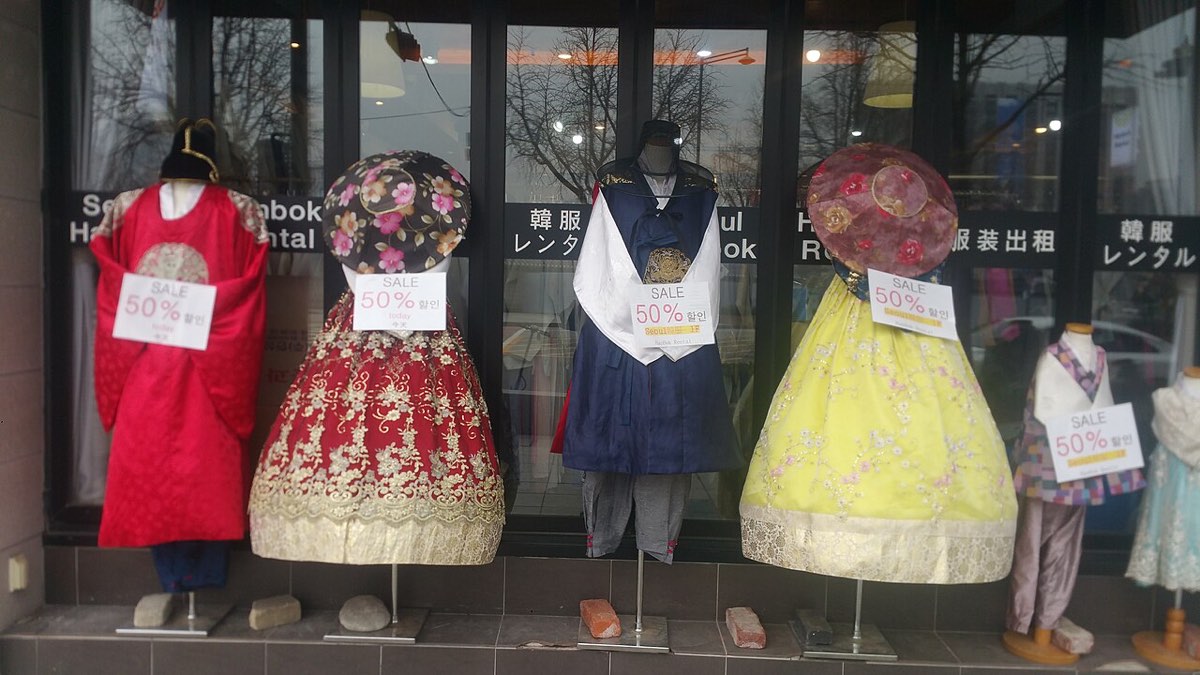
The free-entry rule, clause by clause
Visitors wearing hanbok enter the major royal heritage sites free: the four palaces (Gyeongbokgung, Changdeokgung, Changgyeonggung and Deoksugung), Jongmyo Shrine and the Joseon royal tombs. The Royal Palaces and Tombs Center's own Q&A states that the benefit applies to Korean and foreign visitors alike, because its purpose is to spread hanbok at home and abroad. One exception matters for planners: the Changdeokgung rear garden (Huwon) tour is a separately ticketed visit whose free list does not include hanbok, so you still pay for it.
The guideline, which is more detailed in Korean than in English, comes down to structure. Both traditional and modernized hanbok qualify. You need an upper garment and a separate lower one, so a durumagi thrown over jeans does not count. The jeogori must keep its overlapping wrap collar; the Korean text says the style of tie or knot does not matter, while the English page asks that ties and buttons stay fastened. Trousers must follow the traditional wide-panel cut, even if they zip at the waist. Any style of skirt is accepted, including a waist-tied one, provided the jacket reaches the waistline.
Refusals follow the same logic. A jeogori over jeans fails, as does a hanbok skirt with a T-shirt, a T-shirt-style top printed or cut to look like a jeogori, and a one-piece hanbok-style dress with no separate jacket. Staff may also turn away outfits they consider too revealing for the setting. Notice what the rules leave out: there is nothing about gender, so men in skirts and women in trousers qualify as long as the structure holds. The table below summarizes the cases that come up most often at the gate.
Keep the money in perspective. At Gyeongbokgung the adult ticket for foreign visitors aged 19 to 64 is 3,000 won, and foreign visitors aged 18 and under or 65 and over enter free regardless of what they wear. Any rental costs many times that. Rent hanbok because you want to wear it, and treat the free ticket as a courtesy rather than a saving.
| Outfit | Free entry? | Reason |
|---|---|---|
| Wrap-collar jeogori with a chima (any skirt style) | Yes | Separate top and bottom; collar shape kept |
| Jeogori with traditional-cut baji (zip waist is fine) | Yes | Trousers are judged by cut, not fastening |
| Men in a chima, women in baji | Yes | The guideline concerns structure, not gender |
| Durumagi over everyday clothes | No | An overcoat alone is not hanbok |
| Jeogori with jeans, or a hanbok skirt with a T-shirt | No | Mixed with everyday clothing |
| One-piece hanbok-style dress or T-shirt-type jeogori | No | No separate wrap-collar jacket |
How a rental shop visit runs, from payment to return
Rental shops cluster around Gyeongbokgung Station on Line 3, whose Exit 5 is about two minutes from the palace on foot. Search 한복대여 (hanbok daeyeo) on Naver Map or Kakao Map and dozens appear. The useful filters are opening time, whether the shop takes online reservations, and whether recent customer photos show the plainer styles you want. Weekend mornings in spring and autumn are the busiest slots, so reserve ahead if your dates are fixed.
The sequence is broadly the same everywhere. You choose a time block, commonly a few hours or a full day, and pay up front; returning late usually triggers an extra charge, so read the shop's rule before you leave. Some shops ask for a deposit or an ID. You then pick a skirt or trousers and a jacket, and staff help you dress, often over a thin layer of your own clothes, setting the skirt height and tying the ribbon. Your bag and coat stay in a locker or behind the counter.
Extras are where the bill grows: hair styling (braids finished with a daenggi ribbon, or a low bun with a binyeo pin), accessories such as norigae, a small handbag, and premium garments. Ask exactly what the base price includes before you start choosing, and decide in advance whether hair styling is worth the extra time, since it can mean a second queue at busy hours. Ask whether shoes are included; if you wear your own, flat, closed shoes in a dark color disappear under a long skirt and save your feet on palace gravel.
Before you walk out, check three things. The skirt hem should clear the ground by about a finger's width; the jacket ties should sit centered rather than slipping to one side; and your phone and cash should be somewhere you can reach. Rental hanbok rarely has pockets, so take the small drawstring bag if the shop offers one.
Fitting the rental clock to palace hours and weather
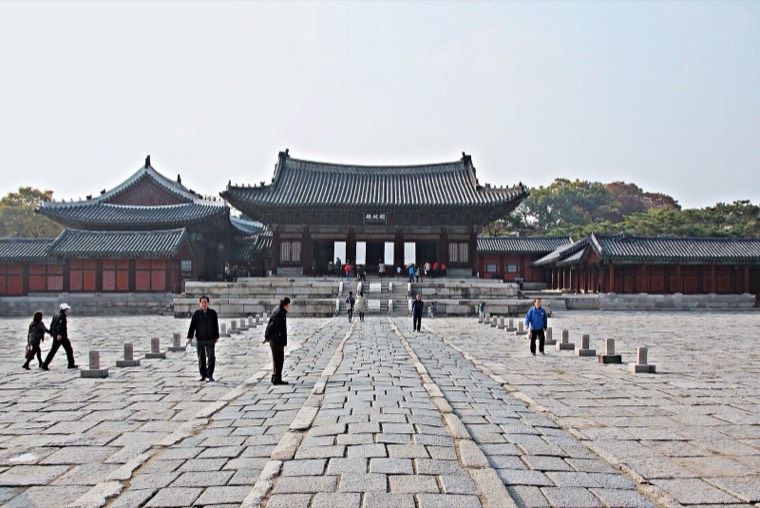
Your rental block and the palace's opening hours need to overlap. Gyeongbokgung is closed every Tuesday; when a Tuesday is a public holiday it opens and closes on the next non-holiday instead. It opens at 09:00 and closes at 17:00 from November to February, 18:00 in March to May and September to October, and 18:30 from June to August, with last entry an hour before closing. Changdeokgung, Changgyeonggung and Deoksugung close on Mondays instead, so a Tuesday in hanbok belongs at one of those.
A three-hour block suits a first visit. A sample weekday in October: 09:15 arrive at the shop, choose and dress; 10:00 enter Gyeongbokgung through Gwanghwamun and Heungnyemun and walk up to the throne hall, Geunjeongjeon; 10:45 Gyeonghoeru pavilion and its pond for photographs; 11:20 the quieter northern courtyards toward Hyangwonjeong; 11:50 walk back toward the shop; 12:15 return the hanbok. Add half an hour if you book hair styling, and push everything earlier on weekends.
Weather changes the calculation more than visitors expect. Rental hanbok is layered synthetic fabric, and in July and August the paved courtyards hold heat, so go at opening time or skip it. In December and January the problem reverses: thermal layers underneath are fine, and a coat on top is fine too, but remember that a durumagi only counts as part of hanbok when the jeogori and skirt or trousers are underneath. On wet days long hems soak up water from the stone, so choose a shorter block and carry an umbrella.
Deoksugung and Changgyeonggung, both open until 21:00 with last entry at 20:00, are the palaces where an evening rental works, and Deoksugung's compact grounds suit a short block. Wherever you go, return on time. A late fee on an inexpensive rental is a frustrating way to end a good day.
Taking photos without turning the palace into a studio
The palace visitor rules treat ordinary souvenir photography as already permitted, so you can photograph yourself and your companions freely. The same rules draw a line at commercial shoots such as films, dramas and advertising, and at souvenir photos using character costumes, mascot suits or similar non-everyday outfits and props, which require a permit because they can disrupt other visitors or the dignity of the site. Drone filming is limited to approved public-interest projects. A rented hanbok counts as dress, not costume; a cosplay outfit with props may not.
The unwritten rules matter as much. Keep gateways, thresholds and narrow bridges clear, since posing in a gate passage for five minutes blocks everyone behind you. Stay off stone platforms, railings and roped-off steps even when the angle is tempting. If you hire a photographer, keep the session discreet and mobile. Palace grounds are entirely no-smoking, and staff can refuse entry to visitors carrying alcohol, tents or picnic mats.
Other people in hanbok are not part of the scenery. Ask before photographing strangers up close, especially children, and avoid filming staff or guards at close range for social media. A simple test works well: if your shot needs someone else to move, wait or move yourself.
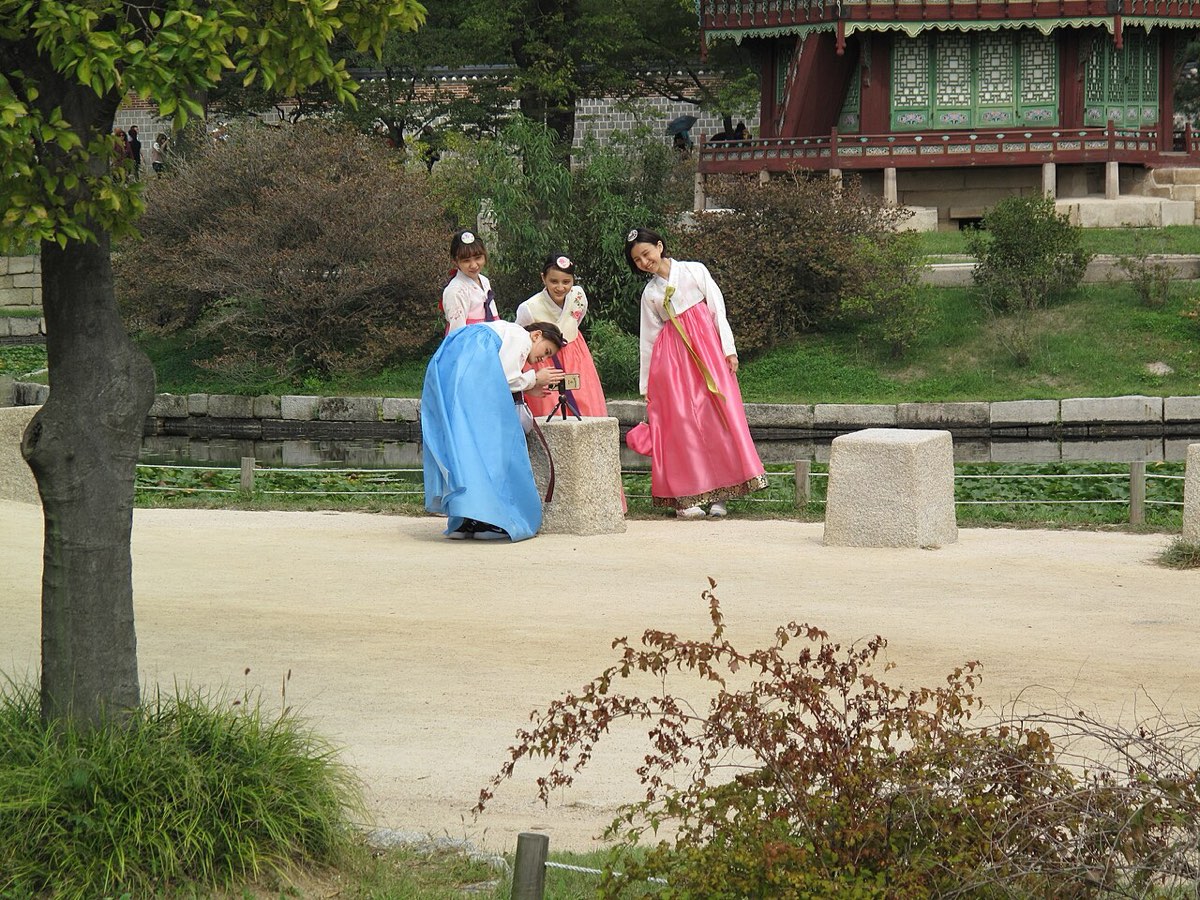
Bukchon in hanbok: walk the lanes between 10 and 5
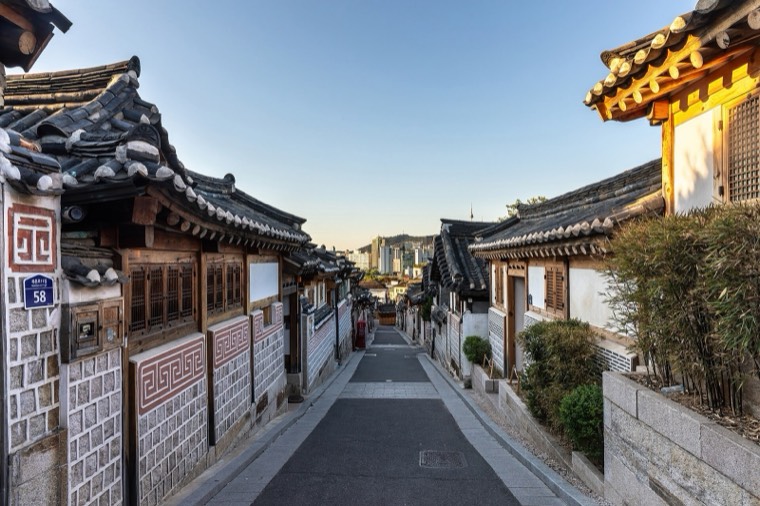
Bukchon, the hanok neighborhood east of Gyeongbokgung, is where many renters head next, and it is where care matters most, because people live in these houses. Jongno District has designated the most crowded lanes around Bukchon-ro 11-gil, about 34,000 square meters, as a red zone where tourist visits are allowed only from 10:00 to 17:00. After a guidance period from November 2024, enforcement began on March 1, 2025, and entering for sightseeing outside those hours can bring a fine of 100,000 won. The surrounding orange and yellow zones have no hour limits but are under closer management.
This shapes your plan. If your rental starts at 09:00, do the palace first and Bukchon after 10:00; if you rent in the afternoon, finish Bukchon well before 17:00 and return the hanbok afterward. In the lanes, speak quietly, do not sit on doorsteps or lean on gates, stay out of courtyards that happen to be open, and never photograph residents or through windows. Search 북촌로11길 on Naver Map before you go to see where the restricted stretch begins.
Our judgment: the palace courtyards are the better backdrop for hanbok, with space, context and no one's front door in the frame. Treat Bukchon as a short walk of fifteen or twenty minutes for one or two street views on the way back, not as a location for a photo shoot.
Who should rent, who should skip, and the avoidable mistakes
Rent if you want photographs to remember the trip, if you are with children or a group who will enjoy dressing up together, or if you are curious to see the palace from inside the clothes it was built around. Raised thresholds, steep wooden steps and floor-level rooms make more sense when you move in a long skirt. A first visit to Gyeongbokgung in spring or autumn is the classic case, and it is genuinely worth doing once.
Skip it if you have only half a day for several sights, because dressing, returning and walking back to the shop easily absorb an hour. Skip midsummer afternoons, and think twice if you have mobility concerns, since long skirts and uneven stone are a poor combination. If you want something of the experience without the logistics, buy a single accessory, such as a norigae or a hairpin; it travels home better than a hundred near-identical photographs.
The common mistakes are predictable: renting on a Tuesday for Gyeongbokgung; choosing a one-piece dress and paying at the gate after all; leaving the shop without noting the return time; wandering into Bukchon's red zone after 17:00; and booking hair styling on a crowded weekend morning, which can consume half the rental block. Avoid those five and the hanbok becomes what it should be, the part of the day you remember most clearly.
Questions visitors ask
Do foreign tourists get free palace entry in hanbok?
Yes. The Royal Palaces and Tombs Center says free admission for hanbok wearers applies to Korean and foreign visitors alike at the four palaces, Jongmyo Shrine and the royal tombs. Your outfit needs a wrap-collar jacket and a separate skirt or trousers. The Changdeokgung rear garden (Huwon) tour still requires its own ticket.
Can a man wear a skirt or a woman wear trousers and still enter free?
Yes. The official guideline is written around structure, not gender: a wrap-collar jeogori plus a separate skirt or traditional-cut trousers. As long as the outfit keeps that structure and is not overly revealing, who wears which piece does not affect free admission.
Is modern or fusion hanbok accepted for free admission?
Modernized hanbok is accepted when it keeps the basic form. What fails is anything without a separate wrap-collar jacket, such as a one-piece hanbok-style dress or a T-shirt cut to look like a jeogori, and any mix of hanbok with everyday clothes like jeans.
What should I wear under a rental hanbok?
A thin, close-fitting layer such as a T-shirt and leggings or shorts works in most seasons, and thermals are fine in winter. Wear flat, closed shoes in a dark color unless the shop supplies footwear, since palace paths are gravel and stone.
Can I visit Bukchon in hanbok in the evening?
Not the red zone around Bukchon-ro 11-gil, where tourist visits are limited to 10:00–17:00 and sightseeing outside those hours can be fined 100,000 won. Plan Bukchon for late morning or early afternoon, and choose Deoksugung or Changgyeonggung, both open until 21:00, if you want an evening in hanbok.
Is it disrespectful for foreigners to wear hanbok?
No. The palaces' free-entry program exists precisely to popularize hanbok in Korea and abroad, and it applies to foreign visitors explicitly. What reads as disrespectful is behavior, not nationality: parody costumes, blocking paths for photo shoots, or treating residential Bukchon as a set.
Sources and method
Written for: First-time visitors to Seoul deciding whether to rent hanbok for a palace visit, and how to do it without wasting time or breaking the rules.
Method: Researched from the official sources listed below, checked on October 20, 2026. Hours, fees and booking rules can change; the linked official pages are the final word. Spotted something out of date? Tell us.
- Royal Palaces and Tombs Center — Free Admission Guidelines for Hanbok Wearers (English)Traditional and modernized hanbok eligible; durumagi alone not accepted; ties and buttons fastened; T-shirt-type hanbok not allowed; mixed outfits refused.
- Royal Palaces and Tombs Center — 한복무료관람 가이드라인 (Korean hanbok guideline and Q&A)Wrap-collar requirement, tie style not judged, sapok-cut trousers with zips accepted, waist skirts accepted if jacket reaches waist, one-piece dresses refused, foreigners eligible.
- Royal Palaces and Tombs Center — 관람요금 (admission fees and free categories)Gyeongbokgung adult fee 3,000 won (foreigners 19–64); foreigners 18 and under and 65+ free; hanbok wearers free; Huwon free list excludes hanbok.
- Royal Palaces and Tombs Center — 관람시간 (opening hours and closing days)Gyeongbokgung seasonal hours and last entry, Tuesday closure and holiday rule; Monday closures for other palaces; Deoksugung 09:00–21:00.
- Royal Palaces and Tombs Center — 관람규칙 (visitor rules)Souvenir photography deemed permitted; permits needed for commercial shoots and costume or prop photography; drone limits; no smoking; alcohol, tents and mats restricted.
- Royal Palaces and Tombs Center — 오시는 길 (Gyeongbokgung directions)Gyeongbokgung Station Line 3 Exit 5, about two minutes on foot.
- Korea.net K-Info Hub — Basic Structure and Parts of the HanbokDefinitions of jeogori parts (git, dongjeong, seop, somae, goreum), chima, baji and durumagi.
- Korea.net K-Info Hub — Hanbok Etiquette and Wearing CultureAccessories (norigae, binyeo, daenggi) and the etiquette context of wearing hanbok.
- Korea.net — 'Hanbok lifestyle' designated National Intangible Cultural HeritageJuly 2022 designation of hanbok saenghwal; occasions when Koreans wear hanbok today; Joseon-era development.
- Seoul Metropolitan Government — Notice on Restrictions for Tourist Visits to Bukchon Special Management AreaRed zone around Bukchon-ro 11-gil (about 34,000 m²), tourist hours 10:00–17:00, KRW 100,000 fine, guidance from Nov 1, 2024 and fines from Mar 1, 2025; orange and yellow zones without hour limits.
- Royal Palaces and Tombs Center — October–November 2026 free admission noticeFree admission at the four palaces, Jongmyo and the royal tombs from October 29 to November 15, 2026, regular closing days and the Changdeokgung Secret Garden excluded.