In shortShare the side dishes, eat rice and soup with the spoon, keep your bowl on the table, and never leave chopsticks or a spoon standing upright in rice, which mimics a step in Korean ancestral rites. Let the eldest start, call staff with the table bell or 'jeogiyo', pay at the counter on the way out, and don't tip: menu prices already include tax and service.
Key facts
- Calling staff
- Table bell, or 저기요 (jeogiyo) / 여기요 (yeogiyo)
- Side dishes
- Shared; refills are free
- Chopsticks
- Never upright in rice (ancestral-rite image)
- Rice bowl
- Stays on the table; eat rice with the spoon
- Who starts
- The eldest at the table
- Paying
- Usually at the counter (계산대) on the way out
- Tipping
- Not customary; menu prices include VAT and service
- Eating alone
- Some restaurants require 2 portions (2인분 이상)
Checked Oct 20, 2026 against the official sources listed at the end of this guide.
The table is shared, and the side dishes are part of the meal
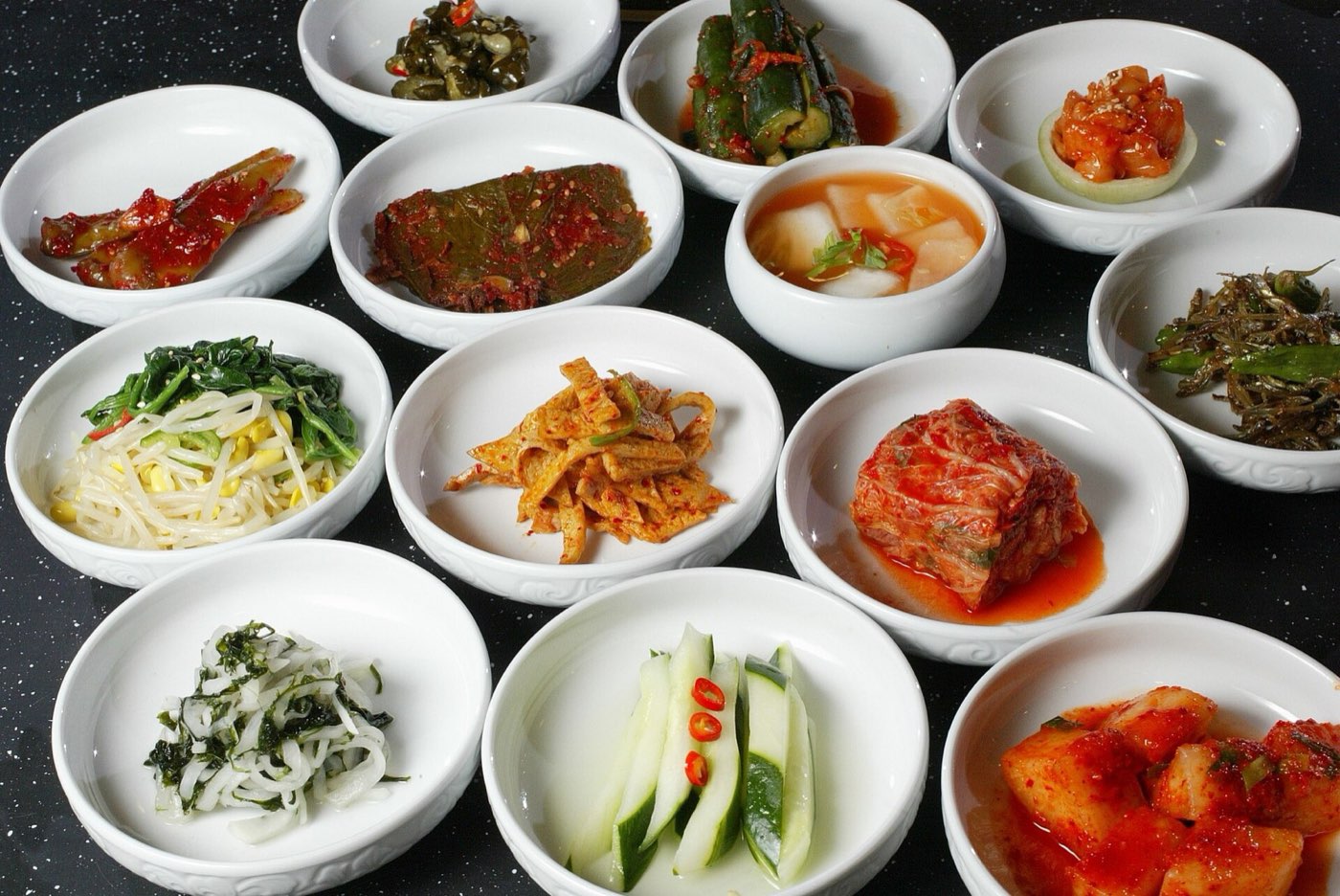
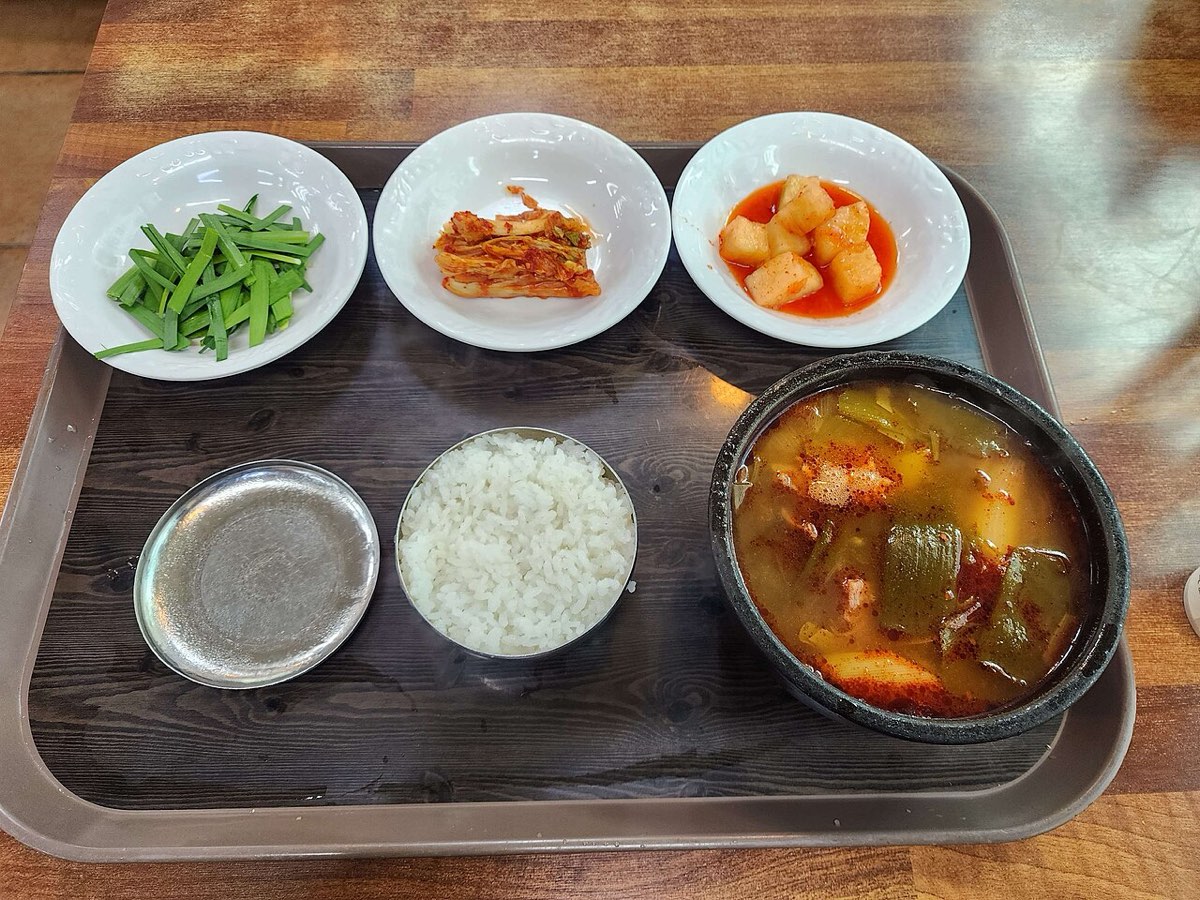
A Korean meal is built around the bansang (반상): rice and soup in front of each diner, and everything else set down in the middle at once. Korea.net's etiquette series points out that a Korean set meal arrives all together rather than in courses, which is the first adjustment many visitors make. The small shared plates are banchan (반찬): kimchi, seasoned greens, braised potatoes, fish cake, whatever the kitchen made that day. They are not starters to clear before the main dish. They are meant to be eaten with rice from the first spoonful to the last.
Banchan refills are free. VisitKorea notes that asking for more water or side dishes costs nothing, and many restaurants top up the kimchi without being asked. To request more, point at the empty dish and say 이거 좀 더 주세요 (igeo jom deo juseyo, 'a little more of this, please'). What draws looks is waste: asking for a third refill of something you then leave untouched. Take what you will eat, and finish what you asked for again.
You eat from shared dishes with your own chopsticks; there is no serving-spoon ritual for banchan. The courtesy lies in how you do it. Lift a piece cleanly instead of turning the plate over in search of the best bit, take from the side nearest you, and never put a bitten piece back. A bubbling pot of jjigae (찌개, stew) in the center often comes with a ladle (국자, gukja). When one is provided, use it to move broth into your own bowl rather than dipping your spoon straight into the pot.
Spoon for rice and soup, chopsticks for the rest
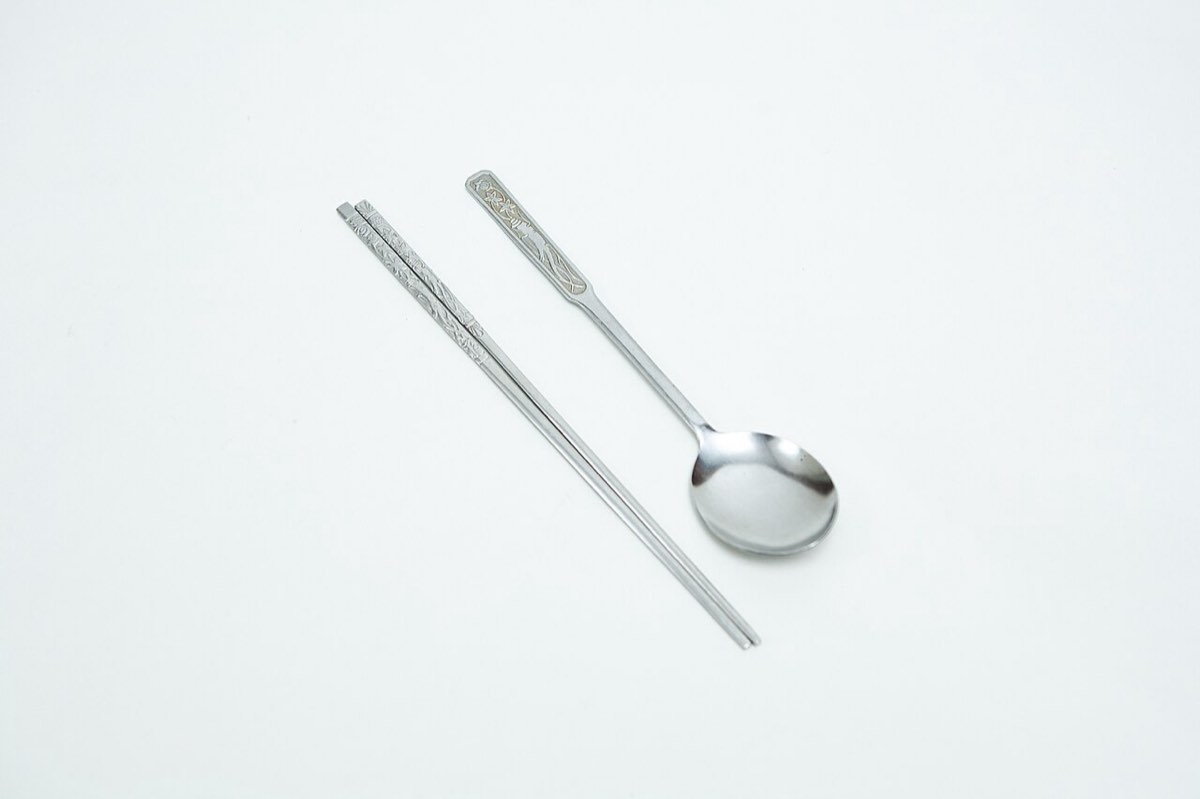
Korea is one of the few chopstick cultures where the spoon does the heavy lifting. Rice, soup and stew travel on a long-handled spoon (숟가락, sutgarak), while the flat metal chopsticks (젓가락, jeotgarak) handle banchan, fish and anything you need to pick up. Together the pair is called sujeo (수저). VisitKorea says plainly that using the spoon alongside chopsticks is fine if chopsticks are a struggle, and no one will think less of you for scooping a slippery bean.
Two habits mark an experienced diner. Use one utensil at a time rather than holding spoon and chopsticks together in one hand, and rest the idle one on the table. And keep the rice bowl on the table. Korea.net lists lifting the rice or soup bowl among the things to avoid; with a spoon doing the scooping, there is no need to bring the bowl to your mouth as diners do in Japan. Restaurant rice often comes in a lidded stainless-steel bowl that is too hot to hold anyway, which makes the rule easy to keep.
Place settings follow a pattern you will see at home tables and in set-meal restaurants: Korea.net describes rice on the diner's left, soup on the right, and the spoon laid beside the chopsticks. When you finish, return both utensils to where they started, as Visit Seoul's etiquette page advises, instead of leaving them in an empty bowl. Blowing your nose is best done away from the table; the same Korea.net episode flags it as something Koreans find unpleasant during a meal.
Why nothing stands upright in a bowl of rice
The strongest taboo at the Korean table comes from ancestral rites. In jesa (제사), the memorial service many families still hold on death anniversaries and holidays, there is a step called sapsi jeongjeo (삽시정저). After the last cups of liquor are poured, the spoon is planted in the center of the rice bowl offered to the ancestor, its hollow facing east, and the chopsticks are set straight. The Seoul Facilities Corporation's guide to traditional rites lays out what follows: the participants bow, then leave the room briefly so the ancestors can eat undisturbed.
A spoon or chopsticks left standing in rice therefore looks like a meal set for the dead. Most Koreans will not lecture a visitor about it, but the image is jarring at a dinner table, especially with older people present, and someone may quietly lay your chopsticks down for you. Visit Seoul includes the rule in its short list of dining basics, and Korea.net ties it directly to rituals for the dead. When you need to put utensils down mid-meal, rest them flat on the table, on a napkin or across a side plate.
If you are hosted at a family home during Seollal (설날) or Chuseok (추석), you may see the real thing. The morning holiday rite, charye (차례), follows the same table-setting logic, and afterwards the family shares the food and drink from the ritual table, a custom called eumbok (음복). Wait to be told where to sit and when to begin, accept what you are offered, and treat the ritual dishes with the same care you would any shared plate.
Age sets the pace of the meal
Visit Seoul's first dining rule is to start eating only once the eldest at the table has begun, and Korea.net describes younger diners waiting until older people pick up their utensils. This is Confucian courtesy in its most everyday form. In practice the senior person often says 많이 드세요 (mani deuseyo, 'eat plenty') or simply lifts a spoon, and the table follows. Among friends of similar age with no obvious senior, people just start.
Small duties tend to fall to the youngest or most junior person, and you will see them at office lunches all over Seoul. Someone takes spoons and chopsticks from the drawer or box at the table and lays a set on a napkin for everyone; someone fills the water cups. As a guest of Korean colleagues, offering to do this is a graceful gesture, though a visitor will usually be waved off. Matching the eldest's pace matters too: try not to finish far ahead, and don't get up to leave while seniors are still eating.
Visitors get a lot of latitude. Nobody expects a tourist couple to perform seniority rituals, and the family in Korea.net's own example admits that many households are relaxed about formality. The rules matter most in three settings: meals with someone's parents or grandparents, business dinners, and formal occasions. In those, watch the senior person and copy the rhythm. Everywhere else, the shared-dish courtesies and the chopstick taboo are the parts worth getting right.
Getting attention: the call bell, 'jeogiyo' and self-service
Korean restaurant staff do not hover, and they are not expected to. Many tables have a call button (호출벨, hochulbel); press it once and someone will come, and VisitKorea warns that it can be louder than you expect. Without a bell, raise a hand and call 저기요 (jeogiyo, roughly 'excuse me') or 여기요 (yeogiyo, 'over here'). Both are normal and not rude, even in a quiet room. Waiting silently to catch someone's eye usually means waiting a long time.
Self-service is common, and signs will tell you. 물은 셀프 (mureun selpeu) means water is self-service: look for a dispenser or a fridge of water bottles and stainless cups near the counter. Some places run a side-dish station, the 셀프바 (selpeu-ba), where you refill kimchi and banchan yourself, and VisitKorea mentions unmanned ordering machines. Tablet and kiosk ordering is now widespread and often has an English option; if not, a translation app's camera mode reads menus well.
These are the phrases that cover almost every exchange in an ordinary restaurant. Said with the 요 or 다 endings shown, they are polite enough for any table, including one with older people. Pronunciation does not need to be perfect; pointing while you speak does most of the work.
| Situation | Korean | Romanization |
|---|---|---|
| Calling staff | 저기요 / 여기요 | jeogiyo / yeogiyo |
| More of a side dish | 이거 좀 더 주세요 | igeo jom deo juseyo |
| A table for one | 한 명이에요 | han myeong-ieyo |
| Can I order one portion? | 1인분 돼요? | irinbun dwaeyo? |
| The bill, please | 계산해 주세요 | gyesanhae juseyo |
| We'll pay separately | 따로 계산할게요 | ttaro gyesanhalgeyo |
| Thanks after the meal | 잘 먹었습니다 | jal meogeotseumnida |
Eating alone and the two-portion minimum
Eating alone, honbap (혼밥), is ordinary in Korea now. The Korea JoongAng Daily, citing Statistics Korea's 2024 survey, reported that about 27 percent of people eat lunch alone. Restaurant layouts have not fully caught up. Barbecue houses, stew restaurants and places built around a shared pot often require at least two portions per order, written 2인분 이상, and some turn away single diners at busy times. A Fair Trade Commission spokesperson told the paper this is the owner's decision and breaks no law.
The reasons are economic rather than personal: one diner occupies a four-person table and a grill that costs the same to run. Knowing that makes the workarounds obvious. Avoid the noon office rush and the evening peak, choose places with counter seats or one-person menus, and look for 1인분 or 혼밥 on the menu or door. Noodle shops, gimbap chains, food courts and department-store food halls are built for one. If the dish you want only comes as two portions, ordering two is acceptable, and many restaurants will pack cooked leftovers if you ask for 포장 (pojang).
Be direct when you walk in: 한 명이에요 (han myeong-ieyo, 'just one'). If you are waved toward a small table, sit there; if the answer is an apologetic '2인분 이상', you have learned the house rule without any awkwardness. Timing does the rest. A restaurant that hesitates over a single customer at 12:15 is often glad of one at 2:30, when the room is empty and the kitchen is quiet.
Paying at the counter, splitting the bill and why there is no tip
In most Korean restaurants you pay at the counter (계산대, gyesandae) on your way out, not at the table. The bill is often left on the table when the food arrives, or staff simply remember your table number; take it to the register when you are done. In kiosk restaurants and cafes you pay before you eat. Cards are widely accepted in Seoul's restaurants, though small market stalls are a different story.
Korean groups have traditionally not split the check. A Korea.net column on the 'sneak pay' describes the usual pattern: one person covers the whole bill, often the oldest for a first meal, and friends race to pay or slip away to settle it quietly, so it evens out over time. Splitting, known as deochi pei (더치페이, 'Dutch pay'), is also common now among friends and colleagues of similar age, often with one person paying and the others sending their share by bank transfer. To pay separately, say 따로 계산할게요; most counters will run several cards, though a long split at the lunch peak is not popular.
Tipping is not customary. Visit Seoul says tipping is not customary in Korea, and VisitKorea says there is no need to tip at Korean restaurants. There is a structural reason as well. Seoul's food safety guidance requires restaurants to show prices as the final amount the customer pays, with VAT and service charges included rather than added separately. The price on the menu is the price, and cash left on the table is more likely to cause confusion than gratitude.
A worked example: a weekday lunch for two
Here is how an ordinary lunch runs at a neighborhood restaurant serving kimchi-jjigae and doenjang-jjigae sets. Staff call out a greeting as you enter; hold up two fingers or say 두 명이요 (du myeong-iyo). Sit where you are pointed, or at any free table if no one points. Open the drawer at the table edge for spoons and chopsticks and lay out a set for each of you on a napkin. If a sign says 물은 셀프, fill two cups at the water station rather than waiting.
Order by pointing at the menu or wall pictures, or press the bell. The banchan land first, then the bubbling stews and two bowls of rice. Let the older person start if you are with one. Eat rice and broth with the spoon and pick at the banchan with chopsticks; ask for more kimchi with 이거 좀 더 주세요 if you finish it. When you are done, lay the spoon and chopsticks side by side on the table. Take the bill to the counter, pay by card, and say 잘 먹었습니다 (jal meogeotseumnida, 'I ate well') on the way out. No tip.
Run through this short list before you sit down. None of it is complicated, and these six points cover nearly everything Korean diners notice about a visitor's manners, from the chopstick taboo to the moment you pay at the counter.
- If you are alone, look for 2인분 이상 on the door or menu before sitting.
- Check whether water is 셀프 before waiting for someone to bring it.
- Find the call bell on the table or the wall.
- Keep the rice bowl on the table and rest utensils flat, never upright in rice.
- Let the eldest start, and roughly match their pace.
- Pay at the counter on the way out; do not leave a tip.
How well would you do at a Korean dinner table?
Seven everyday moments at a Korean restaurant, from the side dishes to the bill, to see how you would handle them.
-
You've finished the kimchi from the shared side dishes and would like more. What do you do?
Show the answer
Point at the empty dish and say 이거 좀 더 주세요 (igeo jom deo juseyo). Banchan refills are free, and pointing while asking for 'a little more of this' is the normal way to get them. What draws looks is asking for refills and then leaving them untouched.
-
You're ready to order, but no server is coming over and there's no call bell on the table. What's the polite move?
Show the answer
Raise a hand and call 저기요 (jeogiyo) or 여기요 (yeogiyo). Korean restaurant staff don't hover, and calling 'jeogiyo' ('excuse me') or 'yeogiyo' ('over here') is normal, even in a quiet room. Waiting silently usually means waiting a long time.
-
Mid-meal, you want to put your chopsticks down for a moment. Where should they go?
Show the answer
Flat on the table, on a napkin or across a side plate. Chopsticks or a spoon standing in rice look like sapsi jeongjeo, the step in ancestral rites where a spoon is planted in rice offered to the dead. Rest them flat instead, and if you slip, simply lay them down.
-
Your rice arrives in a lidded stainless-steel bowl. How do you eat it?
Show the answer
Keep the bowl on the table and eat the rice with your spoon. In Korea the long-handled spoon carries rice, soup and stew, so there's no need to lift the bowl, and Korea.net lists lifting it among the things to avoid. Restaurant steel bowls are usually too hot to hold anyway.
-
You're having dinner with a Korean friend's grandparents, and the food has just been served. When do you start eating?
Show the answer
Once the eldest at the table has picked up a spoon or begun eating. Younger diners wait for the eldest to begin, often cued by a lifted spoon or 많이 드세요 (mani deuseyo, 'eat plenty'). It also helps to roughly match their pace and not get up while seniors are still eating.
-
Eating alone, you spot 2인분 이상 on a barbecue restaurant's door. What does it tell you?
Show the answer
Orders start at two portions, so you'd order two or find a place that serves one. Many barbecue and stew restaurants require at least two portions per order, since one diner still takes up a table and a grill. Ordering two is acceptable, or look for 1인분 or 혼밥 on the menu and avoid the lunch and dinner peaks.
-
The meal was great and the staff were lovely. How do you pay and say thanks?
Show the answer
Take the bill to the counter, pay, and say 잘 먹었습니다 (jal meogeotseumnida) with no tip. Most Korean restaurants take payment at the counter on the way out, and tipping isn't customary because menu prices already include VAT and service. Cash left on the table is more likely to confuse staff than please them.
Questions visitors ask
Is it rude to ask for a fork?
Not rude, but rarely necessary. Most restaurants set out only spoons and metal chopsticks, and the spoon handles rice, soup and soft side dishes. VisitKorea says using the spoon alongside chopsticks is perfectly acceptable. Some places keep forks for children; ask 포크 있어요? (pokeu isseoyo?) if you really need one.
Do I have to finish every side dish?
No. Banchan are shared and you can leave some. What reads badly is requesting refills and then leaving them untouched. Ask for more only of what you are actually eating, and try to finish your own rice, which is the part of the meal served to you alone.
Can I eat with my hands?
Only for wraps. Visit Seoul's etiquette guide says to avoid touching food with your fingers except when wrapping food in lettuce or cabbage, which is how grilled meat and some boiled pork dishes are eaten. For everything else, use the spoon or chopsticks; scissors and tongs handle anything large.
What should I do if I accidentally stuck my chopsticks in my rice?
Just lay them down flat on the table or across a side plate. It is a common slip for visitors, and nobody will make a scene. The reason it matters is the resemblance to the spoon planted in rice during ancestral rites, so simply removing them resolves it.
Should I pay for my Korean host's meal?
Offer once, sincerely, but expect to be refused if your host is older or invited you. The usual pattern is that one person pays for everyone and the favor is returned another time. A good reply is to say you will pay next time, or to cover coffee or a second round afterward.
Sources and method
Written for: First-time visitors who want to eat in ordinary Korean restaurants, alone or with Korean hosts, without awkward moments.
Method: Researched from the official sources listed below, checked on October 20, 2026. Hours, fees and booking rules can change; the linked official pages are the final word. Spotted something out of date? Tell us.
- VisitKorea (Korea Tourism Organization) — About Korean FoodSpoon-centered eating, using the spoon alongside chopsticks, free water and side-dish refills, self-service and ordering machines, call buttons and 'Yeogiyo', no need to tip.
- Visit Seoul (Seoul Tourism Organization) — The Basics of Korean EtiquetteStart after the eldest begins, no fingers except for wraps, no utensils upright in rice, return utensils to place, tipping not customary.
- Korea.net — [While in Korea] Episode 7: Table mannersDishes served at once, rice left and soup right, waiting for elders, chopsticks in rice associated with rites for the dead, not lifting bowls, not blowing your nose at the table.
- Seoul Facilities Corporation — Traditional memorial rite procedure (전통 제례절차)The sapsi jeongjeo step: spoon planted in the center of the rice bowl facing east, followed by bows and the hapmun step.
- Korea.net — The sneak pay: eating out is a game riddled with intrigueOne person usually pays for the group, often the oldest for the first meal.
- Korea JoongAng Daily — Solo diners are on the rise, but restaurants still say 'no soup for you' (Sept. 10, 2025)Share eating lunch alone (Statistics Korea 2024), two-portion minimums and refusals at barbecue and stew restaurants, Fair Trade Commission view that it is the owner's discretion.
- Seoul Metropolitan Government Food Safety Information — Restaurant price display system (음식점 등 가격표시제)Menu prices must be the final amount paid, including VAT and service charges, which cannot be listed separately.