In shortHead for the central food alley, sit at a counter stall with a posted price board, and say exactly what you want and how many before the food is served. Start with mayak gimbap and bindaetteok with makgeolli, add kalguksu or yukhoe, and carry small notes because some stalls still prefer cash. The food alley runs 09:00–23:00 every day, but the fabric and hanbok shops close on Sundays.
Key facts
- Korean name
- 광장시장 (Gwangjang Sijang); map search 광장시장 먹자골목Naver Map
- Address
- 88 Changgyeonggung-ro, Jongno-gu, Seoul
- Subway
- Jongno 5-ga (Line 1) Exit 8; Euljiro 4-ga (Lines 2, 5) Exit 4
- Food alley hours
- 09:00–23:00, open year-round
- Shops
- 09:00–18:00, closed Sundays
- Founded
- July 1905 (market company); present site from 1909
- Visitor help
- 1330 Travel Hotline (+82-2-1330), English available
Checked Oct 20, 2026 against the official sources listed at the end of this guide.
Founded in 1905 by Korean merchants pushing back
The market's own history begins in July 1905, when Korean merchants formed the company that would run it, Gwangjang Jusikhoesa (광장주식회사). The timing matters. Japan was tightening its grip on the Korean Empire that year, and a Japanese-led currency overhaul shook Korean traders; the market's official history describes the new venture as a market built on Korean capital at a time when other Seoul markets were under Japanese management. The Encyclopedia of Korean Culture calls the founding company the first privately run market-management company in Korea.
The name hides a story. The founders first planned to cover over the stream between the Gwanggyo (광교, 'wide bridge') and Janggyo (장교, 'long bridge') crossings of what is now Cheonggyecheon, and named the company 廣長, 'wide and long', after them. A flood swept away the building materials. They moved the plan east to the Baeogae (배오개) area, one of the three great market districts of late Joseon Seoul, kept the sound of the name and changed its characters to 廣藏, 'gather widely and keep'. According to the encyclopedia, the market settled on its present site in early March 1909.
For decades it went by another name. The market's history says it applied for its permit from the Hanseong city authorities in 1905 under the name Dongdaemun Market, and the Gwangjang name took hold from the 1960s. The Korean War destroyed part of it; refugees trading daily goods and military surplus revived it, the start of the imported secondhand clothing trade still found here. VisitKorea describes it as Korea's first permanent market, although the Encyclopedia of Korean Culture dates Seoul's first urban permanent market to 1897, on the site of today's Namdaemun Market. Gwangjang remains a working wholesale market for silk, bedding and wedding goods as much as a food destination.
How the market is laid out, and where the food is
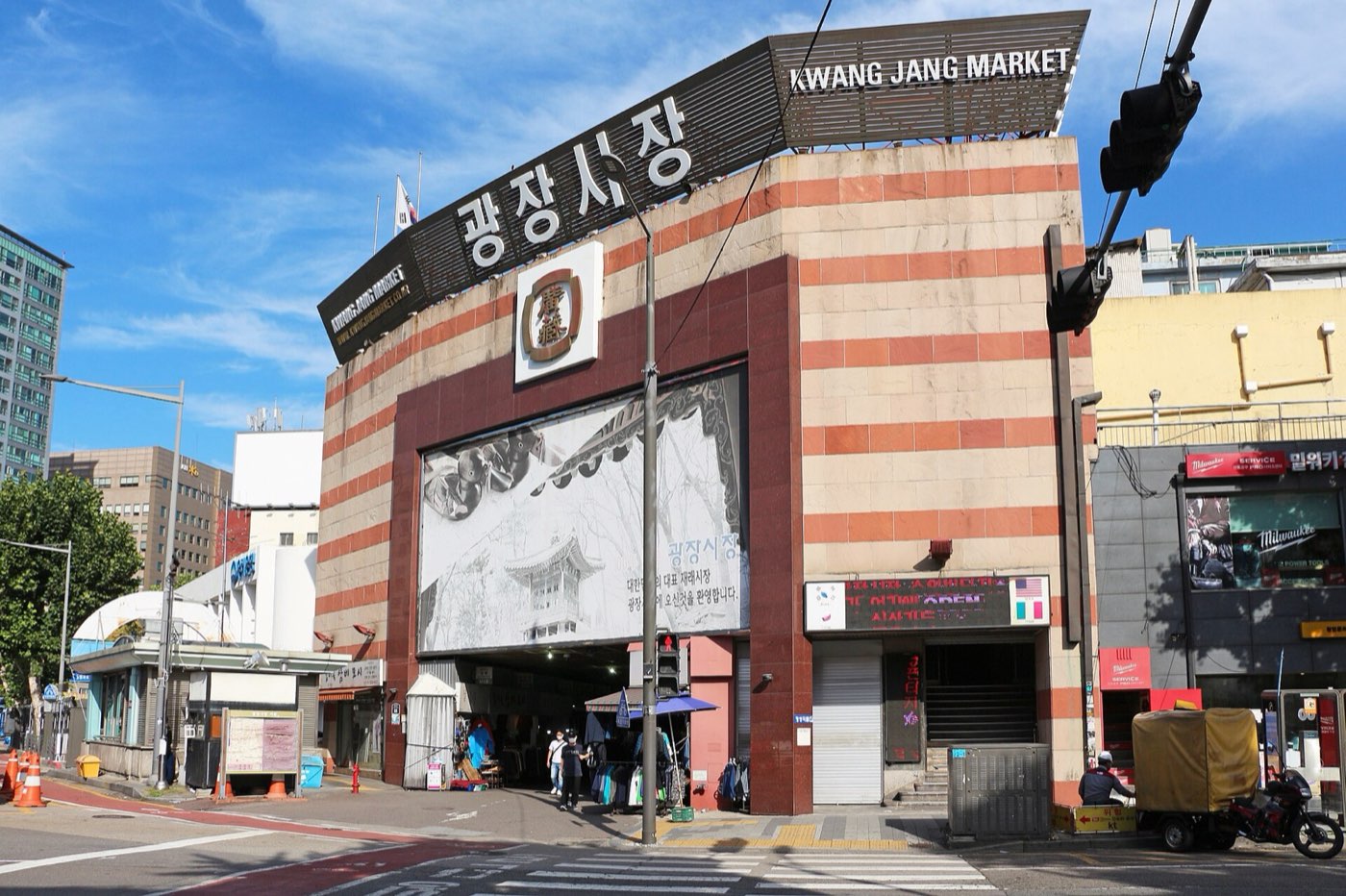
Think of Gwangjang as a covered grid of arcades with a food crossroads at its heart. The food alley (먹자골목, meokja golmok) is a long central aisle lined with rectangular counter stalls, each a cooking station ringed by benches. VisitKorea says the food street connects to the East Gate, North Gate 2 and South Gate 1, so whichever entrance you use, follow the smell of frying oil toward the middle. Around it, and far quieter, are the trades that built the market: silk and fabric, hanbok makers, bedding, and shops selling pyebaek (폐백) gifts for weddings.
The imported secondhand clothing arcade (구제상가, guje sangga) keeps its own hours and is worth a look if vintage clothing interests you. Two merchants' bodies share the site, which is useful to know if anything goes wrong. The Korea Herald reported that the Gwangjang Market Merchants' Association represents about 200 shops in the main building, while the Gwangjang Traditional Market Merchants' Association oversees roughly 250 stalls, including the food stalls. Most of what you eat in the alley comes from the second group.
In Naver Map or Kakao Map, search 광장시장 for the market as a whole, or 광장시장 먹자골목 to be routed straight to the food alley. The official address is 88 Changgyeonggung-ro, Jongno-gu (서울 종로구 창경궁로 88). The market's own directions give Jongno 5-ga Station, Exit 8, on Line 1, or Euljiro 4-ga Station, Exit 4, on Lines 2 and 5, about 100 meters away.
Bindaetteok, and the three other dishes that define the alley
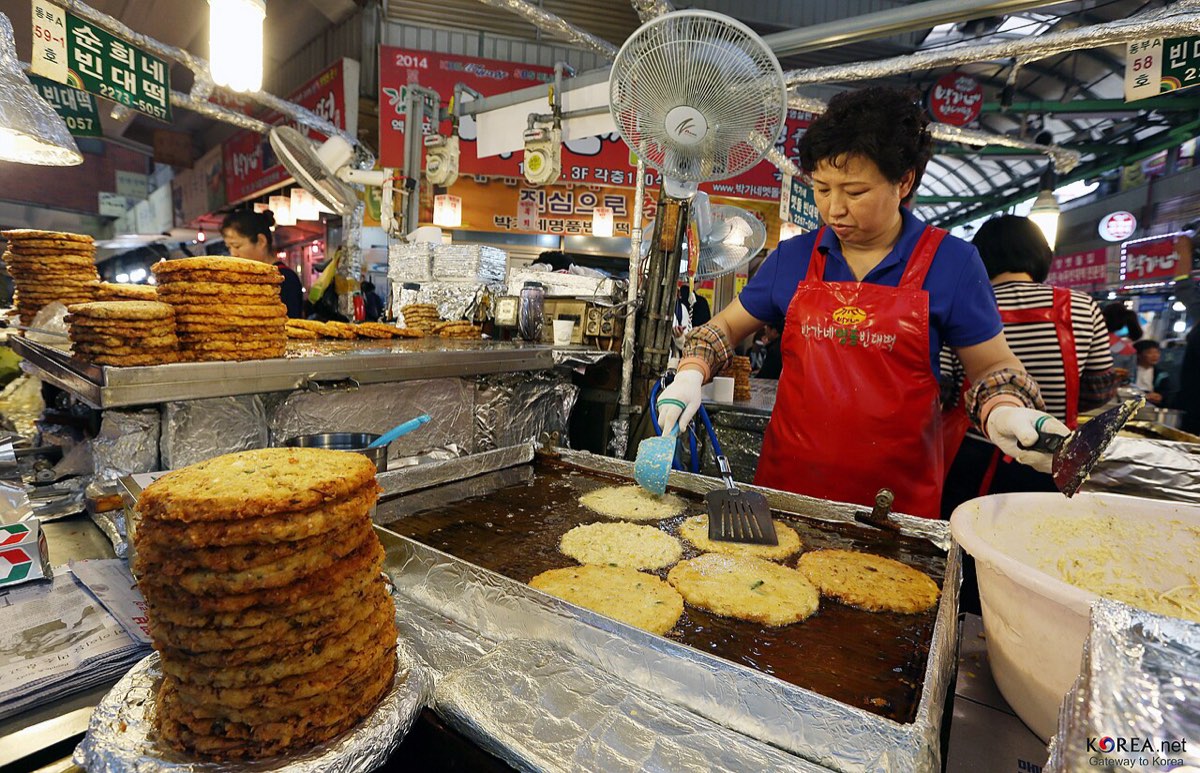
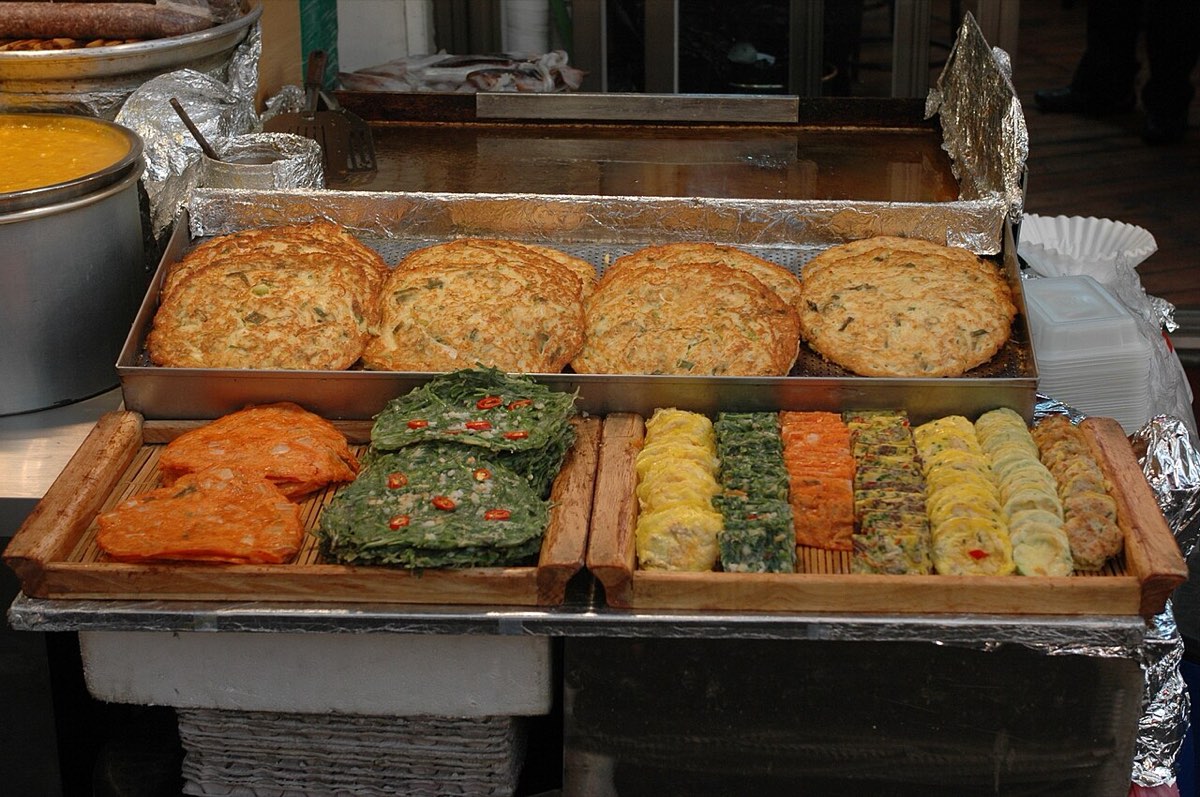
Bindaetteok (빈대떡) is the market's signature. It is a thick pancake of soaked, ground mung beans mixed with bean sprouts, kimchi or pork and fried in a generous layer of oil until the edges crackle. Several stalls grind the beans in full view, which is part of the show. It comes cut into pieces with a dip of soy sauce and sliced onion, and it is made for sharing. The traditional partner is makgeolli, and the Korea JoongAng Daily's report on makgeolli's heritage status names bindaetteok among the foods it is most often drunk with.
Mayak gimbap (마약김밥) is the opposite: finger-length rolls of rice and a few simple fillings, brushed with sesame oil and served with a sharp mustard dip. The name borrows the word for narcotics as a joke about how hard they are to stop eating. Order a plate first while you decide on everything else. Kalguksu (칼국수), knife-cut wheat noodles in a light anchovy broth, is the alley's comfort bowl; a VisitKorea feature on a guided morning walk to the market recommends it, often with dumplings (만두, mandu) from the same counters.
Yukhoe (육회) is the splurge: raw beef cut into strips and dressed with sesame oil and sweet pear, often topped with an egg yolk. It is generally ordered at specialist sit-down restaurants rather than snack counters, and it is the priciest of the common orders. Eat it promptly once served, and skip it if you are pregnant or have a weakened immune system, as with any raw meat. Beyond these four, the counters sell sundae (순대, blood sausage), tteokbokki, assorted jeon (모둠전, modumjeon) and japchae.
How ordering at a counter stall works
Counter stalls do not work like restaurants. There is no host and usually no printed menu at your seat: the food on display is the menu, with prices on a board above the cook. Choose a stall with a clear price board, sit on the bench and point. The vendor cuts, reheats or plates your order in front of you, and you normally pay when you finish. You can stay at one stall for everything or graze, eating one dish per stall and moving on, which is the better way to cover the alley.
Friction usually comes from vague orders. Name the dish and the quantity, ask the price before the food arrives if it is not posted, and decline extras clearly. The disputes described below involved portion sizes and dishes charged differently from the board, and the most effective protection is agreeing the amount before you eat. If a vendor suggests adding another dish, 이것만 주세요 (igeonman juseyo, 'just this, please') is polite and final. Sharing benches with strangers is normal; keep bags on your lap rather than on the seat.
These phrases handle almost every exchange at the counters. Vendors in the alley are used to visitors and to pointing, so speed matters more than perfect pronunciation. Hold up fingers for quantities, and repeat the price back if you are unsure you heard it correctly.
| You want to say | Korean | Romanization |
|---|---|---|
| How much is this? | 이거 얼마예요? | igeo eolmayeyo? |
| One of this, please | 이거 하나 주세요 | igeo hana juseyo |
| Just this, please | 이것만 주세요 | igeonman juseyo |
| Can I pay by card? | 카드 돼요? | kadeu dwaeyo? |
| A bottle of makgeolli, please | 막걸리 한 병 주세요 | makgeolli han byeong juseyo |
| To take away, please | 포장해 주세요 | pojanghae juseyo |
The overcharging stories, and what has changed since
Gwangjang's fame has brought scrutiny, and it is fair to know the record. In late 2023 a YouTube video showed a 15,000-won plate of assorted pancakes that many viewers found meager. Seoul responded with plans to print serving weights next to menu prices, to display food models of signature dishes such as bindaetteok, and to send mystery shoppers to check prices and portions. In November 2025 another viral video alleged a stall charged 10,000 won for sundae listed at 8,000 won; the vendor said the customer had agreed to extra meat. The Korea Herald reported that the street-stall association suspended that stall for 10 days.
That episode exposed a rift between the two merchants' associations, with the main-building group seeking damages from the stall association over harm to the market's reputation, according to the Herald. In December 2025 the Ministry of SMEs and Startups met both groups with Seoul and Jongno District officials and called for accurate price displays, transparent payment and multilingual signs with QR-code information. The city and district proposed real-name management of stall operators plus mandatory hygiene and service training, according to the ministry's announcement.
In May 2026 Seoul and Jongno District announced a joint May–June inspection of 159 food businesses and 109 food stalls, to be followed by regular checks, along with ongoing visits by mystery shoppers, foreign nationals among them, and a real-name system for stall vendors from June in which violations bring penalty points, suspensions and, at worst, loss of the stall's road-occupancy permit. Keep this in proportion: most visits involve nothing more than good food at posted prices. If something does go wrong, stay calm, note the stall, and call the 1330 Travel Hotline (+82-2-1330), which VisitKorea lists for the market and which offers English.
Cash, cards and settling up
VisitKorea's listing says cards are accepted, and most shops and sit-down restaurants do take them. The food counters are less consistent. Seoul's 2023 measures included training vendors not to steer customers toward cash, and the government's December 2025 meeting still named transparent payment as a priority. The practical answer is to carry enough small notes (1,000-, 5,000- and 10,000-won bills) for a few dishes, ask 카드 돼요? before you order if you want to pay by card, and treat a card-friendly stall as a bonus.
A request to pay by bank transfer was part of the 2023 story, and a visitor without a Korean bank account cannot use one anyway. If a vendor asks for a transfer, pay with cash or a card instead. Keep coins and small notes handy as you go; you will want them at the next counter, and exact money speeds things up when the benches are full.
When to go, and what Sunday means here
The market runs on two clocks. Its official site lists the shops at 09:00–18:00 with Sunday closing and the secondhand clothing arcade at 10:00–19:00 (closed Sundays, though the market says it opens on public holidays), and VisitKorea lists the food alley at 09:00–23:00 with no closing day. Individual stalls set their own hours within that, so a favorite counter may close early or take a day off.
For food, the best window is a weekday late morning, roughly 10:30 to 11:30, when counters are stocked and the lunch crowd has not arrived; mid-afternoon on a weekday is the next best. Evenings are lively with after-work drinkers and tour groups, which is fun but means waiting for bench space. Sunday is the trade-off: the food alley runs as usual while the fabric, hanbok and vintage sections are shuttered, so the market feels like a food court surrounded by closed stores. Come on a Sunday only if food is the whole point.
Pairing it with Cheonggyecheon, Jongmyo and a three-hour plan
Gwangjang sits between two of central Seoul's best walks. Its southern edge faces Cheonggyecheon (청계천), the restored stream whose old bridges gave the market its name, so a stream walk ending at the market is the natural approach. A guided morning walk featured by VisitKorea follows the stream east from the Gwanghwamun end to Jongno 5-ga and finishes at the market for noodles and pancakes. It is a long stretch on foot, and you can join or leave it at any bridge.
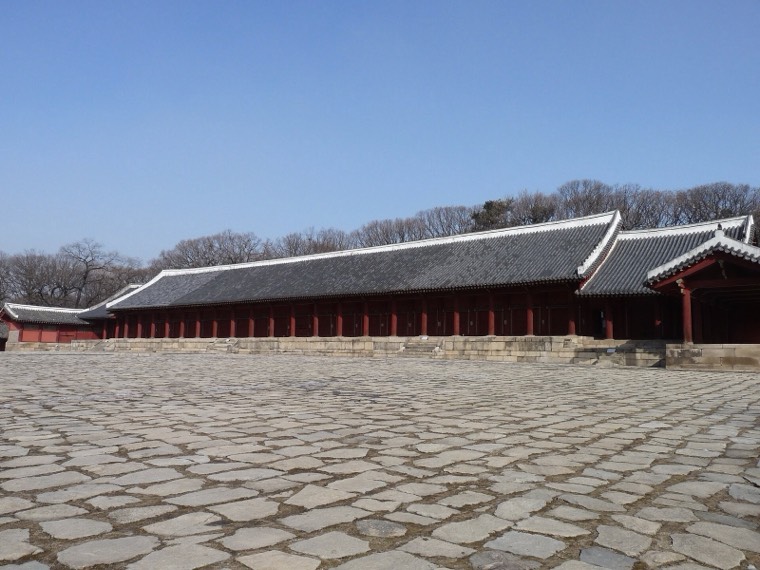
North across Jongno lies Jongmyo (종묘), the royal ancestral shrine; the market's own directions send drivers to the Jongmyo public parking lot, which tells you how close the two are. Pair them as a morning and a lunch: shrine first, market second. Jongmyo has its own visiting rules and closing day, so check the shrine's official site before you go. The Dongdaemun fashion district to the east is also within walking distance if you would rather shop than sightsee.
A sample three-hour weekday plan: arrive at Jongno 5-ga Station, Exit 8, at 9:30 and loop the fabric and hanbok arcades as shutters go up. At 10:45 take a bench for mayak gimbap and a shared bowl of kalguksu. Around 11:30 move to a bindaetteok stall for one pancake and a bottle of makgeolli between two. At 12:15 either finish with yukhoe at a specialist restaurant or climb to the vintage arcade. Leave by the south side around 12:30 and walk west along Cheonggyecheon to let lunch settle.
Before you take a seat at any counter, run through these five habits. They prevent nearly every misunderstanding described in the news coverage above, they cost nothing but a few seconds, and vendors who run an honest stall will not mind them at all.
- Find the price board and check the dish you want is on it.
- Name the dish and the quantity, and ask the price if it is not posted.
- Ask 카드 돼요? first if you need to pay by card; otherwise have small notes ready.
- Decline add-ons clearly with 이것만 주세요.
- Remember the stall's name or number in case you need the 1330 hotline.
Questions visitors ask
Is Gwangjang Market a tourist trap?
Not as a whole, but it is a crowded tourist favorite with a documented history of overcharging complaints, especially in 2023 and 2025. Seoul and Jongno District have since stepped up inspections, sent in mystery shoppers and announced a real-name system for stall vendors. Choose stalls with posted prices, confirm the amount before you eat, and you will usually pay what the board says.
Is the food alley open on Sundays?
Yes. VisitKorea's official listing gives the food alley as open 09:00–23:00 year-round, while the general market shops and the secondhand clothing arcade close on Sundays. On a Sunday you can eat normally, but most of the fabric, hanbok and vintage sections will be shuttered.
Do I need to speak Korean to order?
No. Food is displayed at every counter and pointing works. A few phrases help: 이거 얼마예요? (how much is this?), 이거 하나 주세요 (one of this, please) and 이것만 주세요 (just this, please). Multilingual signs and QR guides were among the improvements officials called for in December 2025.
What should I order if I can only try two things?
Bindaetteok and mayak gimbap. The mung bean pancake is the dish the market is known for and pairs naturally with makgeolli, while mayak gimbap is quick, cheap and shows how Korean market snacks are meant to be eaten: on a bench, shared, with a sharp dip.
Is there anywhere to sit with a back rest?
The counter stalls have backless benches. If you want a proper table, look for the sit-down restaurants around the alley, which include the yukhoe specialists. They take longer than a counter but suit older travelers, families and anyone carrying shopping.
Sources and method
Written for: Independent visitors who want to eat well at Gwangjang Market, understand what they are eating, and avoid the usual friction over ordering and paying.
Method: Researched from the official sources listed below, checked on October 20, 2026. Hours, fees and booking rules can change; the linked official pages are the final word. Spotted something out of date? Tell us.
- Gwangjang Market (official site) — History (광장시장 연혁)July 1905 founding of Gwangjang Jusikhoesa, currency-reform context, Korean-capital market, registration as Dongdaemun Market in 1905, Gwangjang name from the 1960s, Korean War and secondhand clothing trade.
- Gwangjang Market (official site) — Directions and hours (오시는길)Address, Jongno 5-ga Exit 8 and Euljiro 4-ga Exit 4 (100 m), Jongmyo parking lot, shop hours 09:00–18:00 and secondhand arcade 10:00–19:00 with Sunday closing (arcade open on public holidays). Does not list food-alley hours.
- Encyclopedia of Korean Culture (Academy of Korean Studies) — 광장회사First private market-management company (July 1905), original 廣長 name and Gwanggyo–Janggyo plan, flood, move near Baeogae, 廣藏 renaming, present site from early March 1909.
- VisitKorea (Korea Tourism Organization) — Gwangjang MarketFirst permanent market description, food street gates, product range, hours incl. food street 09:00–23:00 year-round, cards accepted, 1330 hotline.
- VisitKorea — Stroll along the Cheonggyecheon Stream and have breakfast at the marketStream walk ending at Jongno 5-ga and Gwangjang Market; kalguksu in anchovy broth, dumplings and mung bean pancake.
- Korea JoongAng Daily — Seoul to introduce measures to curb exorbitant pricing at Gwangjang Market (Dec. 4, 2023)15,000-won pancake plate video, planned quantity labeling, food models and undercover checks.
- The Korea Herald — Overcharging scandal at Gwangjang Market escalates into fight among merchant groups (Nov. 23, 2025)Sundae price dispute, 10-day suspension, the two merchants' associations and their sizes, damages claim.
- Korea.kr (Ministry of SMEs and Startups policy news) — Gwangjang Market trust-restoration meeting (Dec. 5, 2025)Ministry meeting with Seoul, Jongno-gu and both merchants' associations: accurate price display, transparent payment, multilingual and QR guidance; city and district proposals for real-name stall management and mandatory hygiene and service training.
- Seoul Metropolitan Government press release — Comprehensive hygiene, commerce and safety inspection of Gwangjang Market (May 20, 2026)Joint city–Jongno May–June inspection drive followed by regular checks; domestic and foreign mystery shoppers; 159 food businesses and 109 food stalls; Jongno-gu real-name system for stall vendors from June 2026 with penalty points, suspensions and possible cancellation of road-occupancy permits.
- Seoul Metropolitan Government (Naeson-ane Seoul) — Gwangjang Market introduces quantity labelling to curb overcharging (Dec. 4, 2023)Official city announcement of the 2023 measures: serving weights next to menu prices, food models for signature dishes such as bindaetteok, mystery shoppers checking prices and portions, and merchant training against steering customers to cash.