In shortDecide on a pork house (samgyeopsal, moksal) or a beef house (galbi, hanu) before you go, then order by the portion, 인분 (inbun), usually at least two to start. Menus must show meat prices per 100 grams, so use that line to compare. Wrap grilled meat in lettuce or perilla with ssamjang and garlic, eat each wrap in one bite, and finish with rice and doenjang jjigae or cold naengmyeon.
Key facts
- Portion word
- 인분 (inbun); 1인분 = one portion
- Menu price rule
- Meat priced per 100 g; portion weight shown with any per-portion price
- Usual minimum
- 2 portions on the first order (varies by restaurant)
- Beef quality grades
- 1++ (marbling 7, 8 or 9), 1+, 1, 2, 3
- Domestic beef labels
- 한우 hanu / 육우 yugu / 젖소 jeotso
- Map search
- 삼겹살 (pork belly) or 한우 (Korean beef) + neighborhoodNaver Map
- Tipping
- Not customary
Checked Oct 20, 2026 against the official sources listed at the end of this guide.
Pork house or beef house: the first decision
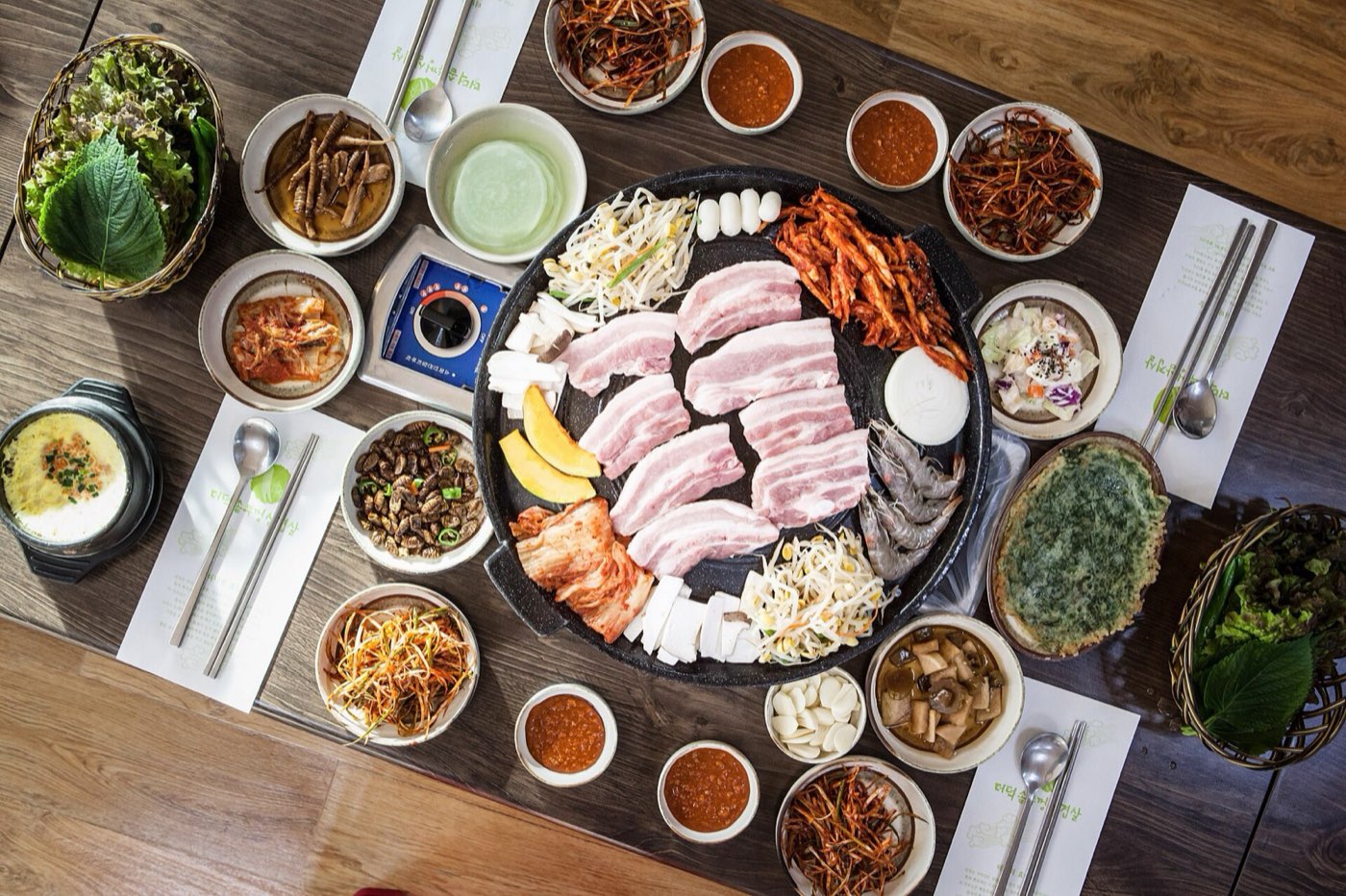
Korean barbecue restaurants, gogitjip (고깃집, 'meat house'), usually specialize. A pork house builds its menu around samgyeopsal (삼겹살), the three-layered belly, and moksal (목살), the leaner neck and shoulder, with extras such as hangjeongsal (항정살, jowl) and marinated pork ribs, dwaeji galbi (돼지갈비). A beef house offers cuts like deungsim (등심, sirloin), chadolbagi (차돌박이, wafer-thin brisket), galbisal (갈비살, boneless rib meat) and short rib, plain or marinated: saeng-galbi (생갈비) or yangnyeom galbi (양념갈비). The sign often tells you which you are entering: 돼지 means pork, 소 or 한우 means beef.
The choice shapes the evening. Pork houses are loud, relatively inexpensive by barbecue standards and built for friends with soju, and you will usually do the grilling. Beef houses, especially hanu (한우) specialists serving Korean native cattle, cost more, feel calmer and are more likely to have staff manage the grill. Bulgogi (불고기), the sweet soy-marinated beef many visitors know first, sits slightly apart: it is commonly cooked with its juices in a pan or on a domed griddle and appears on lunch menus as often as at barbecue houses. For a first night, a pork house is the classic introduction and the safer bill.
Reading the menu: 인분, grams and the 100-gram rule
Meat is ordered by the portion, written 인분 (inbun): 1인분 is one portion, 2인분 two. A portion is not a fixed national size. Under Korea's food sanitation rules, as summarized by the government's Easy Law service and Seoul's food safety office, restaurants must show the price of meat per 100 grams. They may also list a per-portion price, but only together with the weight they define as a portion, in a pattern like '100g ○○원 (1인분 ○○g △△원)'. One restaurant's portion can therefore be noticeably larger than another's at a similar headline price.
Use the per-100-gram figure to compare restaurants and cuts; the per-portion line is what you actually order. Seoul's guidance applies the rule to raw meat you grill and marinated meat you cook at the table, and excludes dishes served ready to eat, such as stews, steamed dishes and yukhoe. Small places do not always follow it to the letter, but when you see two prices beside one cut, that is why.
Look for the origin label too, 원산지 (wonsanji). Restaurants must state where their beef and pork come from, and for domestic beef the type of cattle: 한우 (hanu, Korean native cattle), 육우 (yugu, domestic beef cattle of other breeds) or 젖소 (jeotso, dairy breed), as a Yeongdeungpo District guide to the rules sets out. Hanu is graded. The Korea Institute for Animal Products Quality Evaluation grades beef 1++, 1+, 1, 2 and 3, and since December 2019 the agriculture ministry has required 1++ beef on sale to carry its marbling score of 7, 8 or 9, because the top grade was widened that year to include score 7 and the price gap between the three is real.
Most of the words on a barbecue menu fall into a short list. Learn these and you can read a typical pork or beef house menu without a translation app. Menus in tourist areas often add English, but neighborhood places rarely do, and the Korean names are what staff will recognize when you order.
| On the menu | Romanization | What it is |
|---|---|---|
| 삼겹살 | samgyeopsal | Pork belly, alternating layers of fat and meat |
| 목살 | moksal | Pork neck and shoulder, leaner and chewier |
| 항정살 | hangjeongsal | Pork jowl, rich and slightly crunchy |
| 돼지갈비 | dwaeji galbi | Pork ribs, usually marinated |
| 차돌박이 | chadolbagi | Paper-thin beef brisket; cooks in seconds |
| 등심 | deungsim | Beef sirloin |
| 갈비살 | galbisal | Boneless beef rib meat |
| 양념갈비 | yangnyeom galbi | Soy-marinated short ribs |
| 공기밥 | gonggibap | A bowl of rice |
| 원산지 | wonsanji | Country or type of origin of the meat |
The two-portion minimum, and how to order around it
Most barbecue houses want at least two portions on the first order, often printed as 2인분 이상 or 주문은 2인분부터. The grill, the charcoal and the spread of side dishes cost the restaurant the same whether one person eats or two. The Korea JoongAng Daily found barbecue restaurants among those turning away solo diners at busy times, and the Fair Trade Commission told the paper this is the owner's decision. For a pair, two portions is the natural opening order.
For larger groups, a sensible pattern is to order one portion fewer than the number of people, then add as the grill empties; additional single portions are usually fine once the minimum has been met, and 추가 1인분 돼요? (chuga irinbun dwaeyo?) settles it. Many places let you mix cuts to reach the minimum, so one belly and one neck is a good first order for two at a pork house. Solo travelers have three options: a restaurant advertising 1인분 or 혼밥, a one-person lunch set, or two portions and a slower evening.
Who holds the tongs
At a typical pork house the staff bring the meat, may lay the first strips on the grill, and then leave the rest to you. The tools are tongs (집게, jipge) and kitchen scissors (가위, gawi): Koreans grill long strips whole, then snip them into bite-size pieces on the grill. Turn pork belly once the underside is golden, cut it, and let the pieces finish; pale pork needs more time. At many beef and hanu restaurants staff grill for you, both to protect expensive meat and because well-marbled beef needs only moments per side. If a server reaches for your tongs, let them.
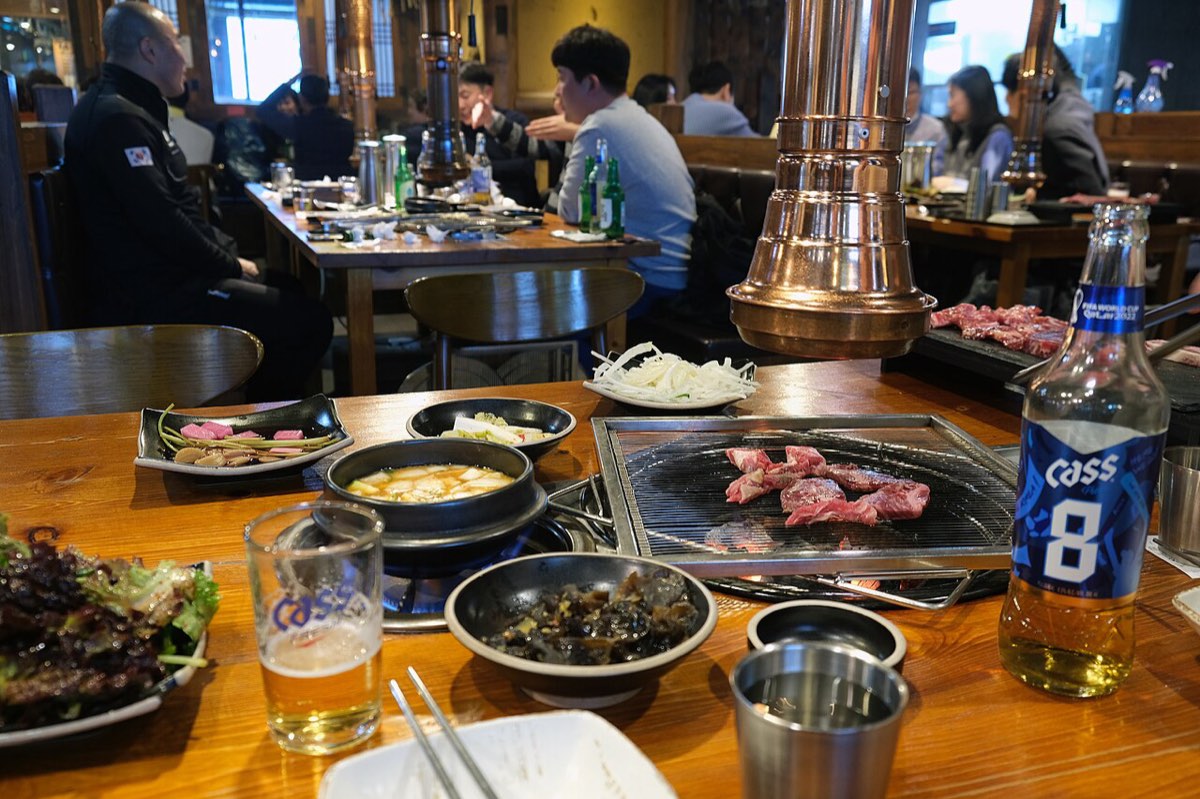
Grilling is social as well as practical. In a group, the person nearest the grill or the most junior often takes charge, and placing cooked meat on someone else's plate is a small act of care. When the grill plate chars and starts to stick, ask for a fresh one: 불판 갈아 주세요 (bulpan gara juseyo). Charcoal grills (숯불, sutbul) bring more smoke and flavor; gas and electric grills are cleaner. Most tables have an extractor hood or vent, but clothes still pick up the smell, so many restaurants hand out aprons or bags for coats.
Building a ssam, and what else goes on the grill
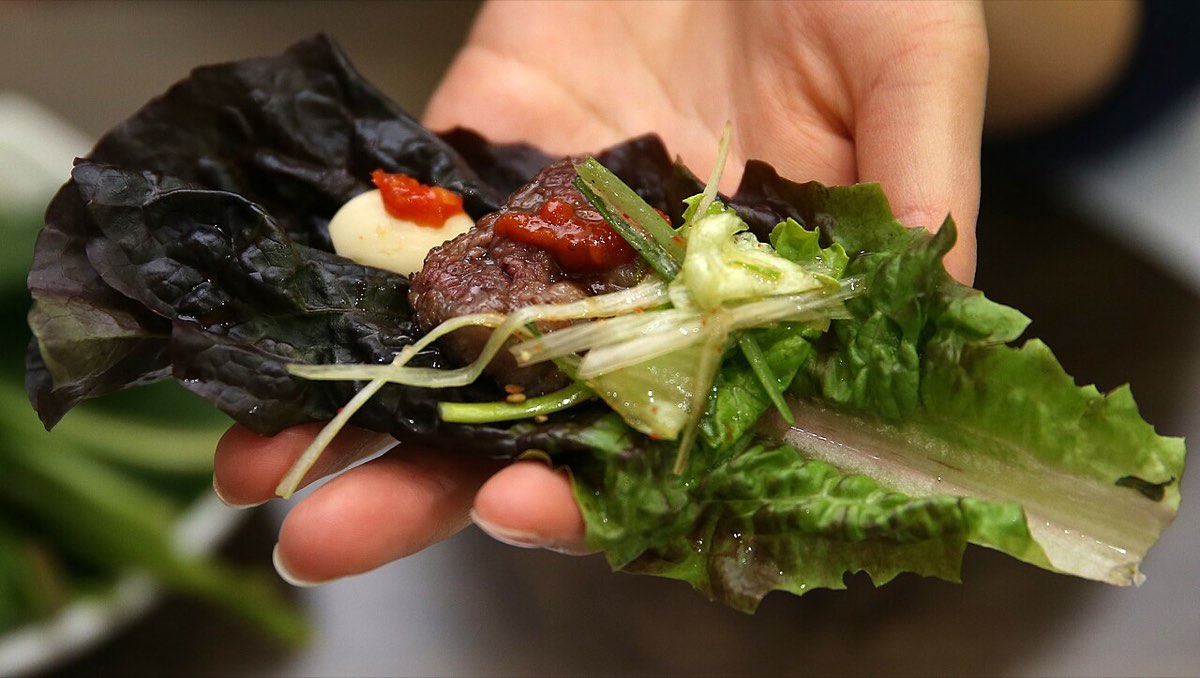
Ssam (쌈) means a wrap, and it is how most Koreans eat grilled meat. Lay a lettuce leaf (상추, sangchu) across your open palm, add a perilla leaf (깻잎, kkaennip) on top if you like its minty, anise-like edge, then a piece of meat. Dab on ssamjang (쌈장), a thick sauce based on doenjang soybean paste and gochujang chili paste, and add a slice of raw or grilled garlic (마늘, maneul), a coin of green chili or a pinch of dressed scallion salad (파채, pachae). Fold the leaf closed around the filling.
Then eat it in one bite. VisitKorea's advice is to open wide and put the whole wrap in at once, and Visit Seoul's etiquette notes make wrapping the one time it is fine to handle food with your fingers. Biting a wrap in half sprays sauce and falls apart, so keep each one small: one piece of meat, a leaf or two, a little sauce. Between wraps, dip plain pieces in gireumjang (기름장), sesame oil with salt and pepper, which flatters pork belly and beef alike.
The grill takes more than meat. At pork houses, set sliced garlic in a small foil cup or at the grill's edge to soften in the rendered fat, and move kimchi onto the grill once there is fat to fry it in; grilled kimchi turns sweet and smoky, and for many Koreans it is the best part of the meal. Mushrooms and onion slices go the same way. Myeongi namul (명이나물), pickled wild-garlic leaves, often appear at pork houses; use them like lettuce, wrapped around a piece of belly.
The second act: rice, stew or cold noodles
A Korean barbecue meal rarely ends with the last piece of meat. Staff will often ask whether you want siksa (식사, 'the meal'), meaning the rice course, and the word says a lot about how Koreans think about food: meat with drinks is one thing, but a meal involves rice. The most common order is doenjang jjigae (된장찌개), soybean-paste stew, with a bowl of rice, 공기밥 (gonggibap). Some pork houses serve a small doenjang stew alongside the meat; others sell it as an add-on.
Naengmyeon (냉면), chewy buckwheat noodles in icy broth (mul-naengmyeon) or tossed in chili sauce (bibim-naengmyeon), is the classic finish at galbi and beef houses, the cold, tangy broth cutting through the fat. Many pork houses offer a smaller bowl, often listed as 후식 냉면 (husik naengmyeon, 'dessert naengmyeon'), for exactly this purpose. Where the restaurant offers it, fried rice, bokkeumbap (볶음밥), made on the grill plate with chopped kimchi and seaweed, is another finish; ask 볶음밥 돼요? (bokkeumbap dwaeyo?).
Soju, beer and the rhythm of a barbecue table
Barbecue is drinking food in Korea, and pork belly with soju is the pairing most Koreans would name first. Green-bottle soju is cheap, clean-tasting and noticeably stronger than it seems, and the small glasses empty quickly in a round of toasts. Many tables order beer as well and combine the two into somaek (소맥), a measure of soju in a glass of beer. Nobody needs to drink: soft drinks (음료수, eumnyosu) and the free water are always fine, and a raised glass of saida (사이다, lemon-lime soda) works for any toast.
The pouring rules apply here as anywhere: fill others' glasses rather than your own, use two hands when pouring for or receiving from someone older, and turn slightly away from elders when you drink. Our guide to makgeolli, soju and traditional liquor explains those gestures and Korea's year-based drinking age in detail. At barbecue the practical point is pacing. Meat arrives in waves, and so do toasts, so drink water between rounds and order the rice course before the night runs late.
Courtesies at the grill, and how the bill adds up
Use the tongs, not your own chopsticks, to handle raw meat; chopsticks go to your mouth, tongs touch the raw pieces. Offer the last piece around before taking it. Don't flip meat constantly: let it brown, then turn it. If someone else is grilling, don't take over without asking, and thank whoever cooked. When you leave, pay at the counter. Tipping is not customary, and Seoul's price-display rules require menu prices to include VAT and service charges, so the menu price is what you pay.
A barbecue bill is built from three parts: the per-portion meat price multiplied by the number of portions, the drinks, and the rice or noodle course. Banchan and lettuce refills are normally free; ask if unsure. The biggest swing is the meat itself. Hanu at 1++ grade with a high marbling score sits at the top of any menu, imported beef and pork well below it, and the origin label tells you which you are buying. If cost matters, read 원산지 and the per-100-gram line before you order.
A worked order for two at a pork house
You walk in and say 두 명이요 (du myeong-iyo, 'two people'). The server switches on or lights the grill and sets out ssamjang, gireumjang, lettuce and banchan. You order: 삼겹살 1인분, 목살 1인분 주세요 (samgyeopsal irinbun, moksal irinbun juseyo), adding 소주 한 병이요 (soju han byeong-iyo) if you are drinking. The meat arrives raw on a tray. Lay the strips flat, put garlic and kimchi at the edge, turn when golden, snip into pieces, and build small wraps. Point at the empty lettuce basket for more.
When the grill is empty, decide between another portion and the rice course. 된장찌개하고 공기밥 하나 주세요 (doenjang-jjigae-hago gonggibap hana juseyo) brings stew and a bowl of rice; 후식 냉면 하나 주세요 brings a small bowl of cold noodles. If the plate is scorched before a second round, say 불판 갈아 주세요. Finally take the bill to the counter, pay by card, collect your coat from its bag, and head out smelling faintly of charcoal, which is how everyone leaves a gogitjip.
Questions visitors ask
Do I have to grill the meat myself?
At most pork houses, yes, though staff often start the first batch and will help if you look unsure. At many beef and hanu restaurants, staff grill for you because the cuts are expensive and need precise timing. If you would like help anywhere, ask 구워 주실 수 있어요? (guwo jusil su isseoyo?, 'could you grill it for us?').
Can one person eat Korean barbecue?
Yes, but choose the place carefully. Many barbecue restaurants require two portions to start, and some turn away solo diners at busy times, which the Fair Trade Commission treats as the owner's choice. Look for 1인분 or 혼밥 on the door or menu, go outside peak hours, or simply order two portions.
Are side dishes and lettuce refills free?
Normally, yes. VisitKorea notes that extra side dishes and water do not cost anything in Korean restaurants, and lettuce, garlic and kimchi refills at barbecue houses are typically part of the meal. You pay for meat, drinks and the finishing course; if a premium place charges for something, it will be on the menu.
What is the difference between galbi and bulgogi?
Galbi (갈비) means ribs: beef or pork short rib, grilled plain or after marinating, often on charcoal at a barbecue house. Bulgogi (불고기) is thinly sliced beef in a sweet soy marinade, usually cooked with its juices in a pan or on a domed griddle and common on lunch menus.
Which cut should a first-timer order?
At a pork house, one portion of samgyeopsal and one of moksal shows the contrast between fatty belly and leaner neck. At a beef house, chadolbagi is quick and forgiving, while galbisal or yangnyeom galbi gives the classic rib flavor. Save top-grade hanu for when you know you enjoy rich, marbled beef.
Sources and method
Written for: Visitors who want to order Korean barbecue confidently in an ordinary Korean-language restaurant rather than a tourist set menu.
Method: Researched from the official sources listed below, checked on October 20, 2026. Hours, fees and booking rules can change; the linked official pages are the final word. Spotted something out of date? Tell us.
- Seoul Metropolitan Government Food Safety Information — Restaurant price display system (음식점 등 가격표시제)Meat prices per 100 g, optional per-portion price only with portion weight, dishes covered and excluded, prices must include VAT and service.
- Easy Law (Ministry of Government Legislation) — Restaurant operators' obligations (음식점 영업자 등의 준수사항)Food Sanitation Act Enforcement Rule Annex 17: per-100-gram meat pricing and per-portion weight format.
- Yeongdeungpo-gu Office — Origin labeling for restaurants (원산지 표시)Beef and pork dishes must show origin; domestic beef must state hanu, yugu or jeotso.
- Ministry of Agriculture, Food and Rural Affairs — 1++ grade marbling score labeling (Dec. 5, 2019)1++ grade widened from marbling 8–9 to 7–9; 1++ beef must show marbling number 7, 8 or 9 from December 2019.
- Korea Institute for Animal Products Quality Evaluation — Livestock Products GradingBeef quality grades 1++, 1+, 1, 2, 3; pork grades 1+, 1, 2.
- Korea JoongAng Daily — Solo diners are on the rise, but restaurants still say 'no soup for you' (Sept. 10, 2025)Barbecue restaurants among those refusing solo diners or requiring two portions; Fair Trade Commission view; some barbecue places adding single portions.
- VisitKorea (Korea Tourism Organization) — About Korean FoodEat a ssam in one bite; free side-dish and water refills; no need to tip.
- Visit Seoul (Seoul Tourism Organization) — The Basics of Korean EtiquetteFingers acceptable only when wrapping food in lettuce; tipping not customary.