In shortStart with the classic trio of tteokbokki, twigim and sundae at a market counter, add a fish-cake skewer with its cup of broth, and in winter look for bungeoppang, hotteok and gyeranppang carts. Gwangjang Market's food alley (09:00–23:00 daily) is the most reliable cluster; Myeong-dong's evening stalls are a spectacle at higher prices. Carry small notes, check the price board and ask before you order if you avoid fish, pork or heat.
Key facts
- Key words
- 분식 (bunsik, flour-based snacks); 포장마차 (pojangmacha, tented stall-bar); 노점 (nojeom, street stall)
- Gwangjang Market food alley
- 09:00–23:00, open year-round; other market shops close Sundays
- Namdaemun Market
- Closed Sundays; Hoehyeon Station (Line 4)
- Myeong-dong stalls
- Set up from late afternoon; chicken skewer or gimbap roll KRW 5,000 (March 2026)
- Tongin Market lunchbox café
- Closed Mondays and the third Sunday of each month
- Jongno 3-ga tent bars
- Tents go up around 17:00
- Bungeoppang price (Dec 2024)
- Once three for KRW 2,000; some downtown stalls now KRW 1,000 each
Checked Oct 20, 2026 against the official sources listed at the end of this guide.
Counters, carts and tents: three ways Seoul eats on the street
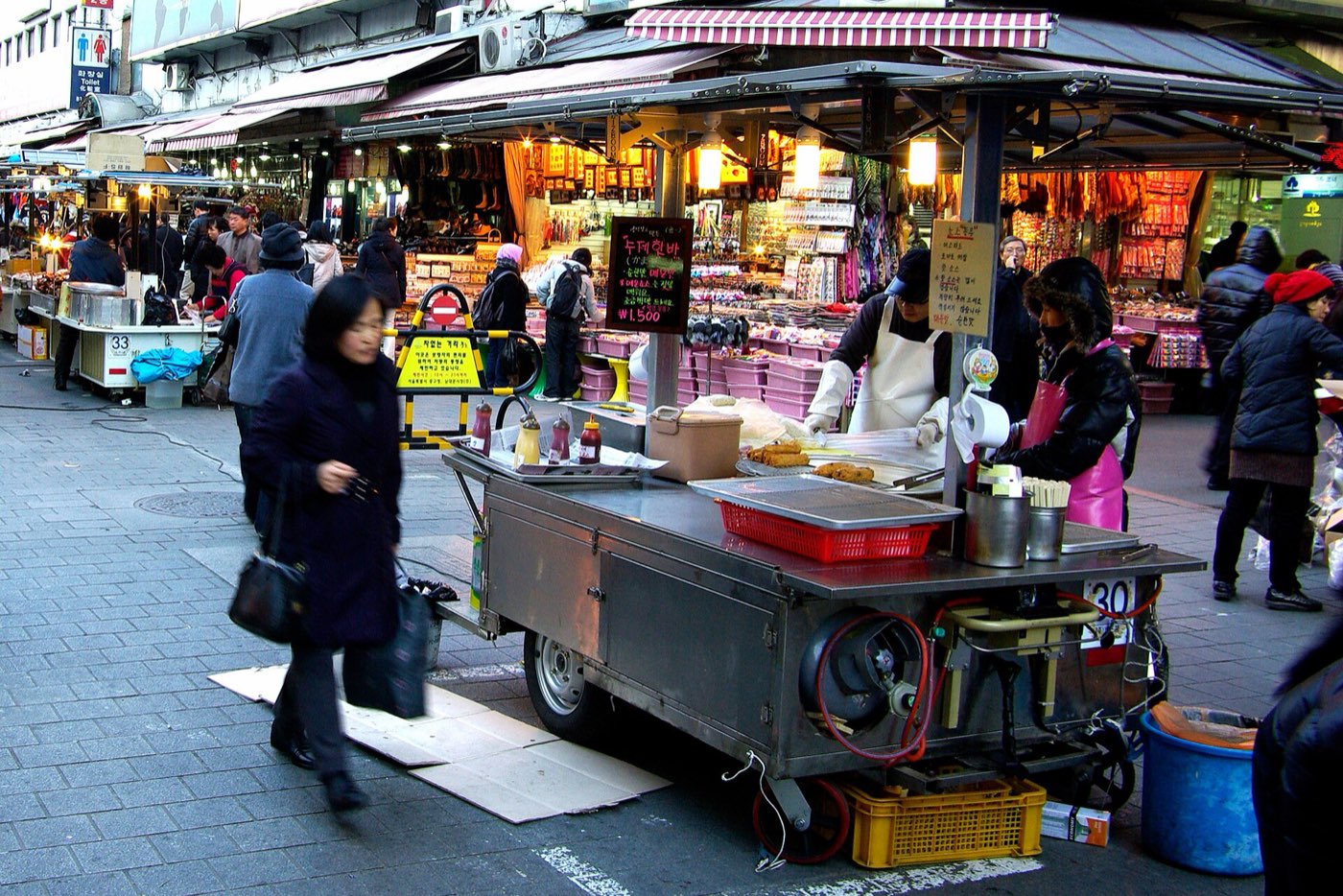
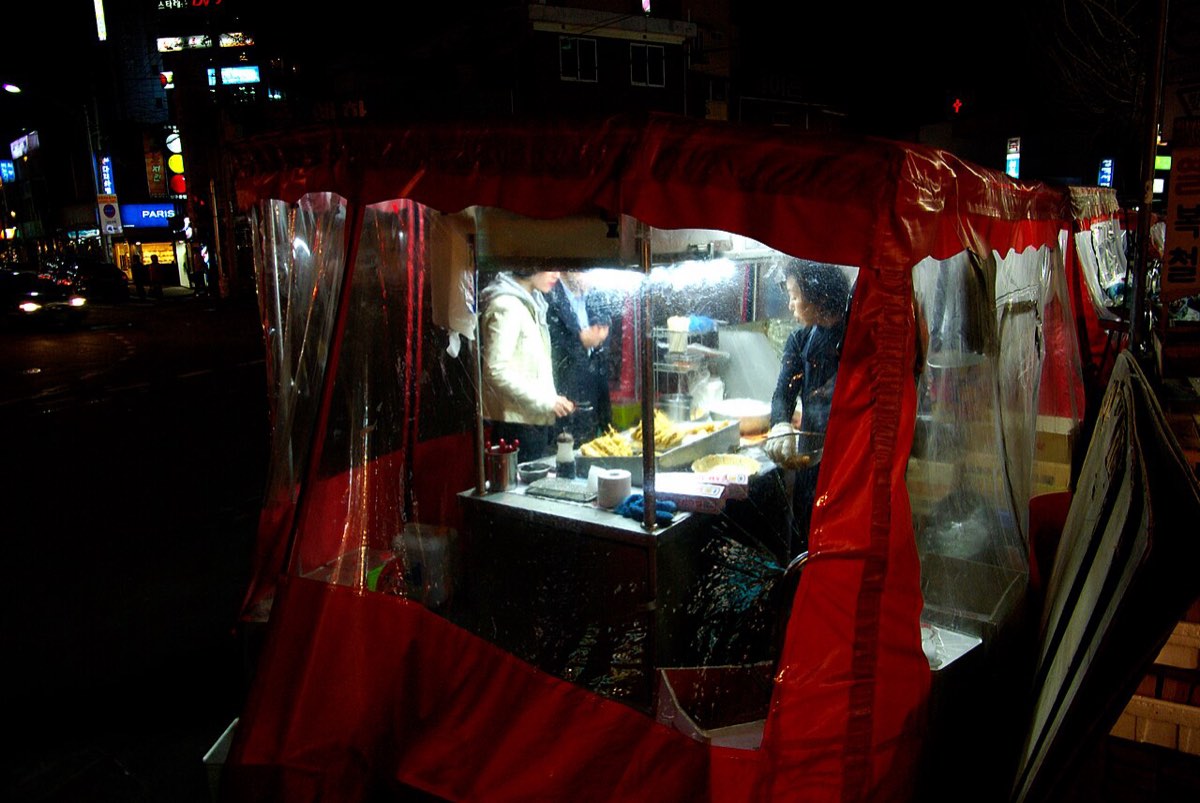
Street food in Seoul is less a cuisine than a habit: something hot, quick and cheap, eaten standing up between other plans. It comes in three settings that work differently. A bunsik (분식) counter, named for flour-based food, sells tteokbokki, gimbap, fried snacks and dumplings by the plate, and you usually sit on a stool or bench. A street stall or cart (노점, nojeom) does one or two things well, such as a fish-shaped pastry or a skewer, and you eat on the spot. A pojangmacha (포장마차), literally a covered wagon, is a tented stall that becomes a small bar after dark, where the food is anju, plates to share over soju.
Choose the setting before you choose the snack. For a first taste, a market counter with a posted price board is the easiest: you can see everything, point and sit. Carts are best for a single item on a cold afternoon. A pojangmacha is an evening out with drinks, better for two or more people than for a solo snack. Tourist streets charge noticeably more than markets for the same food, so decide whether you are paying for the spectacle or for the snack.
How a soy-sauce dish became Seoul's red snack
Tteokbokki (떡볶이) was not always red. In a March 2026 column for the Korea JoongAng Daily, agricultural economist Moon Jung-hoon notes that a 1936 newspaper ingredient chart lists rice cakes with beef, mushrooms, egg, soy sauce and sesame oil and no chili, and that recipes of the 1950s and early 1960s still stir-fried the dish in oil with soy sauce. That savory style survives as gungjung tteokbokki (궁중떡볶이), royal-court tteokbokki, which VisitKorea says you will find mainly at traditional Korean restaurants rather than on the street.
The red version spread later. Its commonly cited origin is a Sindang-dong vendor in 1953, often identified as Ma Bok-rim, who mixed black bean paste and gochujang with boiling rice cakes. Moon points out that packaged gochujang only appeared in the mid-1960s, and that red tteokbokki took hold near schools in the late 1960s as an after-school snack. Government policies promoting wheat made wheat-based rice cakes cheaper than rice ones, which is why menus still distinguish 쌀떡 (ssal-tteok, rice) from 밀떡 (mil-tteok, wheat).
Today's street version is rice or wheat cakes and fish cake simmered in sweet-spicy gochujang sauce until it turns sticky, often with boiled eggs, and VisitKorea lists newer jjajang, cream and rosé flavors too. The sauce is cooked in one large pan for the whole day, so the heat is fixed; a vendor cannot make your portion milder. If chili is new to you, try a forkful from a companion's plate before ordering your own.
The staples, decoded, and what to check before ordering
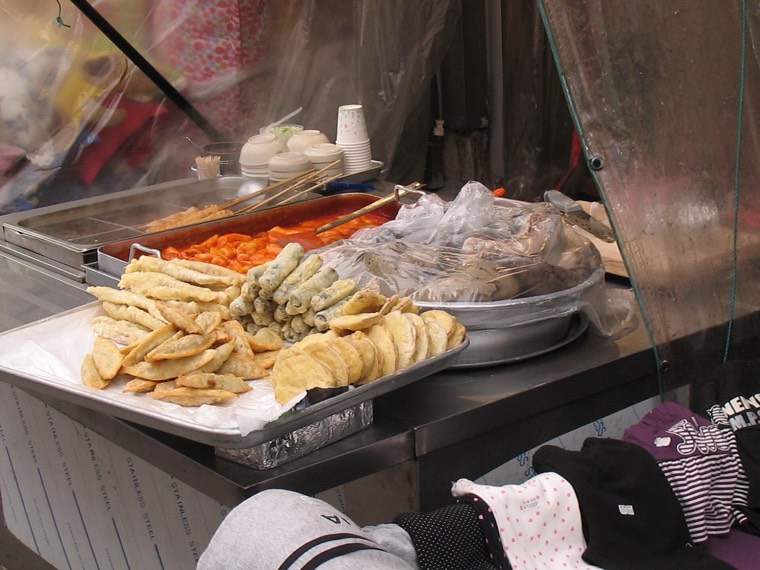
Most stalls display their food rather than a written menu, so recognizing the snacks matters more than reading Hangul. The table gives the Korean name you will see on signs, a plain description from VisitKorea and the press sources listed below, and the one thing worth checking. Winter-only items are marked, because many carts appear only when the weather turns cold.
| Snack | What it is | Check before ordering |
|---|---|---|
| 떡볶이 tteokbokki | Rice or wheat cakes and fish cake in sweet-spicy gochujang sauce | Heat is fixed; contains fish cake |
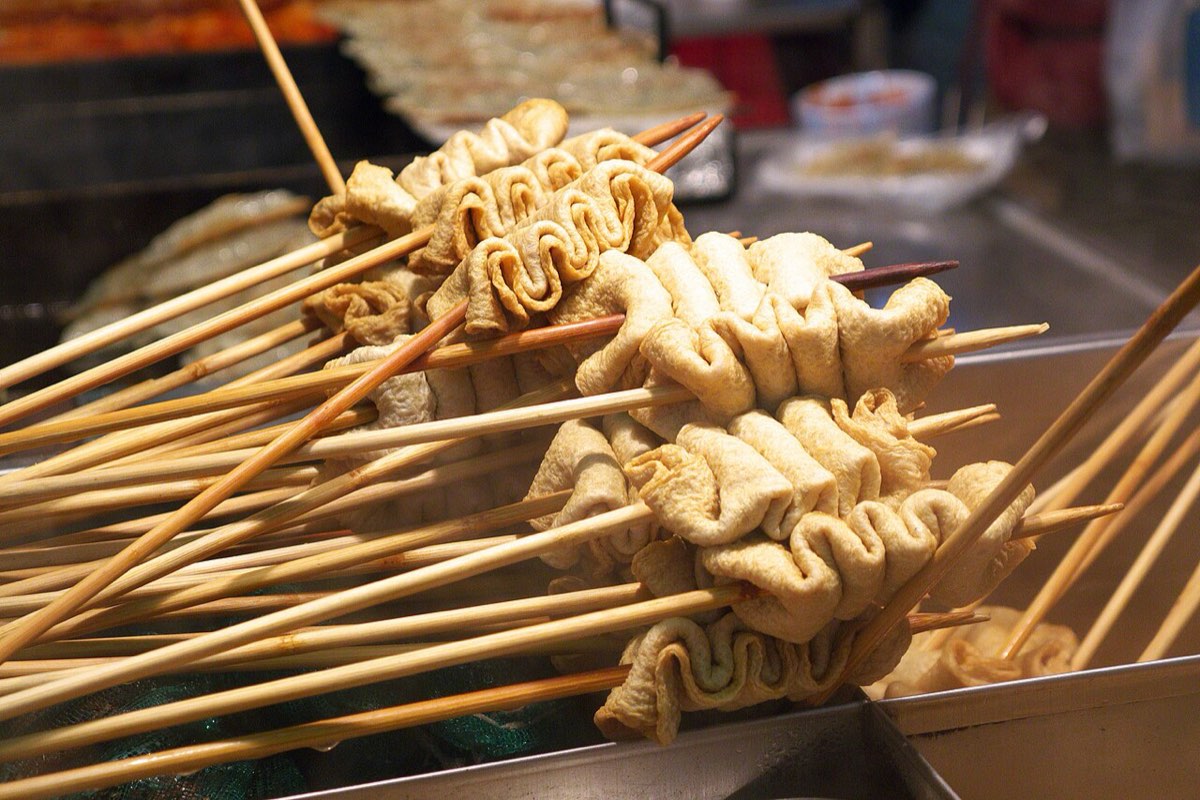
| 어묵 / 오뎅 eomuk / odeng | Fried fish-paste cakes threaded on long skewers and kept hot in broth | Fish; broth is often made with anchovy |
| 순대 sundae | Pork intestine filled with glass noodles and vegetables, steamed with pork blood | Pork and blood; served with seasoned salt or red sauce in Seoul |
| 튀김 twigim | Battered, deep-fried sweet potato, chili pepper, squid, shrimp or seaweed rolls stuffed with glass noodles | Batter ingredients vary; ask about egg or seafood |
| 김밥 gimbap | Rice and fillings rolled in dried laver and sliced | Fillings vary by stall; ask if you avoid meat or fish |
| 호떡 hotteok | Chewy dough pancake filled with brown sugar, cinnamon and nuts, fried flat (winter) | Nuts; the molten sugar is very hot |
| 붕어빵 bungeoppang | Fish-shaped pastry, classically red bean, now often custard (winter) | Batter recipe varies; ask about milk or egg |
| 계란빵 gyeranppang | Muffin-style bread baked with a whole egg (winter) | Egg and flour |
| 닭꼬치 dakkochi | Charcoal-grilled chicken skewer finished with salt, soy or spicy sauce | Ask for the non-spicy sauce |
| 떡꼬치 tteok-kkochi | Fried rice cakes on a stick glazed with sweet-spicy sauce | Mildly spicy, very sticky |
| 호빵 hoppang | Steamed bun, originally red bean or vegetable, kept in shop steamers (winter) | Fillings now range widely |
| 회오리감자 hoeori gamja | Tornado potato: a whole potato spiral-cut on a skewer, deep-fried and dusted with seasoning | Cheese powder contains dairy |
| 군고구마 / 군밤 gun-goguma / gunbam | Sweet potatoes or chestnuts roasted in their skins (winter) | Often the safest vegetarian choice |
The tteok-twi-sun plate and the fish-cake pot
At a bunsik counter the classic order is 떡튀순 (tteok-twi-sun): tteokbokki, twigim and sundae on one plate, a trio VisitKorea singles out by that very nickname. The fried pieces are meant to be dragged through the tteokbokki sauce. In Seoul, sundae comes with seasoned salt or the same red sauce, while VisitKorea notes that other regions prefer soybean paste, chili paste with vinegar, salted shrimp or soy sauce. Say so if you want the sauce on the side rather than over everything.
Eomuk (어묵) is the most useful first snack on a cold day: cheap, mild and quick. Stalls keep the long skewers in a simmering pot and pour you a paper cup of the broth to sip, which VisitKorea describes as made with anchovy and radish. Many Koreans still say odeng (오뎅), a word the Korea Times traces to the Japanese oden, while eomuk is the Korean term. The same paper notes that Japanese colonial-era factories in Busan helped establish the industry, and that fish cakes became an affordable protein after the Korean War.
At stands where you pick skewers straight from the pot yourself, keep your empty sticks in your hand or in the cup the vendor provides. They are how the vendor counts what you owe, so do not drop them in a bin until you have paid. The trio plus one fish cake makes a full, filling meal for one person, and it is the best order for anyone who wants to understand why Koreans call these snacks comfort food.
Winter snacks, and why Koreans now need a bungeoppang map
Cold weather brings out the carts. Bungeoppang (붕어빵), a fish-shaped pastry usually filled with red bean, descends from Japan's taiyaki, which reached Korea during the 1910–45 occupation, according to a December 2024 Korea Times guide. Cheap wheat flour after the Korean War made it a working-class snack through the 1960s and 1970s, and it came back during the late-1990s financial crisis. Its cousin ingeoppang (잉어빵), made with glutinous rice flour, has a chewier, thinner shell and more filling.
Prices tell the story of a shrinking trade. The Korea Times recalls bungeoppang selling at three for KRW 2,000 and reported in December 2024 that some downtown Seoul vendors were charging KRW 1,000 each. Rising costs have thinned out the carts so much that Koreans joke about living in a bungsegwon (붕세권), a neighborhood within reach of one, and Korean map services and the secondhand marketplace Karrot have built maps of where they are still sold. Searching 붕어빵 in Naver Map is a reasonable start.
Hotteok (호떡) is a chewy dough pancake folded around brown sugar, cinnamon and nuts and pressed flat in oil until the filling melts. The Korea Times cites the Korea Heritage Service's estimate that it arrived in the late 19th century with Qing merchants, and adds that Busan's seed-filled version dates from the Korean War, when refugees added seeds. Namdaemun Market's yachae hotteok swaps in glass noodles and vegetables; the Korea Times put it at KRW 2,500 in December 2024. Bite carefully, because the sugar inside is far hotter than the crust.
Gyeranppang (계란빵), a muffin-style bread with a whole egg baked into it, began in 1984 at a shop near Inha University in Incheon for customers who did not eat red bean, the Korea Times reports. Hoppang (호빵), the steamed bun, is a packaged-food story: Samlip launched it in October 1971 in red bean and vegetable versions and began supplying steamers to shops the following year, according to the Korea JoongAng Daily. VisitKorea notes that roasted sweet potatoes and chestnuts are now sold in convenience stores and subway stations as well as on the street.
Myeong-dong at dusk: spectacle, price boards and the card question
Myeong-dong is the street-food scene most visitors picture: rows of stalls down the main shopping streets, with vendors setting up one by one in the late afternoon and crowds swelling toward dusk, as Financial News described in March 2026. The menu has drifted toward showpieces for tourists. In that report, chicken skewers and a single roll of gimbap cost KRW 5,000, fruit juices KRW 5,000 to 10,000, and steak or grilled lobster around KRW 20,000, prices the paper called relatively high.
Jung District, which manages the area, supplies the price boards that many stalls now use under a fixed-price policy. The same 2026 report found QR payments such as Alipay widely accepted, but some vendors discreetly covering their card-payment signs and reacting reluctantly when customers offered a card. Read the board before you order, ask 카드 돼요? if you need to pay by card, and keep a few small notes as a fallback.
Our judgment: go to Myeong-dong for the atmosphere and one or two novelty snacks, not for value or tradition. Early evening, before the densest crowds, is the most comfortable time to walk the stalls. If you want classic bunsik at ordinary prices, or a seat while you eat, the markets below serve the same staples to a largely local clientele.
Market counters by daylight: Gwangjang, Namdaemun and Tongin
Gwangjang Market (광장시장) is the most dependable cluster. VisitKorea lists its food street at 09:00 to 23:00 and open all year, even though the market's other shops close on Sundays, and the counters there serve mung bean pancakes, mayak gimbap, sundae and tteokbokki. VisitKorea lists cards as accepted, but individual counters vary, so carry cash too. Our Gwangjang guide covers ordering, the market's price disputes and the measures Seoul has taken since.
Namdaemun Market (남대문시장), with over 10,000 stores and roots that Visit Seoul traces to King Taejong's reign, closes on Sundays; use Hoehyeon Station on Line 4. Its kalguksu alley is easy to miss: VisitKorea directs you from Exit 5 to a small transparent plastic door beside an eyeglasses shop, behind which diners sit shoulder to shoulder over knife-cut noodles and barley rice, often with cold buckwheat noodles on the side. Go on a weekday or Saturday, and combine it with a yachae hotteok.
Tongin Market (통인시장), about 515 meters from Gyeongbokgung Station Exit 2 on Line 3, is the gentlest introduction. Visit Seoul lists the market at 07:00 to 21:00, varying by shop, and points visitors to its gireum tteokbokki, rice cakes stir-fried in oil and chili rather than simmered in sauce. Its lunchbox café sells tokens you spend at stalls along the lane, and Visit Seoul gives the café's hours as 11:00 to 15:00, to 16:00 at weekends, closed on Mondays and the third Sunday of each month. Our Seochon guide explains the token system.
Jongno 3-ga's tents, and a winter evening for two
The strip of pojangmacha near Jongno 3-ga Station, on the edge of the Ikseon-dong hanok lanes, is the easiest place to try a tented stall-bar. Visit Seoul, in a page edited in June 2026, says the tents start going up around 17:00 and serve chicken feet, rolled omelet, chewy udon and seafood pancakes with cold beer and soju. Sit down, order one or two plates for the table plus drinks, and expect to stay a while: these are bars, not snack counters, and a single skewer is the wrong order.
A worked example for a winter weekday. Arrive at Gwangjang's food alley around 16:00 and share a plate of mayak gimbap and one mung bean pancake. At about 16:45, walk west along Jong-ro, buying a bungeoppang or a hotteok if you pass a cart. Reach Jongno 3-ga around 17:30 as the tents fill, and order fish-cake soup and a rolled omelet with a bottle of soju or beer between two. Finish with a walk through Ikseon-dong's lanes, having eaten from a market counter, a cart and a tent in one evening.
Ordering, paying and the words that do the work
Most exchanges at a stall take four steps: point at the food, say how many, confirm the price, pay. At counters and tent bars you usually pay when you finish; at carts you pay as you are served. Bring small notes, ask before ordering if you need to pay by card, and if a vendor asks for a bank transfer, offer cash or a card instead, since a transfer needs a Korean bank account. These phrases cover nearly every situation, and pointing does the rest.
| You want to say | Korean | Romanization |
|---|---|---|
| One of these, please | 이거 하나 주세요 | igeo hana juseyo |
| How much is it? | 얼마예요? | eolmayeyo? |
| Do you take cards? | 카드 돼요? | kadeu dwaeyo? |
| Tteokbokki, twigim and sundae, please | 떡튀순 주세요 | tteok-twi-sun juseyo |
| Sauce on the side, please | 소스는 따로 주세요 | soseuneun ttaro juseyo |
| Is it spicy? | 매워요? | maewoyo? |
| Is there meat in this? | 고기 들어가요? | gogi deureogayo? |
| To take away, please | 포장해 주세요 | pojanghae juseyo |
Heat, fish, pork and the empty-skewer problem
Spice and diet need planning, because labels are rare on the street. The mildest staples are eomuk, gyeranppang, hotteok, roasted sweet potatoes and sundae with salt. For vegetarians, the honest picture is that fish runs through the core menu: tteokbokki contains fish cake, eomuk is fish and its broth is commonly anchovy-based, and sundae is filled pork intestine steamed with blood. Roasted sweet potatoes and chestnuts are the safest choices; hotteok and bungeoppang usually are, but ask about the batter. Anyone with a nut allergy should treat hotteok as off limits.
Eat at the stall rather than walking off with a dripping cup of broth, and hand your cup and skewers back to the vendor when you finish. Public bins are scarce: the Korea Times reported in 2023 that Seoul had 4,956 street bins, down from 7,607 in 1995, after a volume-based waste fee led people to dump household rubbish in them and the city removed many. The city has said it will add bins back, but carry a small bag for wrappers, and never leave skewers on walls, steps or shop windowsills.
Questions visitors ask
Can I pay by card at Seoul street food stalls?
Often, but not everywhere. Gwangjang Market's listing says cards are accepted, and many Myeong-dong stalls display card signs, yet a March 2026 report found some Myeong-dong vendors hiding them and reluctant to take cards. Market counters and carts vary. Ask 카드 돼요? before ordering, carry 1,000- and 5,000-won notes as a fallback, and decline any request to pay by bank transfer.
Where should I go for street food on a first trip to Seoul?
Gwangjang Market's food alley if you want classic dishes at counters where you can sit and see prices; it runs 09:00 to 23:00 every day. Myeong-dong in the early evening if you want the stall-lined spectacle and novelty snacks, at noticeably higher prices. Tongin Market near Gyeongbokgung is the calmest option, with its token lunchbox and oil-fried tteokbokki.
What can vegetarians eat from Korean street stalls?
Roasted sweet potatoes and chestnuts are the safest choices, and sweet hotteok and red-bean bungeoppang usually work, though batters vary. Avoid assuming that anything red or fried is meat-free: tteokbokki contains fish cake, eomuk broth is commonly anchovy-based, and sundae is pork intestine steamed with blood. Ask 고기 들어가요? and name fish separately.
When is street food season in Seoul?
Staples such as tteokbokki, gimbap and fish cakes are sold all year at markets and bunsik counters. The carts selling bungeoppang, hotteok, gyeranppang, roasted sweet potatoes and chestnuts are a cold-weather tradition, and convenience stores bring out steamed hoppang buns in winter. In summer, markets and Myeong-dong's evening stalls are the dependable options.
Is it rude to eat while walking in Seoul?
It is not forbidden, but stall food is designed to be eaten where you buy it: broth comes in a cup, sauces drip and vendors take back cups and skewers. Eating at the stall also solves the problem of Seoul's scarce public bins. On crowded shopping streets, step to the side rather than eating in the middle of the flow.
Sources and method
Written for: First- and second-time visitors to Seoul who want to eat from stalls, carts and market counters with confidence: what to order, where, how to pay and what is in it.
Method: Researched from the official sources listed below, checked on October 20, 2026. Hours, fees and booking rules can change; the linked official pages are the final word. Spotted something out of date? Tell us.
- VisitKorea — Street Food Loved by KoreansTteokbokki ingredients, gochujang sauce, newer flavors and royal-court tteokbokki at traditional restaurants; the tteok-twi-sun trio; twigim types and dipping in tteokbokki sauce; sundae ingredients and regional sauces (seasoned salt or tteokbokki sauce in Seoul). Dated December 2023.
- VisitKorea — Winter Street Food Battle: What's Your Pick?Eomuk skewers with a cup of hot soup; bungeoppang fillings; hotteok with brown sugar, cinnamon and nuts; gyeranppang; dakkochi seasonings; tteok kkochi; roasted chestnuts and sweet potatoes at convenience stores and subway stations. Updated November 2025.
- VisitKorea — Fishcake (Eomuk)Fish paste deep-fried and sold on skewers; stalls boil them in anchovy and radish broth; popular in winter. Dated October 2023.
- The Korea Times — Ultimate guide to Seoul's winter street foodDecember 25, 2024: bungeoppang history (taiyaki, colonial period, postwar flour, 1990s revival), prices (once three for KRW 2,000; some downtown vendors KRW 1,000 each), bungsegwon and maps by map services and Karrot; ingeoppang; hotteok name and Korea Heritage Service dating, Busan seed hotteok; Namdaemun yachae hotteok KRW 2,500; gyeranppang 1984 near Inha University; eomuk vs odeng, paper cup of broth, Busan factories.
- Korea JoongAng Daily — How spicy red tteokbokki became a national street foodMarch 19, 2026 column by Moon Jung-hoon: 1936 soy-sauce recipe, 1950s–60s oil and soy versions, the commonly cited 1953 Sindang-dong origin, mid-1960s packaged gochujang, late-1960s school snacks, wheat-based rice cakes.
- Korea JoongAng Daily — The firm that brought steamed buns homeSamlip hoppang launched October 1971 in red bean and vegetable versions; steamers supplied to shops from 1972; name from the sound of blowing on hot food.
- Korea JoongAng Daily — Street food can be scrumptiousTornado potatoes in Myeong-dong: spiral-cut potato on a wooden skewer, deep-fried and dusted with cheese powder (2007 report; its prices are not used).
- Financial News (fnnews) — Myeong-dong street stalls ahead of BTS concertMarch 8, 2026: stalls set up in the late afternoon; chicken skewers and single gimbap rolls KRW 5,000, juices KRW 5,000–10,000, steak and grilled lobster about KRW 20,000; Jung District price boards; some vendors covering card signs; QR payments such as Alipay.
- VisitKorea — Gwangjang MarketFood street 09:00–23:00, open year-round; market shops closed Sundays; cards accepted.
- Visit Seoul — Namdaemun MarketOver 10,000 stores; origins under King Taejong; closed Sundays; Hoehyeon Station (Line 4). Edited September 10, 2026.
- VisitKorea — Namdaemun Market Gourmand Alley (Kalguksu Alley)Hoehyeon Exit 5; small transparent plastic door next to an eyeglasses shop; kalguksu and barley rice sets, often with cold buckwheat noodles; hours vary by shop.
- Visit Seoul — Tongin MarketMarket 07:00–21:00 (varies by store); lunchbox café 11:00–15:00, weekends to 16:00, closed Mondays and the third Sunday; tokens spent at participating stalls; gireum tteokbokki; Gyeongbokgung Exit 2, about 515 m. Edited September 10, 2026.
- Visit Seoul — Embracing the Yajang Culture in SeoulJongno 3-ga pojangmacha street near the Ikseon-dong hanok alleys; tents from around 17:00; chicken feet, rolled omelet, udon and seafood pancakes with beer and soju. Edited June 16, 2026.
- The Korea Times — Lack of trash cans on Seoul streets causes mess, inconvenienceOctober 2023: 4,956 public bins in Seoul, down from 7,607 in 1995; removals after the volume-based waste fee; city plans to add bins.