In shortBukchon is a lived-in neighborhood between Gyeongbokgung and Changdeokgung palaces, not a ticketed attraction. Its most photographed lane, Bukchon-ro 11-gil, is a red zone where tourists may walk only from 10:00 to 17:00, and an officer can fine you KRW 100,000 if you ignore a warning to leave. Arrive soon after 10 on a weekday, keep your voice down, and pair the walk with a palace.
Key facts
- Korean name
- 북촌한옥마을 (Bukchon Hanok Maeul)Naver Map
- Red zone tourist hours
- 10:00–17:00 daily, Bukchon-ro 11-gil (북촌로11길)
- Fine in the red zone
- KRW 100,000, enforced since March 1, 2025
- Admission
- None; these are public residential streets
- Nearest subway
- Anguk Station (Line 3), Exit 3
- Map search term
- 북촌문화센터 (Bukchon Traditional Culture Center)Naver Map
- Culture Center hours
- Tue–Fri 9:00–18:00; Sat–Sun 9:00–17:00; closed Mondays
Checked Oct 20, 2026 against the official sources listed at the end of this guide.
A neighborhood that people still come home to
Bukchon (북촌, literally the northern village) fills the south-facing slope between Gyeongbokgung (경복궁) and Changdeokgung (창덕궁), the two great palaces of the Joseon dynasty (1392–1910). The location explains its history. Living within a short walk of the throne meant influence, and Seoul's hanok portal notes that in 1906 about 44 percent of Bukchon's residents were nobles or government officials. Gahoe-dong, Gye-dong and Samcheong-dong, the sub-districts you will cross, were addresses that signaled rank.
Most of what you see today, however, is not a Joseon mansion. From the 1910s into the 1930s, as large estates were broken up, housing developers bought big plots, divided them into small lots and filled them with standardized hanok set shoulder to shoulder. The houses kept timber frames and tiled roofs but gained glass doors and eaves extended with galvanized-iron sheeting. The best-known builder, Jeong Se-kwon (정세권, 1888–1965), founded the firm Geonyangsa around 1920 and developed much of Gahoe-dong and Samcheong-dong; Seoul's own history writers go as far as saying that without him there would be no Bukchon as we know it.
That history matters for how you visit. These are family homes, not reconstructions, and for years residents lived with visitors in their lanes from early morning until late at night. In July 2024 Jongno-gu (종로구), the district government, made Bukchon the first area in Korea designated by a local government as a special management area under the Tourism Promotion Act. Read every lane as someone's front step and both the rules and the architecture make more sense.
The 10-to-5 rule and what each colored zone means
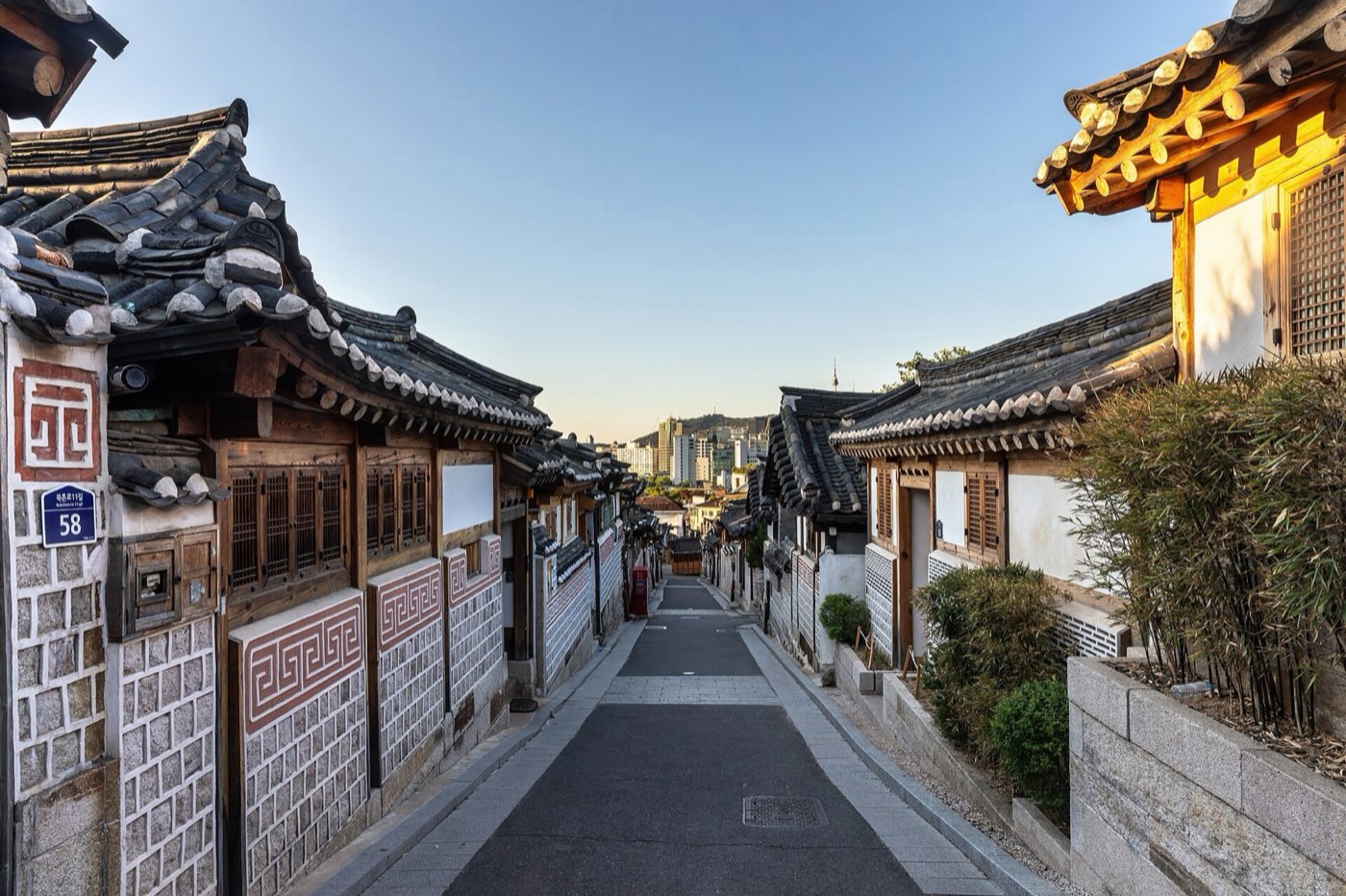
The district sorted Bukchon by how heavily residents are affected. The strictest area, the red zone, covers roughly 34,000 square meters around Bukchon-ro 11-gil in Gahoe-dong, the steep lane of tiled roofs that appears in most Bukchon photographs. Tourists may be there only from 10:00 to 17:00. A guidance period began on November 1, 2024, fines started on March 1, 2025, and Visit Seoul's listing, edited in September 2026, still shows the same hours. A June 2026 Yonhap report likewise describes the hour limits as in force. Seoul's English notice also names Sunday a rest day for the alleys; it is a request rather than a fined rule, but one more reason to come on a weekday.
Enforcement is graduated. An officer first tells you that you are inside restricted hours and asks you to leave; the KRW 100,000 fine applies if you stay. According to the district's announcement, photographing, strolling and lingering for sightseeing all count as tourism. Residents and their relatives, people going to a business inside the zone and people simply passing through are exempt, so a booked dinner or a hanok stay is not a violation. A selfie session at 6 p.m. is.
The orange and yellow zones carry no hour limit; instead, staff guide visitors and the district watches numbers, a signal of where the next restrictions could come if behavior does not improve. Charter buses are also barred at all times from about 2.3 kilometers of Bukchon-ro, Bukchon-ro 5-gil, Bukchon-ro 4-gil and Changdeokgung 1-gil; after a guidance period from July 2025, fines starting at KRW 300,000 have applied since January 1, 2026. If you join a group tour, expect to be dropped outside the area and to walk in.
| Zone | Where | What it means for you |
|---|---|---|
| Red | Bukchon-ro 11-gil, Gahoe-dong (about 34,000 m²) | Tourists 10:00–17:00 only; KRW 100,000 fine after a warning |
| Orange | Bukchon-ro 5ga-gil and Gyedong-gil | No hour limit; staff guide visitors and ask for quiet |
| Yellow | Bukchon-ro 12-gil | No hour limit; visitor numbers are monitored |
| Charter-bus zone | Bukchon-ro, Bukchon-ro 5-gil, Bukchon-ro 4-gil, Changdeokgung 1-gil (about 2.3 km) | No charter buses at any time; fines since January 1, 2026 |
How to read a hanok from the lane
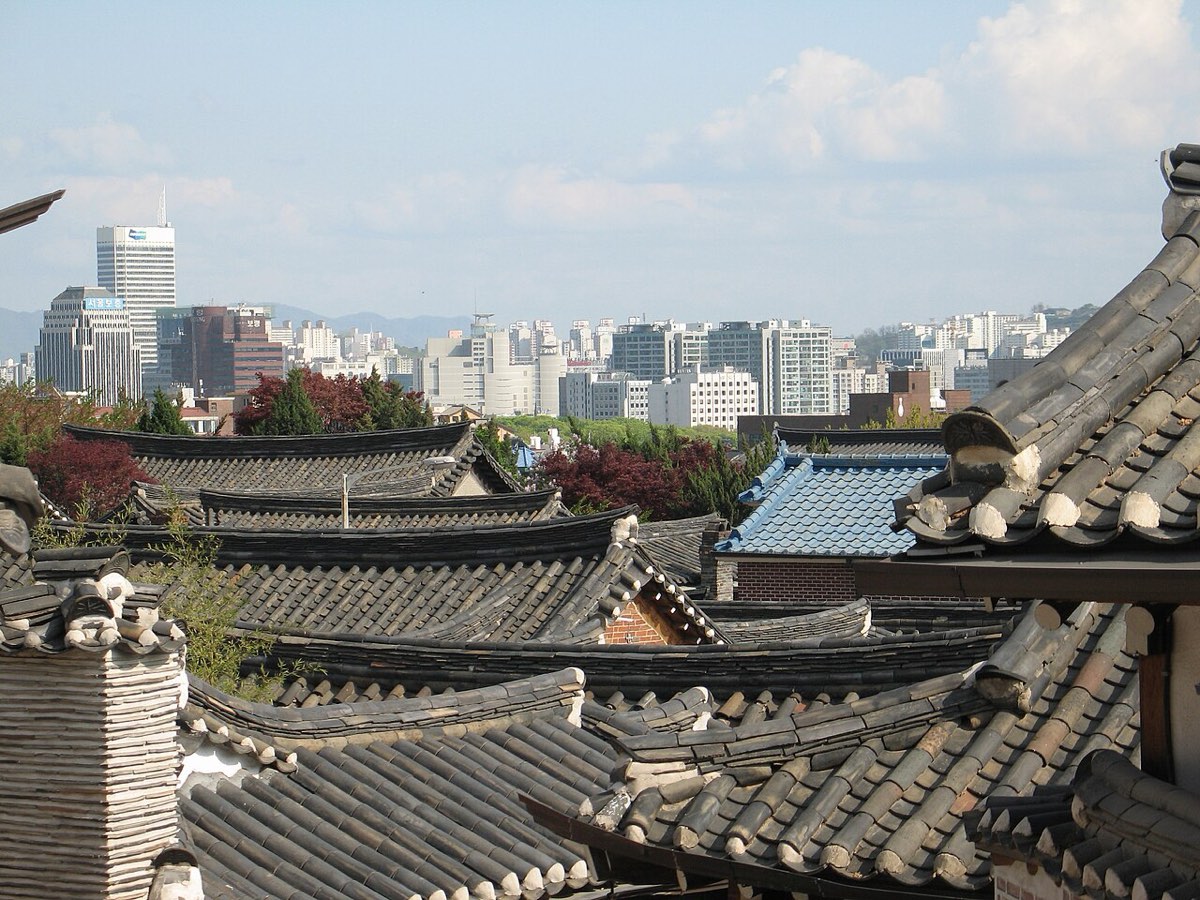
You will rarely be invited inside a Bukchon house, so learn to read one from outside, starting at the top. Giwa (기와) are fired clay roof tiles laid in two interlocking kinds: broad concave amkiwa (암키와) that carry rainwater down the slope, and narrow convex sukiwa (수키와) that cap the seams. At the eaves the rows end in round or crescent end tiles, often stamped with a pattern. Seoul's own legal definition of a hanok rests on exactly these two things: a timber frame of columns, beams and purlins, and a roof in the traditional tiled style.
Next, look at the cheoma (처마), the eaves. Hanok eaves project well beyond the walls and lift gently at the corners. The overhang is climate engineering as much as decoration: it shades rooms from the high summer sun, lets low winter light reach deep inside, and keeps rain off timber posts and paper-covered doors. In Bukchon you will often spot a strip of metal sheeting extending the eave line, one of the 1920s and 1930s adaptations that let traditional houses cope with tight city lots and shared walls.
Two features shape the house even though you can barely see them. The madang (마당) is the open yard; on Bukchon's small plots, rooms wrap around a compact courtyard in an L, U or closed square plan, so from an open gate you might glimpse only a square of sky framed by eaves. Ondol (온돌) is underfloor heating: heat and smoke from a firebox travel through flues beneath stone slabs before leaving by a chimney, which is one reason hanok rooms sit on a raised stone base and why people traditionally sit and sleep on the floor. Beside the heated rooms, a raised wooden-floored hall called a maru (마루) stays cool in summer.
Social rank shows in the plan, too. Wealthy Joseon households spread across several buildings: the anchae (안채), the inner quarters where the women of the family lived; the sarangchae (사랑채), where the master received guests; and the haengnangchae (행랑채), a row of servants' rooms that often contained the main gate. Seoul's hanok portal notes that upper-class houses kept men and women, and seniors and juniors, apart with low walls. Bukchon's 1920s and 1930s houses compressed all of this into a single compact block, which is why most gates here open straight onto one small courtyard.
Reading from the lane also means knowing where to stop. Visit Seoul asks visitors not to photograph or film the inside of houses even when doors are open, and a stone step up to a gate is still private property. A long lens pointed into a courtyard is exactly the behavior that pushed the district to regulate.
Viewpoints worth the climb, and the one that needs timing
A set of signposted photo points called the Bukchon 8 Views (북촌8경) runs from a view of Changdeokgung's halls over the palace wall to a stone stairway that drops toward Samcheong-dong. The markers are useful for orientation, but you do not need all eight. Three give most of the payoff, and they can be linked in about ninety minutes at a relaxed pace.
Start with the palace view, which many visitors walk straight past: it is one of the few places where you look down onto Changdeokgung's tiled roofs rather than up at them. Then cross into Gahoe-dong and the dense cluster known as Gahoe-dong 31 (가회동 31번지), where Visit Seoul specifically asks for extra quiet. Finish on Bukchon-ro 11-gil, whose downhill run of rooflines stepping toward the high-rises of central Seoul is the postcard image. Because it sits in the red zone, that view is available to you only between 10:00 and 17:00.
Timing changes everything here. On weekdays the lanes are calmest soon after 10, before groups and hanbok-rental parties build toward midday. Late autumn and winter light rakes low across the giwa and picks out every tile edge, while a rainy day shows the roof drainage working. Shoot from the side of the lane rather than its center, keep it quick, and step aside for residents, delivery riders and the occasional car, since these alleys are their only way home.
Bukchon manners, translated into actions
The district calls its approach silent tourism, and Visit Seoul's listing turns it into concrete requests. Most visitors who annoy residents do so out of ignorance, not rudeness: sound carries in lanes lined with tiled walls, and a group pausing outside one gate is, for the family inside, a crowd in the front yard. Here is what the rules look like on the ground.
- Keep voices low everywhere, and especially around Gahoe-dong 31; no shouting, horseplay or loud video narration.
- Keep groups to 10 people or fewer, and leave microphones, megaphones and portable speakers off.
- Do not photograph or film into houses, even when a gate is standing open.
- Do not sit on doorsteps, lean on gates or climb onto stone bases for a better angle.
- Carry your litter and coffee cups out with you.
- Leave Bukchon-ro 11-gil by 17:00 unless you are going to a business inside the zone.
- Give way to residents, delivery scooters and cars in the narrow lanes.
Begin inside a real hanok at the Bukchon Traditional Culture Center
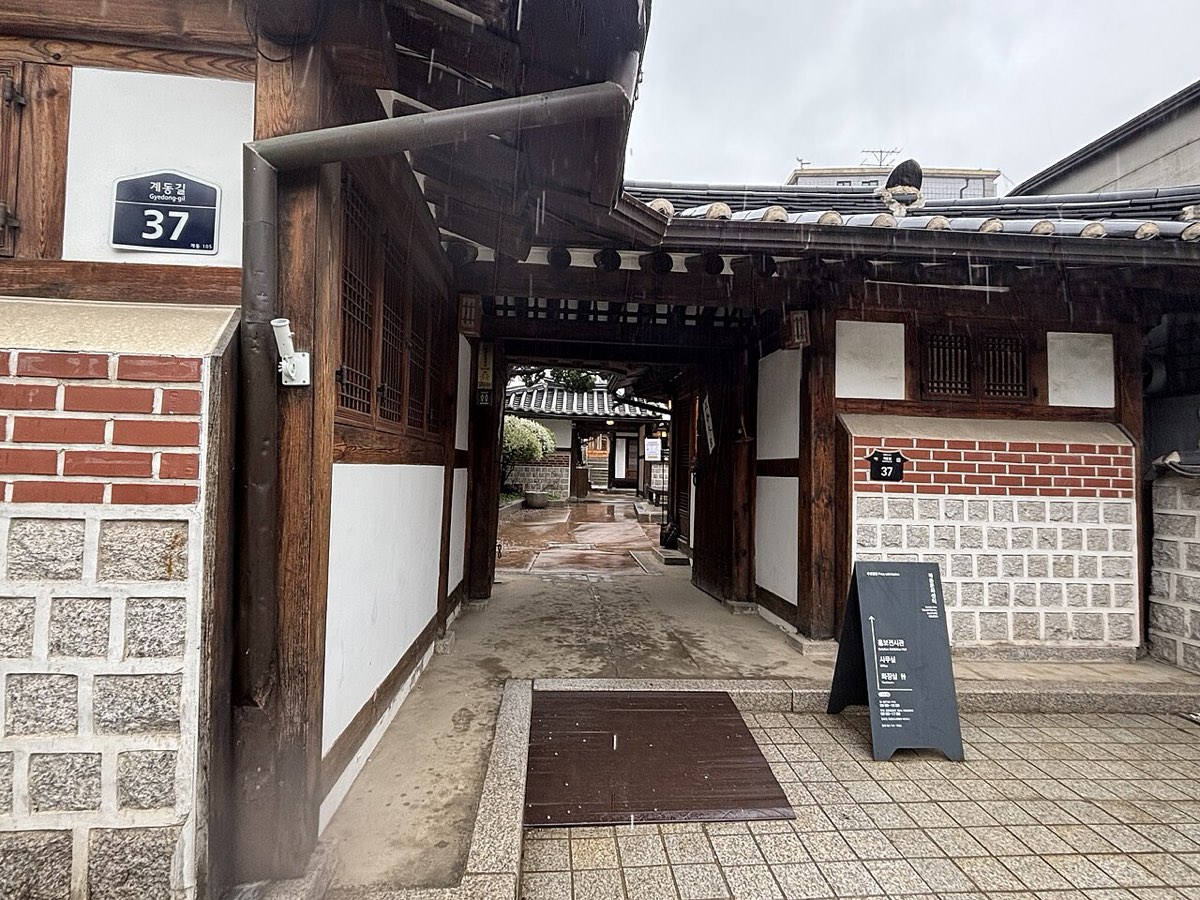
Before you climb, stop at the Bukchon Traditional Culture Center (북촌문화센터) at 37 Gyedong-gil, about five minutes on foot from Anguk Station Exit 3 on Line 3. It occupies a restored hanok long known as the house of Min Hyeong-gi (recent research suggests it belonged to his wife, Yu Jin-gyeong), a registered cultural heritage building that once included an inner quarters, an outer quarters, servants' wings and a family shrine. Opened in October 2002, it now serves residents and visitors alike.
This is the easiest place in Bukchon to stand in a courtyard and see a maru and the layered roofs up close, which makes the lanes outside far easier to read. The information hall covers the neighborhood's history and preservation, and the center runs traditional culture classes in its main hall. Seoul's Korean-language hanok portal lists hours of 9:00 to 18:00 from Tuesday to Friday (to 20:00 on Wednesdays) and 9:00 to 17:00 on weekends; the center is closed on Mondays. Type 북촌문화센터 into Naver Map or Kakao Map. Gyedong-gil itself is an orange-zone street, so the same quiet applies on the way.
A palace-to-palace morning that respects the clock
Bukchon's visiting window slots neatly between two palaces, and the walk itself is the connecting route. Here is a weekday plan that keeps you inside the red-zone hours without rushing. Begin at Changdeokgung at opening time and give its main halls about an hour; leave Huwon, the separately ticketed rear garden, for another day unless you have booked it. Around 10:15, walk west from Donhwamun, the main gate, to Gyedong-gil and spend twenty minutes at the culture center.
From about 10:45, climb to the palace viewpoint, cross to Gahoe-dong 31, then walk Bukchon-ro 11-gil while the morning light is still on the roofs. Around noon, take the stone stairway down into Samcheong-dong for lunch, then walk roughly fifteen minutes west to Gyeongbokgung for the afternoon. If your day starts at Gyeongbokgung instead, simply reverse it and aim to reach Bukchon by early afternoon, leaving plenty of margin before 17:00.
One planning caution: Changdeokgung and the culture center close on Mondays and Gyeongbokgung on Tuesdays, so this route works best from Wednesday to Friday; when a palace's closing day falls on a public holiday it opens and closes on the next non-holiday instead, as the Royal Palaces and Tombs site (royal.khs.go.kr) explains. Our separate guides to Gyeongbokgung and to Changdeokgung's Huwon cover tickets and timed entry in detail.
When Bukchon is packed: Seochon, Namsangol or Eunpyeong instead
If you arrive to find Bukchon-ro 11-gil shoulder to shoulder, you have better options than queuing for a photograph. Seochon (서촌), on the west side of Gyeongbokgung, has urban hanok mixed in with ordinary houses, a traditional market and small literary museums. It offers fewer postcard views but far more everyday life, and it suits a second visit to Seoul especially well.
If what you really want is to stand inside hanok yards, go to Namsangol Hanok Village (남산골한옥마을) at the foot of Namsan, where relocated late-Joseon houses of families from different social ranks are open to walk into, and nobody lives behind the gates. It is the better classroom for hanok architecture, and it combines easily with Namsan and Myeong-dong.
For a contemporary take, Eunpyeong Hanok Village (은평한옥마을) is a newer development of neatly built modern hanok with Bukhansan's granite peaks behind it and Jingwansa temple a short walk uphill. It is a residential area too, so the same courtesy applies. Visit Seoul's route is Gupabal Station (Line 3) Exit 4, then bus 7723 or 7211 to the Hanago, Samcheonsa, Jingwansa Entrance stop. Budget a half day.
Our judgment: Bukchon is irreplaceable for one thing, the view of a living hanok neighborhood rolling downhill toward a modern city. For understanding how a hanok works, the culture center plus Namsangol will teach you more, with less friction for you and for the people who live in Bukchon.
Questions visitors ask
Can I walk around Bukchon in the evening?
Not in the red zone on Bukchon-ro 11-gil, where tourist visits are restricted from 17:00 to 10:00. If you have a dinner booking or a hanok stay inside the zone, the district treats you as a customer or guest rather than a sightseer. The orange and yellow zones have no hour limit, but they are still residential streets, so keep evening visits short and quiet.
Is there an entrance fee for Bukchon Hanok Village?
No. Bukchon is a neighborhood of public streets, not a fenced site, so there is no ticket or gate. Individual museums, workshops and cafés inside hanok set their own prices. The only charge you can incur in the lanes themselves is the KRW 100,000 fine for staying in the red zone outside 10:00 to 17:00 after an officer has warned you.
How long should I spend in Bukchon?
Ninety minutes to two hours covers the culture center, the Changdeokgung viewpoint, Gahoe-dong 31 and Bukchon-ro 11-gil at an unhurried pace. Add an hour if you want lunch or tea in Samcheong-dong afterward. Combined with one palace, it makes a full and comfortable morning or afternoon.
Can I go inside a hanok in Bukchon?
Private homes are off limits, and you should not photograph into them. You can enter the Bukchon Traditional Culture Center, hanok that operate as museums, shops or cafés, and licensed hanok stays. For walking freely through several historic houses and courtyards, Namsangol Hanok Village is the better choice.
Is Bukchon worth it if I only have one day in Seoul?
Yes, if you combine it with Gyeongbokgung or Changdeokgung, because Bukchon sits between them and the walk costs you almost no extra time. Go between 10:00 and noon on a weekday. If your day falls on a weekend afternoon, consider seeing the palace and saving your hanok time for Namsangol or Seochon.
Sources and method
Written for: First-time independent visitors who want to see Bukchon's hanok lanes without breaking the visiting-hour rules or disturbing the people who live there.
Method: Researched from the official sources listed below, checked on October 20, 2026. Hours, fees and booking rules can change; the linked official pages are the final word. Spotted something out of date? Tell us.
- Visit Seoul (Seoul Tourism Organization) — Bukchon Hanok VillageVisiting hours 10:00–17:00, restricted hours, silent-tourism requests (groups of 10, no filming interiors, Gahoe-dong 31), Anguk Exit 3; page edited September 2026.
- Seoul Metropolitan Government — Notice on Restrictions for Tourist Visits to Bukchon Special Management AreaRed zone (Bukchon-ro 11-gil, about 34,000 m²), 17:00–10:00 restriction, KRW 100,000 fine, guidance from Nov 1, 2024, fines from Mar 1, 2025; charter-bus zone with fines from Jan 1, 2026; orange zone (guidance) and yellow zone (monitoring) without hour limits; Sunday as a rest day for the alleys.
- Jongno-gu Office (Jongno Culture Platform) — 북촌 특별관리지역 안내 (Bukchon special management area rules and FAQ)July 1, 2024 designation under the Tourism Promotion Act; red-zone hours and KRW 100,000 fine; warning-then-fine by Bukchon officers; what counts as tourism; exemptions for residents, relatives, guests and shop customers; Bukchon-ro 12-gil yellow zone; charter-bus streets (Bukchon-ro, 5-gil, 4-gil, Changdeokgung 1-gil), guidance from July 2025 and fines from Jan 1, 2026.
- Financial News (Yonhap report) — Jongno-gu review of hanok stays in Bukchon (June 1, 2026)Confirms visiting-hour limits remain in force in 2026; growth of hanok-stay businesses in Bukchon.
- YTN — Jongno-gu designates Bukchon Korea's first special management area (July 2, 2024)July 2024 designation, first in Korea; red zone (Bukchon-ro 11-gil), orange zone (Bukchon-ro 5ga-gil, Gyedong-gil) with guidance and no hour limit, yellow zone (Bukchon-ro 12-gil) with monitoring.
- Seoul Hanok Portal — BukchonLocation between the palaces, 1906 share of nobles and officials, 1910s–1930s standardized urban hanok with glass doors and galvanized-iron eaves, Gahoe-dong 31.
- Seoul Hanok Portal — 북촌문화센터 소개 (Bukchon Traditional Culture Center, Korean)Address and Anguk Exit 3 directions; hours Tue–Fri 09:00–18:00, Sat–Sun 09:00–17:00, closed Mondays, Wednesdays to 20:00; Min Hyeong-gi / Yu Jin-gyeong house, registered heritage, October 2002 opening, programs.
- Seoul Hanok Portal — Definition of HanokLegal definition (timber frame of columns and purlins, traditional tiled roof); ondol, maru and yard as core elements; L, U and square layouts on the structure tab.
- Seoul Mediahub — The story of 'architecture king' Jeong Se-kwon (Nov. 2025)Jeong Se-kwon's dates, Geonyangsa founded around 1920, development of Gahoe-dong, Samcheong-dong and Ikseon-dong.
- Visit Seoul — Eunpyeong Hanok VillageModern hanok at the foot of Bukhansan, Jingwansa nearby, Gupabal Exit 4 and bus 7723/7211 route; page edited September 2026.