In shortGive Gyeongbokgung (경복궁) two to three hours on any day except Tuesday, arrive before 10:00, and walk the central line from Gwanghwamun gate through the throne hall to the queen's quarters before detouring to the Gyeonghoeru and Hyangwonjeong pavilions. Adult admission is 3,000 won, free in a qualifying hanbok, and the guard-changing ceremony runs at 10:00 and 14:00.
Key facts
- Korean name / map search
- 경복궁 (Gyeongbokgung)Naver Map
- Closed
- Tuesdays (if a Tuesday is a public holiday, it closes the next non-holiday instead)
- Hours
- 09:00–18:00 Mar–May and Sep–Oct; 09:00–18:30 Jun–Aug; 09:00–17:00 Nov–Feb; last entry 1 hour before
- Adult admission
- 3,000 won (foreign visitors aged 19–64); free for 18 and under, 65 and over, and hanbok wearers
- Guard changing ceremony
- 10:00 and 14:00, about 20 minutes, Heungnyemun forecourt
- Nearest subway
- Gyeongbokgung Station (Line 3), Exit 5, about 2 minutes on foot
- Founded / rebuilt
- 1395 / completed 1867
Checked Oct 20, 2026 against the official sources listed at the end of this guide.
Why Gyeongbokgung runs in one straight line
Gyeongbokgung (경복궁) was the first and principal palace of the Joseon (조선) dynasty, completed in 1395, three years after the kingdom was founded. King Taejo had the scholar-official Jeong Do-jeon (정도전) name it, and he drew the phrase from the Chinese Book of Songs; the official reading is a wish that the new dynasty would enjoy great fortune and prosper. The site was chosen for its setting. Bugaksan (북악산) rises directly behind the throne hall, and the avenue of government ministries, today's Sejong-daero, ran south from the main gate.
The plan is political philosophy you can walk. The palace's own visitor notes compare it with Beijing's Forbidden City: both line up their key halls from south to north, but Gyeongbokgung is narrow and very deep rather than broad, and it has no moat because the mountain behind it was considered protection enough. Heading north, you move from public ritual to government business to private life, ending in a small garden. Any building on that central line outranks the ones beside it, and that single idea will make sense of everything you see.
Expect a reconstruction rather than a medieval original. The palace burned during the Japanese invasion of 1592 and lay in ruins for roughly 270 years until King Gojong's government rebuilt it, finishing in 1867 on a far larger scale than the first palace. Under Japanese colonial rule most buildings were torn down for a 1915 industrial exhibition, and in 1926 the Government-General building was planted in front of the throne hall. It was demolished between 1995 and 1997, and restoration has continued since. The bright paint is careful modern work on a 19th-century plan.
Gwanghwamun to Geunjeongjeon: the ceremonial front
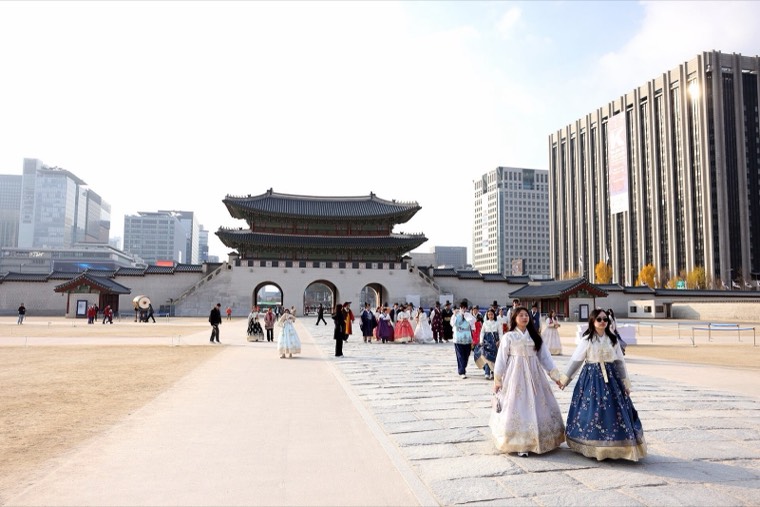
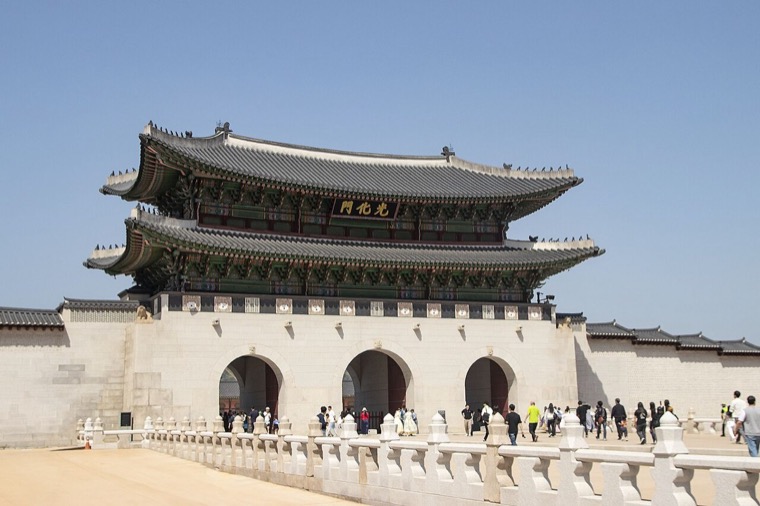
You enter through Gwanghwamun (광화문), the main gate, and cross a broad stone forecourt to Heungnyemun (흥례문), where tickets are checked. Beyond it, the bridge Yeongjegyo (영제교) carries you over a stone-lined channel. Crossing water before approaching the throne is a recurring device in Korean palaces: it marks the line between the ordinary world and the king's ritual space. Slow down on the bridge and look at the carved stone creatures crouching on the embankments, which most people walk straight past on their way to the big hall.
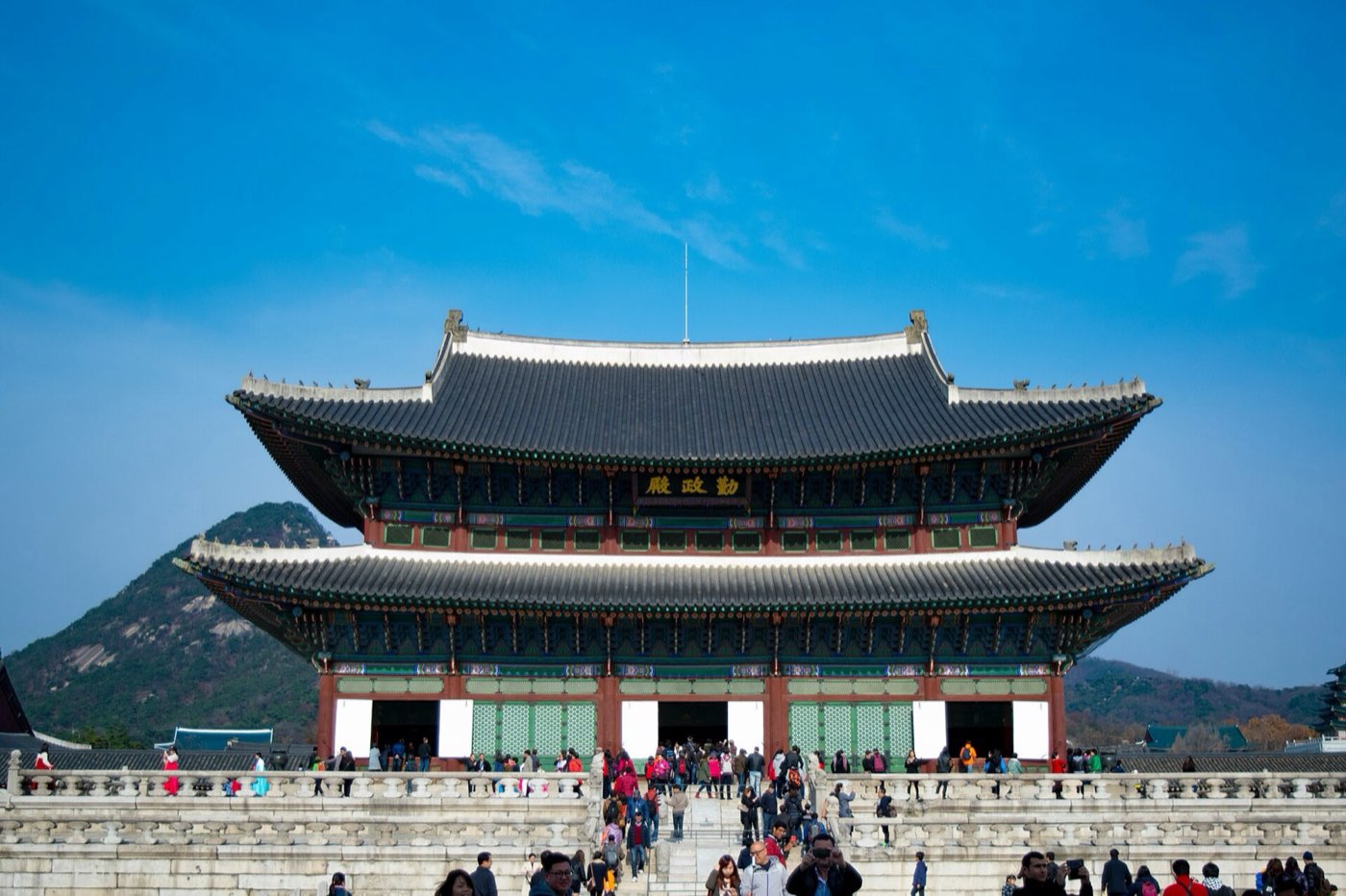
Geunjeongmun (근정문) frames your first view of Geunjeongjeon (근정전), the throne hall. Its name urges diligent government, the idea being that a king who works hard for his people rules well. Great state ceremonies, New Year audiences and receptions of foreign envoys took place here. Two rows of small stone posts run up the courtyard. These are rank stones (품계석, pumgyeseok): at a court assembly each official stood beside the marker for his grade, so the courtyard itself was a diagram of the bureaucracy, with the king raised above it at the head.
The hall stands on a two-tier stone platform, the woldae (월대), whose railings carry carved guardian animals, including the twelve animals of the zodiac. Count the columns across the facade: six, giving five bays, the traditional unit (칸, kan) for measuring Korean buildings, so this is a five-by-five hall. Inside, the throne sits before a painted folding screen under a canopy. The palace closes the platform at busy times to protect the stone railings, as it did for the autumn 2026 peak season, so you may be viewing the hall from the courtyard.
Behind the throne: an office, two bedrooms and a garden
Directly north stands Sajeongjeon (사정전), the king's working office, where he met ministers each morning. Its name asks the ruler to think carefully before he governs. After the towering throne hall it feels almost modest, a single story at human scale, flanked by smaller side halls used for the same purpose. That contrast is the point. Geunjeongjeon displayed royal authority to the whole court, while the real arguments over taxes, defense and appointments happened here, in a far smaller room.
Next comes Gangnyeongjeon (강녕전), the king's sleeping quarters, named for health and peace, one of the classical Five Blessings. Behind it lies Gyotaejeon (교태전), the queen's residence, and behind that Amisan (아미산), a terraced garden raised with earth dug from the Gyeonghoeru pond and set between decorative brick chimneys. The palace's own notes point to old maps that draw the peninsula's mountain spine running from Baekdusan all the way down into this little garden, as if the country's vitality flowed into the queen's quarters. Both residences were rebuilt from 1994 onward.
Two side stories repay a short detour. West of the axis, Sujeongjeon (수정전) stands on the site of Jiphyeonjeon, the royal research institute linked to King Sejong's Korean alphabet, Hunminjeongeum, promulgated in 1446. In the far northeast, Geoncheonggung (건청궁), a private residence King Gojong built in 1873, is where Empress Myeongseong was assassinated in 1895; the following year the king took refuge in the Russian legation. Both deepen the story of the dynasty's last decades, but neither is essential on a tight schedule.
Gyeonghoeru and Hyangwonjeong: where the court relaxed
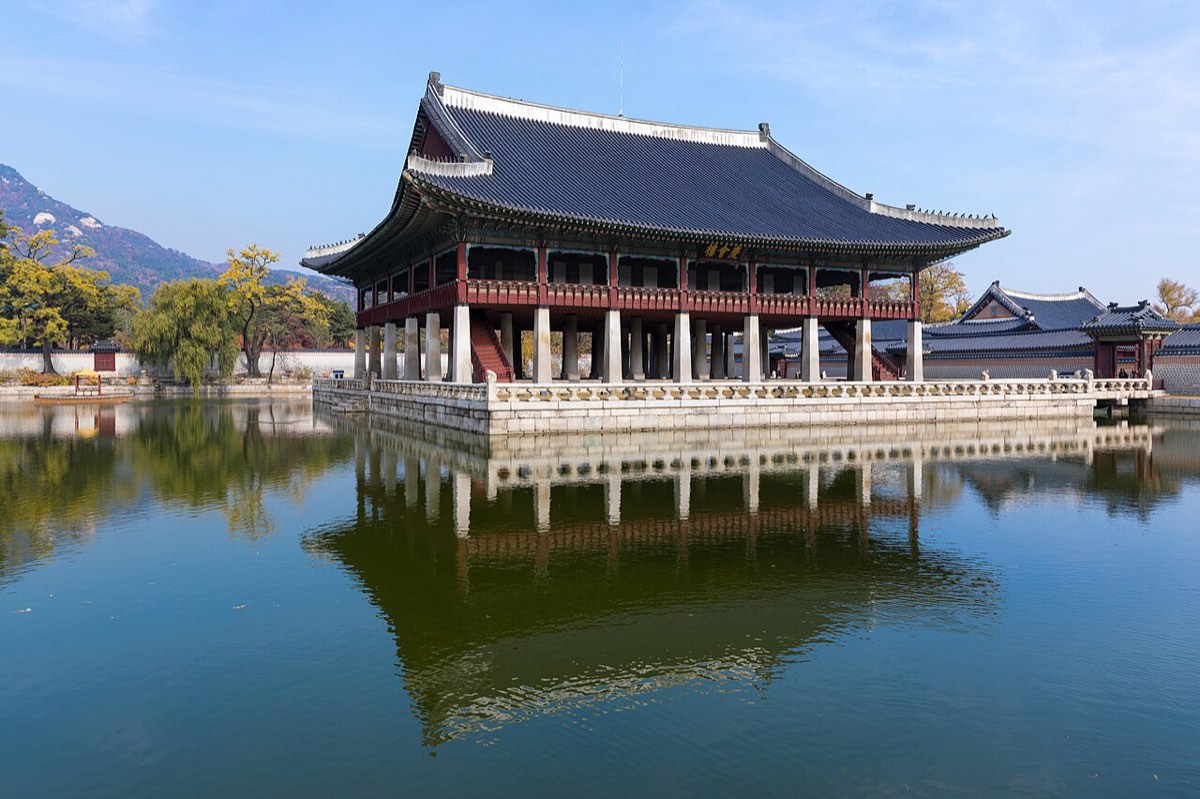
West of Sajeongjeon, Gyeonghoeru (경회루) rises from a square artificial pond. It was the hall for state banquets and for entertaining foreign envoys. It was enlarged in 1412 under King Taejong when the pond was widened, burned in 1592 down to its stone supports, and rebuilt in 1867. The open lower story stands on 48 stone pillars, square on the outside and round on the inside, and the upper floor was built at slightly different levels so that guests sat according to rank. It is generally described as the largest raised pavilion in Korea.
From the shore you get the classic reflection photograph, and for most visitors that is enough. Going inside requires the separate Gyeonghoeru and Hyangwonjeong special tour, which runs on Wednesdays and Fridays at 10:00 and 14:00 during its spring-to-autumn season (April 1 to October 30 in 2026), for about 70 minutes and 25 people per session. It costs nothing beyond palace admission and is booked online from 10:00 nine days ahead, but it is conducted in Korean only and pauses during the June–August heat. Treat it as a bonus for Korean speakers, not something to plan a trip around.
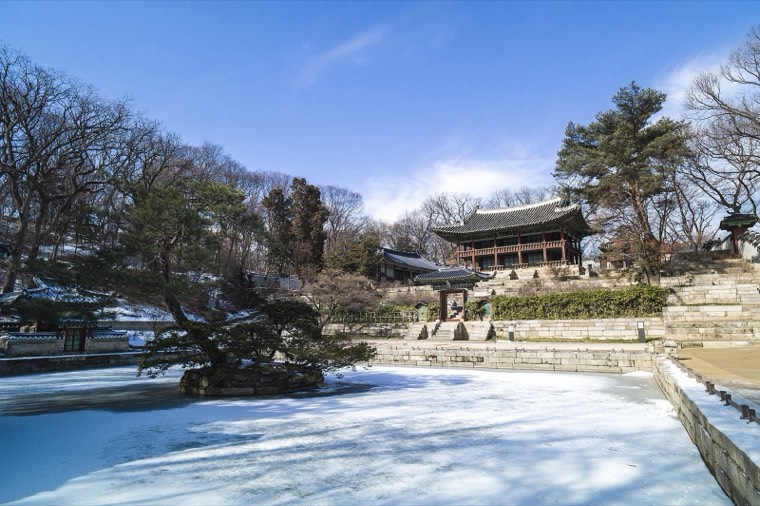
Farther north, Hyangwonjeong (향원정) is a small two-story hexagonal pavilion on an island, part of the private quarters King Gojong developed in the 1870s. Its wooden bridge, Chwihyanggyo (취향교), was rebuilt on the south side after the Korean War for convenience; a restoration finished in 2021 returned it to the north side and to its original arched form, which is why older photographs show it facing the other way. The pond is calmest in the morning, before the crowds that build up at the throne hall drift this far north.
Fitting in the royal guard ceremony
The Royal Guard Changing Ceremony (수문장 교대의식, sumunjang gyodae uisik) has been staged at Gyeongbokgung since 2002, drawing on a gate-guard system recorded in 1469. The Korea Heritage Agency, which runs it, lists the changing ceremony at 10:00 and 14:00 (about 20 minutes), a shorter Gwanghwamun watch ceremony at 11:00 and 13:00 (about 10 minutes), and a public drill at 09:35 and 13:35 (15 minutes). It takes place in the forecourt in front of Heungnyemun, outside the ticket check, so you can watch before deciding whether to go in.
Plan around the 10:00 performance. It lets you watch, then walk straight into the palace while the air is still cool and before most tour groups arrive, instead of cutting your visit in half to come back out for the afternoon show. Be in place ten minutes early near the middle of the forecourt, where the outgoing and incoming guards exchange duty. Afterward the guards hold their positions for photographs; the organizers ask visitors not to walk between the ranks, touch the flags or weapons, or chat to the guards.
Rain and extreme heat can cancel performances, so check the Korea Heritage Agency's notices or ask at the ticket office on the morning you go, and do not plan on it for a Tuesday, when the palace itself is closed. If the timing does not work, Deoksugung runs its own guard ceremony at Daehanmun gate near City Hall, covered in our five-palace comparison. Seeing one of the two is plenty for most visitors.
Tickets, hanbok entry and the days that trip people up
Gyeongbokgung closes on Tuesdays. When a Tuesday is a public holiday, the palace opens and closes on the next non-holiday instead. Adult admission is 3,000 won; for foreign visitors that means ages 19 to 64, and anyone 18 or under or 65 or over enters free with a passport. One exception catches people out: the government's Culture Day (문화가 있는 날), now every Wednesday, makes the other palaces and Jongmyo free, but Gyeongbokgung is specifically excluded. The 6,000-won integrated palace pass, valid for six months, covers one Gyeongbokgung entry.
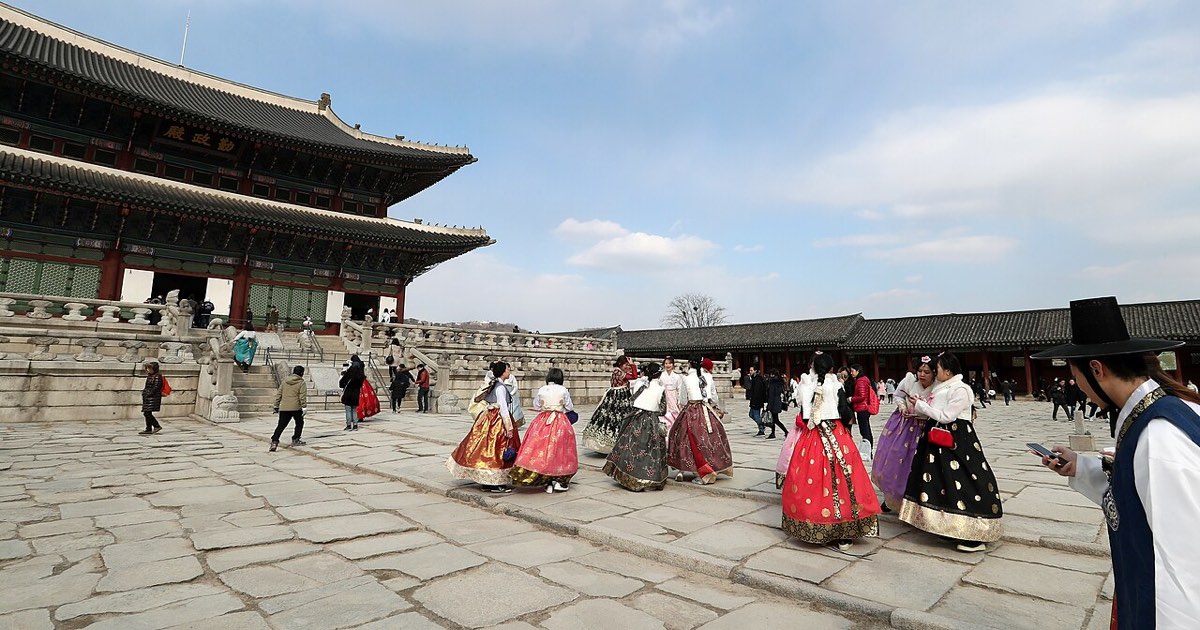
Visitors in hanbok (한복) enter free, foreigners included, but staff check the outfit against a published guideline. Traditional and modern styles both qualify if you wear a proper jeogori top with the wrap-over collar plus a skirt or trousers of traditional shape. A durumagi coat over everyday clothes, a jeogori with jeans, a hanbok skirt with a T-shirt, or a one-piece dress without a jeogori does not count. Palace fees have been frozen for about two decades and the heritage service has been preparing new ones, so check the fee page before a 2027 trip.
Night visits exist, but only in short seasonal runs. The autumn 2026 run, for example, operated from September 2 to October 2, 19:00 to 21:30 with last entry at 20:30, closed on Mondays and Tuesdays, and covered the front courts, Gyeonghoeru and the royal residences. Tickets cost 3,000 won online through NOL Ticket, and 300 same-day tickets per night were set aside for foreign visitors, two per passport. Hanbok wearers entered free without booking. If a night visit matters to you, watch the palace notice board from late April and mid-August, when the 2026 spring and autumn runs were announced.
| Months | Opening hours | Last entry |
|---|---|---|
| January–February, November–December | 09:00–17:00 | 16:00 |
| March–May, September–October | 09:00–18:00 | 17:00 |
| June–August | 09:00–18:30 | 17:30 |
A three-hour first visit, step by step
This route assumes any day except Tuesday, a morning between March and October, and no special bookings. It keeps you on the central axis while the light is soft and the tour buses are still parking, then sends you west and north to the water pavilions with almost no backtracking. Most of the ground is gravel or uneven stone with little shade on the axis, so wear proper walking shoes and carry water in summer. Type 경복궁 or 광화문 into Naver Map or Kakao Map to orient yourself.
An afternoon version works too: arrive for the 13:35 drill and the 14:00 ceremony, then follow the same order. From November to February the last entry is 16:00 and the gates close at 17:00, which leaves a little under three hours, so start no later than 14:00 in winter.
- 09:20 Leave Gyeongbokgung Station by Exit 5 and buy a ticket at the Gwanghwamun ticket office (skip this if you are in hanbok or qualify by age; show ID at Heungnyemun).
- 09:35 Optional: watch the 15-minute public guard drill.
- 10:00 Watch the changing ceremony in the Heungnyemun forecourt (about 20 minutes).
- 10:25 Pass Heungnyemun and Yeongjegyo; spend 20 minutes in the Geunjeongjeon courtyard.
- 10:50 Walk through Sajeongjeon, Gangnyeongjeon, Gyotaejeon and the Amisan garden (about 30 minutes).
- 11:25 Cut west to Gyeonghoeru for the view across the pond (15 minutes).
- 11:45 Head north to Hyangwonjeong and, if you still have energy, Geoncheonggung (30 minutes).
- 12:20 Leave toward the National Folk Museum on the east side, or return south to the National Palace Museum.
Cutting it to 90 minutes, and the two free museums next door
If time is short, keep the axis and Gyeonghoeru and drop everything north and east of them: Geoncheonggung, the library pavilion Jibokjae (집옥재), the shrine hall Taewonjeon (태원전) and the crown prince's quarters on the east side. That trims the visit to about 90 minutes without losing the story of how the court worked. Skip the guard ceremony too if it does not fall naturally into your timing. What you should not skip is the Geunjeongjeon courtyard, which is the reason to come.
The National Palace Museum of Korea (국립고궁박물관) sits at the southwest corner of the palace grounds, two minutes from Gyeongbokgung Station Exit 5, and admission is free. It holds the court's own objects in galleries on Joseon kings, royal life, the Korean Empire, royal carriages, court painting and calligraphy, ritual and science, and it is the best place to see the furnishings you cannot see inside the halls. It opens 09:30 to 17:30 most days, until 21:00 on Saturdays and the last Wednesday of the month, and closes on the last Monday of each month.
The National Folk Museum of Korea (국립민속박물관), on the palace's northeast side at 37 Samcheong-ro, is also free and shows how ordinary Koreans lived, worked and marked the year. It opens 09:00 to 18:00 from March to October, with Wednesday hours to 20:00, and 09:00 to 17:00 from November to February, closing only on January 1, Seollal and Chuseok. Choose the palace museum for royal context, the folk museum for daily life.
Questions visitors ask
Is Gyeongbokgung free on Wednesdays like the other palaces?
No. The weekly Culture Day free admission covers Changdeokgung's palace halls, Changgyeonggung, Deoksugung and Jongmyo, but Gyeongbokgung and the Changdeokgung Secret Garden are excluded. On Wednesdays, adults pay the usual 3,000 won at Gyeongbokgung unless they qualify for free entry by age or by wearing hanbok.
Can I watch the guard ceremony without buying a ticket?
Yes. It takes place in the forecourt between Gwanghwamun and Heungnyemun, before the ticket check, so anyone can watch. The changing ceremony is at 10:00 and 14:00 and lasts about 20 minutes. Rain or extreme heat can cancel it, and there is no ceremony on Tuesdays when the palace is closed.
Will a modern rental hanbok get me in free?
Usually, if it follows the guideline: a jeogori top with the traditional overlapping collar, worn with a traditional-shaped skirt or trousers. A coat alone over ordinary clothes, a hanbok skirt with a T-shirt, or a dress without a jeogori is refused. Staff at Heungnyemun make the call, so check your outfit against those points before you leave the rental shop.
How long should I spend at Gyeongbokgung?
Ninety minutes covers the central axis and Gyeonghoeru. Two and a half to three hours lets you add the guard ceremony, Hyangwonjeong and Geoncheonggung without rushing. Add about an hour if you also want the National Palace Museum or the National Folk Museum, both free and on the palace grounds.
Should I choose Gyeongbokgung or Changdeokgung for my first palace?
Choose Gyeongbokgung for scale, the classic axis and the guard ceremony in one stop. Choose Changdeokgung if you prefer architecture fitted to hills and want the Secret Garden tour. If you can see both, do Gyeongbokgung first; it makes Changdeokgung's departures from the formal plan much easier to appreciate.
Is Gyeongbokgung open at night?
Only during announced seasonal runs, typically in spring and early autumn. In autumn 2026 night viewing ran from September 2 to October 2, with online tickets on NOL Ticket and 300 same-day tickets a night reserved for foreign visitors. Outside those runs the palace closes between 17:00 and 18:30 depending on the month.
Sources and method
Written for: First-time independent visitors to Seoul who want one well-understood palace visit rather than a rushed photo stop.
Method: Researched from the official sources listed below, checked on October 20, 2026. Hours, fees and booking rules can change; the linked official pages are the final word. Spotted something out of date? Tell us.
- Royal Palaces and Tombs Center (Korea Heritage Service) — Visiting hoursSeasonal hours and last entry, Tuesday closure and the holiday rule.
- Royal Palaces and Tombs Center — Admission fees3,000-won adult fee, foreign age bands, free categories, Wednesday Culture Day exclusion for Gyeongbokgung, 6,000-won integrated pass.
- Royal Palaces and Tombs Center — Hanbok free admission guidelineWhat counts as hanbok for free entry; applies to foreign visitors.
- Royal Palaces and Tombs Center — Gyeongbokgung directionsGyeongbokgung Station Exit 5, about 2 minutes on foot; address 161 Sajik-ro.
- Royal Palaces and Tombs Center — Gyeongbokgung Palace and its history (English)1395 founding, name meaning, 1592 destruction, 1867 rebuild, 1873 Geoncheonggung, 1895 assassination, colonial demolition, restoration timeline including Chwihyanggyo.
- Royal Palaces and Tombs Center — Gyeongbokgung notice board2026 autumn night viewing (Sept 2–Oct 2, NOL Ticket, 300 on-site tickets for foreigners), 2026 Gyeonghoeru–Hyangwonjeong special tour, Geunjeongjeon platform closure Sept 2–Oct 31, 2026.
- Korea Heritage Agency — Royal guard ceremony program guideChanging ceremony 10:00 and 14:00 (20 min), Gwanghwamun watch ceremony 11:00 and 13:00, public drill 09:35 and 13:35; visitor conduct rules on the related visitor page.
- National Palace Museum of Korea — General informationFree admission, hours, Saturday and last-Wednesday late opening, last-Monday closure.
- National Folk Museum of Korea — Visitor informationFree admission, seasonal hours, Wednesday late opening Mar–Oct, holiday closures, Permanent Exhibition Hall 1 closure Sept 30–Dec 21, 2026.
- The Korea Herald — Palace admission fees to be revised (Sept. 9, 2026)Fees unchanged for about two decades; Korea Heritage Service preparing revised fees, with hanbok free entry under discussion.
- Royal Palaces and Tombs Center — October–November 2026 closing-day openings and free admissionFree admission at the four palaces, Jongmyo and the royal tombs from October 29 to November 15, 2026 (Korea Grand Festival); regular closing days and the Changdeokgung Secret Garden excluded; Jongmyo switches to general viewing.