In shortChanggyeonggung (창경궁) is the quiet palace beside Changdeokgung: enlarged in 1483 for three widowed queens, turned into a zoo and botanical garden under Japanese rule, and restored from 1983. It has the oldest surviving throne hall of any Joseon palace and a 1909 glasshouse, costs 1,000 won, closes on Mondays and stays open until 21:00.
Key facts
- Korean name / map search
- 창경궁 (Changgyeonggung)Naver Map
- Closed
- Mondays (open on a Monday holiday, closed the next non-holiday instead)
- Hours
- 09:00–21:00 all year, last entry 20:00
- Adult admission
- 1,000 won (foreign visitors 19–64); free every Wednesday and in hanbok
- Nearest subway
- Hyehwa Station (Line 4) Exit 4, about 12 minutes on foot
- Throne hall
- Myeongjeongjeon, rebuilt 1616, National Treasure
- Path to Jongmyo
- Yulgok-ro gate, open Saturdays, Sundays, holidays and Culture Day
Checked Nov 7, 2026 against the official sources listed at the end of this guide.
A palace built for three widowed queens
Changgyeonggung (창경궁) began as a home for a retired king. In 1418, the year King Sejong took the throne, he built Suganggung (수강궁) on this hill for his father, King Taejong, who had abdicated in his favor. In 1483 King Seongjong enlarged it for three senior women of the royal family, his grandmother, his mother and his aunt, all of them widowed queens, and renamed it Changgyeonggung. With Changdeokgung next door it formed a single royal compound known as Donggwol (동궐), the East Palace.
That origin explains what you see. Changgyeonggung was a palace to live in rather than a stage for government, so its halls are lower and more domestic than Gyeongbokgung's, and its grounds open out into woods and a pond instead of running along a ceremonial axis. Its record is one of repeated loss and rebuilding: everything burned in the 1592 Japanese invasion, the inner quarters burned again in Yi Gwal's rebellion of 1624 and were rebuilt from 1633, and a great fire in 1830 destroyed most of the buildings, which were rebuilt by 1834.
Royal family history runs close to the surface here. Crown Prince Sado, son of King Yeongjo, was born in the palace's Jipbokheon (집복헌) hall in 1735. In the summer of 1762 Yeongjo summoned him to the courtyard of Munjeongjeon (문정전), then serving as a memorial hall for the late queen, and had him sealed in a wooden rice chest, where he died eight days later. Munjeongjeon still stands beside the throne hall, rebuilt in the 1980s, and knowing the story changes how its plain courtyard feels.
Myeongjeongjeon: the oldest throne hall, facing east
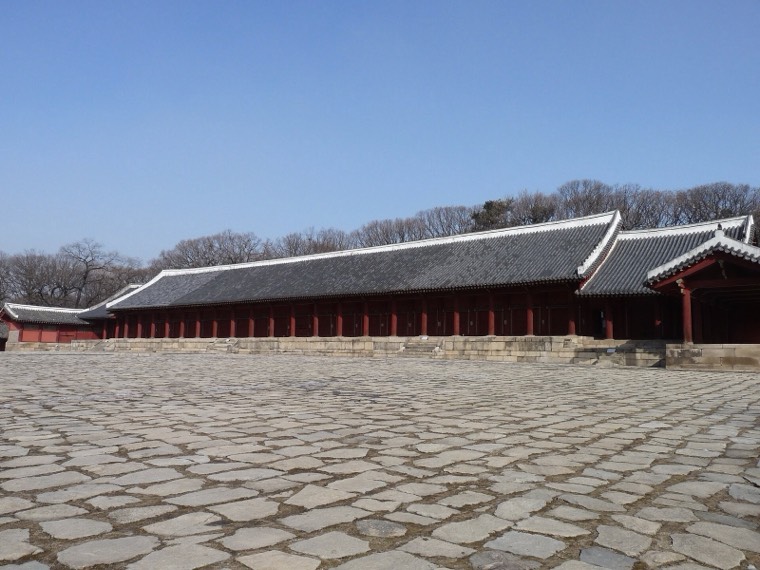
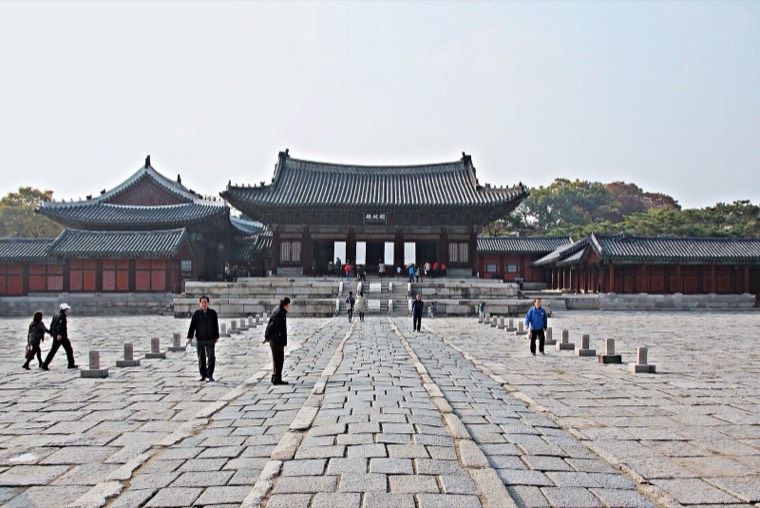
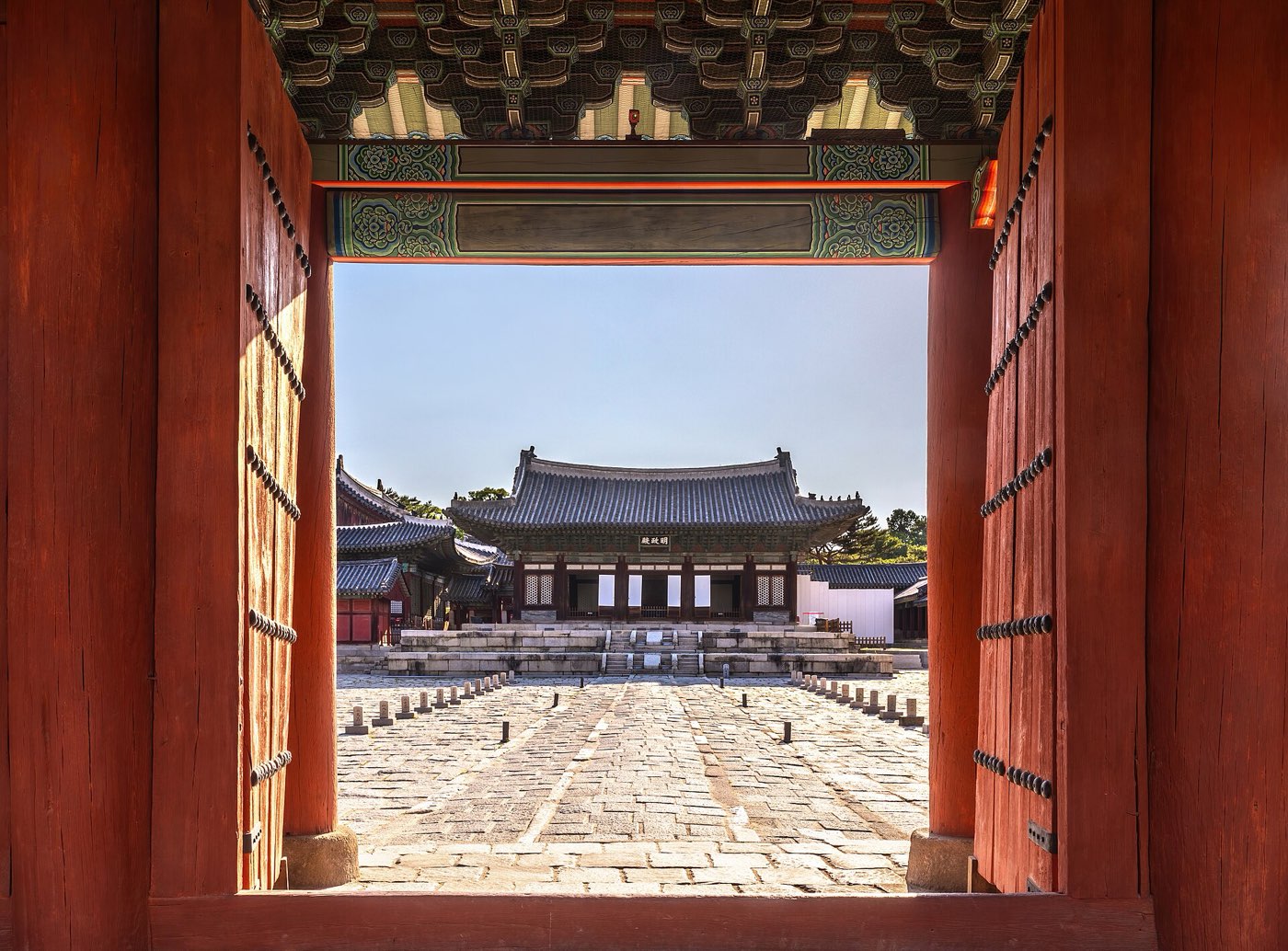
From the main gate, Honghwamun (홍화문), you cross the arched stone bridge Okcheongyo (옥천교) and pass through Myeongjeongmun to reach Myeongjeongjeon (명정전), the throne hall. It was first built in 1484, burned in 1592 and rebuilt in 1616 under King Gwanghaegun, and it has come through every fire since. Its sturdy bracket work once led scholars to date it to the early Joseon period, until an ink inscription found inside the gable in 1963, matching the royal annals, settled the 1616 date. It is the oldest main hall of any Joseon palace and a National Treasure.
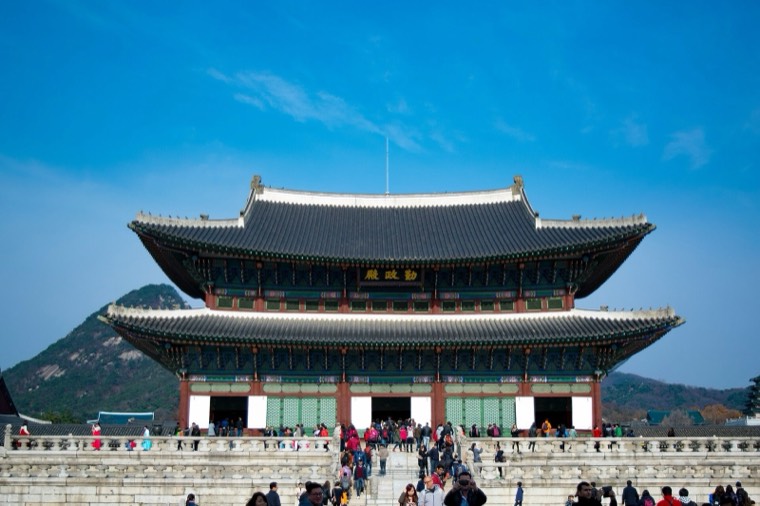
Set it beside Gyeongbokgung's Geunjeongjeon or Changdeokgung's Injeongjeon and two differences stand out. It is a single-story hall five bays wide rather than a towering two-story one, and it faces east rather than south. The Encyclopedia of Korean Culture ties both features to the palace's purpose: it was built as a residence for queen dowagers, not as the seat from which a king governed. Honghwamun and Myeongjeongmun belong to the same early 17th-century rebuilding, which makes this gate-and-hall sequence one of the oldest groups of wooden palace architecture in Seoul.
Take a few minutes in the courtyard. Twenty-four rank stones (품계석) line the raised royal path, marking where officials stood by grade for New Year greetings, state ceremonies and the reception of foreign envoys. The hall stands on a two-tier stone platform about 2.5 meters high. Look up at the dense clusters of brackets under the eaves, and through the doorway for the throne, the screen of the sun, moon and five peaks behind it, and the pair of carved phoenixes set into the ceiling above.
From palace to Changgyeongwon: the zoo and garden years
The decline began in 1907, the year Emperor Sunjong came to the throne under Japanese control. From 1908 most of the palace's buildings were demolished or altered, and in 1909 a zoo and a botanical garden opened on the grounds, with Sunjong attending the opening ceremony. A museum went up on the cleared ground around the throne hall. In 1911 the palace was formally demoted to a public park and renamed Changgyeongwon (창경원), the final syllable meaning a garden rather than a palace.
Thousands of cherry trees, a symbol of Japan, were planted across the grounds, and from April 1924 the colonial authorities opened them for night blossom viewing. A Japanese-style pavilion was built beside the pond. In the early 1930s a road, today's Yulgok-ro, was cut through the ground linking the palace to Jongmyo, the royal ancestral shrine. The amusement-park identity outlived colonial rule: the National Archives of Korea records dense crowds in April 1971 and 918 children reported lost during the 1972 blossom season.
Restoration came late. In 1983 the government announced a plan, closed the grounds for two years and restored the name Changgyeonggung. The animals moved to the new Seoul Grand Park in Gwacheon, south of the city, and most of the cherry trees were transplanted, many of them to Yunjungno on Yeouido, with pines and zelkovas planted in their place. The rebuilding was completed on August 23, 1986. For Koreans who grew up before 1983, Changgyeongwon was simply the city zoo, which is why you may still hear the old name.
Daeonsil, the glasshouse with a double meaning
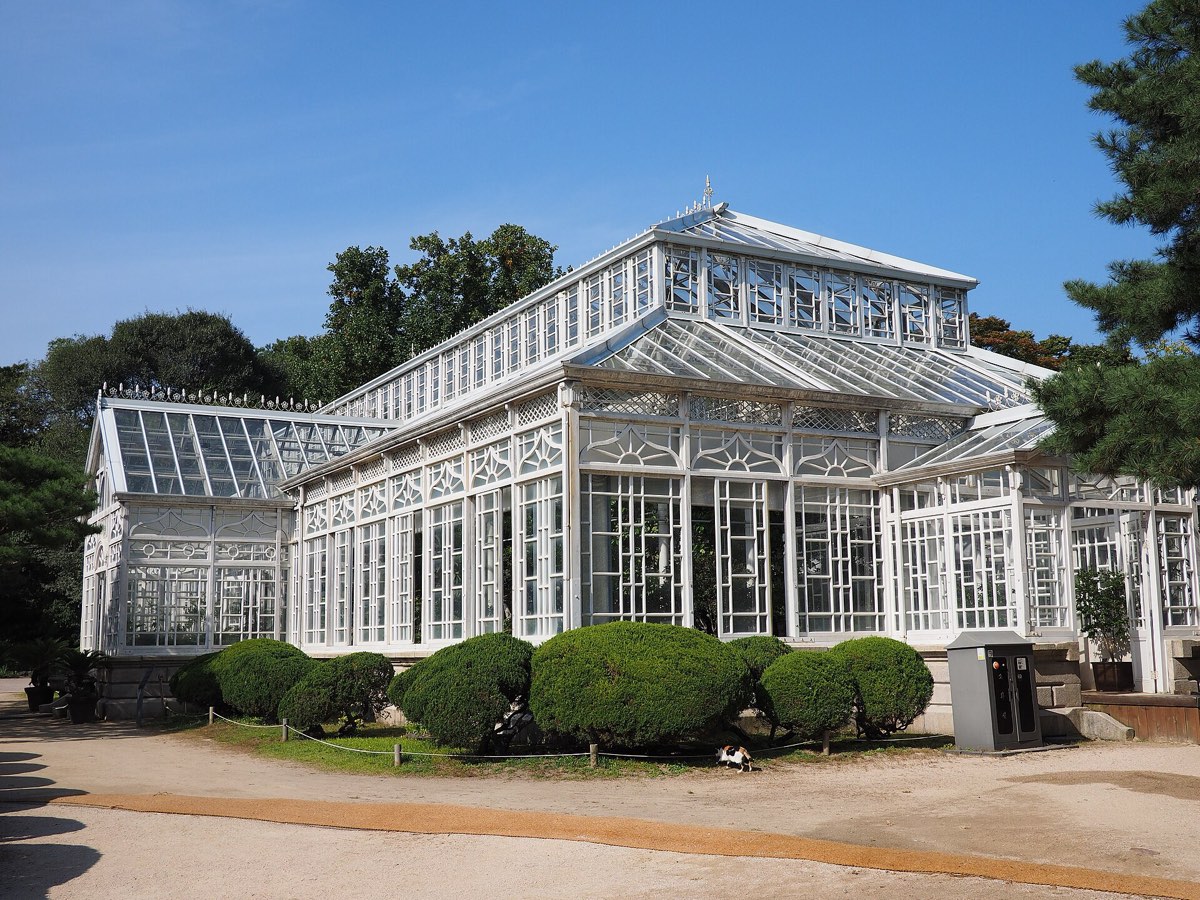
The white glasshouse north of the halls is Daeonsil (대온실), the Great Greenhouse, completed in 1909 as Korea's first Western-style greenhouse. It was designed by Fukuba Hayato, head of the Japanese imperial gardens, and built by a French company. Fukuba had worked at Shinjuku Gyoen in Tokyo, whose 1896 greenhouse was Japan's first, and the two buildings are strikingly alike. A frame of cast iron and timber carries the glass above a granite base, 33 meters long and 10.5 meters high, which still looks light for its size.
Its history is not innocent. The Encyclopedia of Korean Culture describes the greenhouse and the zoo as built on the pretext of consoling Sunjong after Japan had confined him to Changdeokgung, and it reads the glasshouse as both an advanced piece of modern architecture and an instrument for erasing a Joseon palace. Tropical plants under iron and glass were the prestige display of empires at the time. The building survived damage in the Korean War, was registered as national heritage on February 6, 2004, and reopened in November 2017 after 15 months of restoration.
Our advice is to visit it for both reasons. The white tracery and the plants make it the most photographed spot in the palace, and its story makes it the most instructive. After dark the greenhouse area is part of the evening zone. The palace keeps the interior open in the evening in November and from March to October, but from December to February it closes the inside at 18:00 to protect the plants, so a winter evening visit means viewing it from outside.
Chundangji pond, Tongmyeongjeon and the fenced-off corner
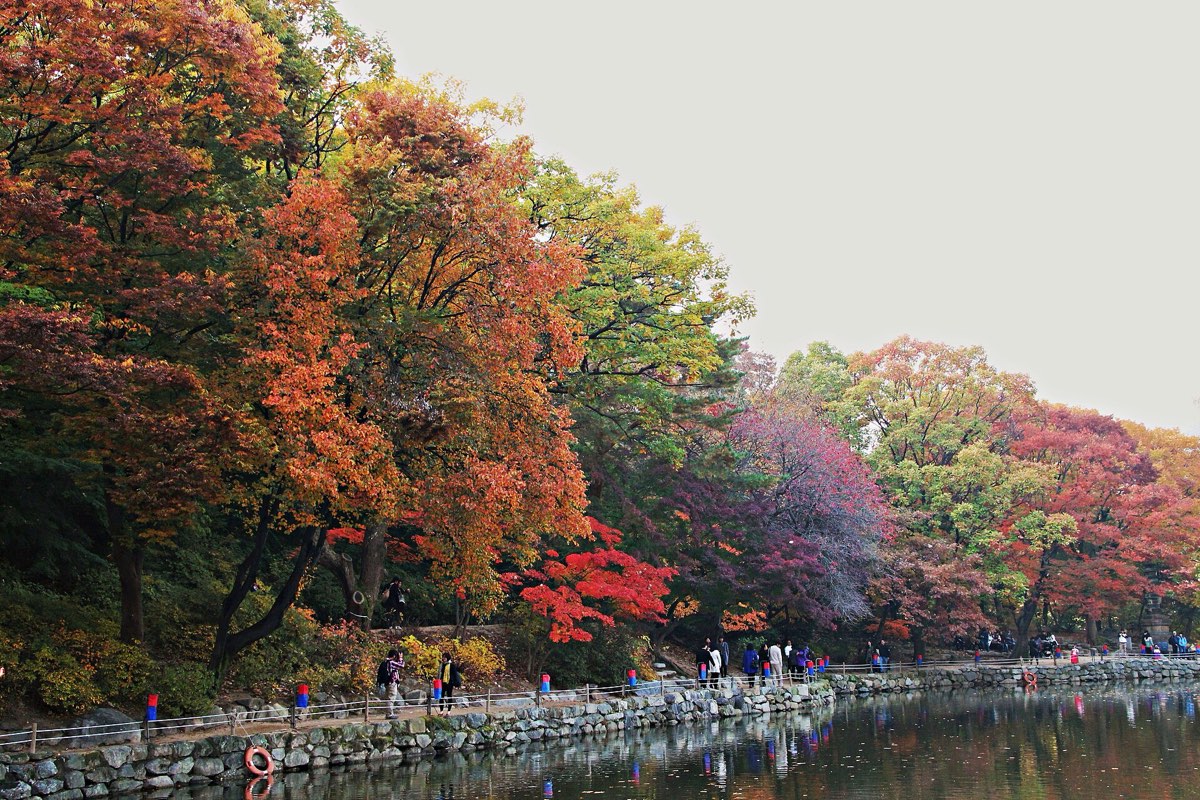
Chundangji (춘당지), the pond in the northern half of the grounds, belongs to the same colonial chapter. According to the Encyclopedia of Korean Culture, it was dug in front of the Chundangdae terrace as part of the garden works, with a Japanese-style water pavilion built to its north. Today it is the calmest corner of the palace, ringed by old trees that turn red and gold from late October into November, and it needs no booking, which makes it a good substitute on days when the Changdeokgung Secret Garden is sold out.
Two notices affect this side of the palace in 2026. Since February 10, part of the path around the pond has been closed from 18:00 to 21:00 until its lighting is repaired. Since September 22, 2025, most of Gwollae Gaksa (궐내각사), the area of former government offices on the palace's south side, has been fenced off while the royal stables are reconstructed. You can still reach Seoninmun gate, the stone observatory platform Gwancheondae (관천대) and the Yulgok-ro gate.
Between the throne hall and the pond, look for Tongmyeongjeon (통명전), a royal sleeping hall rebuilt after the fire of 1830, with a stone-lined pool beside it. It stays inside the evening zone, so you can leave it until after dark. The palace's open halls in 2026, by day and by night, are Yanghwadang, Tongmyeongjeon, Gyeongchunjeon, Haminjeong, Hwangyeongjeon, Munjeongjeon and Myeongjeongjeon, plus the greenhouse and the pond.
Hours, tickets and the evening switch
Changgyeonggung keeps the simplest timetable of the palaces: 09:00 to 21:00 every day of the year except Monday, with last entry at 20:00. When a Monday is a public holiday the palace opens and closes on the next non-holiday instead. Adults pay 1,000 won, which for foreign visitors means ages 19 to 64. Foreign visitors 18 and under or 65 and over enter free, as does anyone wearing hanbok, and every Wednesday is a free Culture Day. The 6,000-won integrated pass also covers it.
The whole palace does not stay open after dark. At a set time each evening, shown in the table, staff move everyone into an evening zone built around five areas: Honghwamun, Myeongjeongjeon, Tongmyeongjeon, Chundangji and the greenhouse. Anything outside them, such as the wooded paths and the outer corners near Gwancheondae, is a daytime sight, so if you arrive in the afternoon, walk those first. The same table gives the last entry through the Yulgok-ro gate from Jongmyo, which follows a different clock.
Two 2026 dates matter. From October 29 to November 15, admission is free for everyone during the Korea Grand Festival, with Mondays still closed. From November 10 to 15, the regular evening opening is suspended for Donggwol Dongnak (동궐동락), a separately booked night program; on those days the palace closes at 17:30, with last entry at 16:30. Booking details are announced on the Royal Palaces and Tombs Center notice board, and enquiries go to 1522-2295.
Search 창경궁 in Naver Map or Kakao Map. Hyehwa Station Exit 4 on Line 4 is about 12 minutes on foot from the main gate, and several city buses stop at 창경궁·서울대학교병원. The palace's car park is closed until December 31, 2026, so come by public transport. The palace office is on 02-762-4868.
| Months | Evening zone from | Greenhouse inside after dark | Yulgok-ro gate last entry |
|---|---|---|---|
| November | 17:30 | Open | 17:00 |
| December–January | 17:30 | Closed from 18:00 | 17:00 |
| February | 17:30 | Closed from 18:00 | 17:30 |
| March–May, September–October | 18:00 | Open | 17:30 |
| June–August | 18:30 | Open | 18:00 |
Walking on to Jongmyo over the buried road
For most of the 20th century the palace and Jongmyo were split by the road cut in the early 1930s, crossed only by a footbridge, Gwandeokgyo, that was later removed. Seoul's restoration project, begun about 2010 and finished in 2022, put that stretch of Yulgok-ro into a tunnel, laid about 8,000 square meters of green space over it, rebuilt 503 meters of palace wall on its old line and restored Buksinmun (북신문), the north gate through which kings entered the shrine informally. A 340-meter path along the wall opened on July 22, 2022.
The path opened before the gates did. In 2022 it led into neither site, and the city said it was still negotiating access with the heritage authorities. Today the Yulgok-ro gate into Changgyeonggung and Buksinmun into Jongmyo open on Saturdays, Sundays, public holidays and Culture Day. Admission is now free every Wednesday, but the palace's hours page still lists its Yulgok-ro gate for the last Wednesday of the month only, so on other Wednesdays confirm at the gate. Each site needs its own ticket, so keep some cash or a card ready at both ends.
Direction matters. Jongmyo closes earlier, at 17:30 from November to January with last entry at 16:30, while Changgyeonggung stays open until 21:00, so on a winter weekend see the shrine first and enter the palace through the Yulgok-ro gate before 17:00. On the west side, Hamyangmun (함양문) links Changgyeonggung with Changdeokgung's palace halls, though not with its Secret Garden. You buy the next ticket at the gate, and crossings stop at Changdeokgung's last entry, 16:30 from November to January.
A Saturday plan, and who should skip the palace
A November Saturday, about four and a half hours: at 14:30, enter Jongmyo from Jongno 3-ga Station Exit 11, five minutes away, and walk past its two great halls, since weekends there are self-guided. At 15:45, leave by Buksinmun, follow the wall path and enter Changgyeonggung by the Yulgok-ro gate. At 16:00, see Gwancheondae, then Munjeongjeon and Myeongjeongjeon in the low sun, and walk the wooded paths before the 17:30 switch to the evening zone. After that, Tongmyeongjeon, the greenhouse, which stays open inside on November evenings, and a circuit of Chundangji. Return to the lit throne hall and leave by Honghwamun around 19:00 for dinner near Hyehwa. On November 10 to 15, 2026, drop the evening part.
Who should come? Anyone on a second palace day, anyone who wants an evening among historic buildings after the other palaces have closed, autumn visitors who could not get a Secret Garden ticket, and readers interested in the colonial period, which is easier to read here than at most palaces. An hour covers the main sights, ninety minutes with the greenhouse and pond. Skip it on a first trip with only one palace slot, when Gyeongbokgung or Changdeokgung will give you more, and do not come for pageantry: there is no guard ceremony.
Three mistakes are common. Visitors arrive at 18:00 expecting the whole palace and find only the evening zone open; they plan the Jongmyo link on a weekday when the gates are shut; or they assume Hamyangmun leads into the Secret Garden. Check the day of the week, the month and the notice board, in that order, and the palace is easy.
Questions visitors ask
Is Changgyeonggung worth visiting if I have already seen Changdeokgung?
Yes, if you have an extra hour. It adds the oldest surviving throne hall of any Joseon palace, the 1909 glasshouse, a large pond and a clear view of what colonial rule did to Seoul's palaces. Walk in through Hamyangmun gate before Changdeokgung's last entry, buying the 1,000-won ticket at the gate.
Can I go inside the greenhouse in the evening?
In November and from March to October, yes: the interior stays open as part of the evening zone. From December to February the palace closes the inside at 18:00 to protect the plants, so after that you see it lit from outside only. Daytime visits are possible all year.
What happened to the Changgyeongwon zoo?
It closed when the restoration plan was announced in 1983. The animals were moved to the new Seoul Grand Park in Gwacheon, most of the cherry trees were transplanted, and the palace's name was restored. Rebuilding work was completed in August 1986.
Is there a bridge between Changgyeonggung and Jongmyo?
No. The road that separated them, Yulgok-ro, now runs through a tunnel with green space and a wall path above it. Gates on that path open on Saturdays, Sundays, public holidays and Culture Day, and each site needs its own ticket.
Do I need to book anything?
Not for ordinary daytime or evening visits; buy a ticket at the gate. Only special programs need booking, such as Donggwol Dongnak, the night program that replaces the regular evening opening from November 10 to 15, 2026.
Sources and method
Written for: Visitors seeing Changdeokgung or Jongmyo who want to know whether Changgyeonggung is worth adding, what its buildings mean and how to use its long evening hours.
Method: Researched from the official sources listed below, checked on October 25, 2026. Hours, fees and booking rules can change; the linked official pages are the final word. Spotted something out of date? Tell us.
- Royal Palaces and Tombs Center (Korea Heritage Service) — Visiting hoursChanggyeonggung 09:00–21:00, last entry 20:00; Monday closure and holiday rule; Yulgok-ro gate days (weekends, holidays, Culture Day listed as the last Wednesday) and last entry by season; evening-zone buildings and move times; greenhouse interior after dark by month; Jongmyo hours and Buksinmun on its general-viewing days.
- Royal Palaces and Tombs Center — Admission fees1,000-won adult fee, foreign adult age band 19–64, free entry for foreign visitors 18 and under or 65 and over, hanbok wearers and every Wednesday (Culture Day); 6,000-won integrated pass.
- Royal Palaces and Tombs Center — Changgyeonggung Palace and its history (English)Suganggung 1418; 1483 expansion for Seongjong's grandmother, mother and aunt; Donggwol; 1592 destruction; 1616 rebuilding of Myeongjeongjeon and Munjeongjeon; 1624 rebellion and 1633 rebuilding; 1830 fire and 1834 rebuilding; 1909 zoo and botanical garden; 1911 Changgyeongwon; 1983 restoration.
- Royal Palaces and Tombs Center — Changgyeonggung notice: evening opening suspended November 10–15, 2026Donggwol Dongnak night program, booking required; daytime closing 17:30, last entry 16:30; enquiries 02-762-4868 and 1522-2295. Related notices on the same Changgyeonggung board: free admission October 29 to November 15, 2026 (id 20260922161754771774); every-Wednesday Culture Day (id 20261007095901706396); area restrictions as of March 3, 2026, covering the Chundangji path closure from 18:00 to 21:00 since February 10 and the Gwollae Gaksa closure since September 22, 2025, with open halls listed (id 20260227165959365512).
- Royal Palaces and Tombs Center — Changgyeonggung directionsHyehwa Station (Line 4) Exit 4, about 12 minutes on foot; bus stops 서울대학교병원 and 창경궁·서울대학교병원; car park closed January 5, 2025 to December 31, 2026; address 185 Changgyeonggung-ro, phone 02-762-4868.
- Encyclopedia of Korean Culture (Academy of Korean Studies) — 창경궁 명정전 (Myeongjeongjeon)Built 1484, burned 1592, rebuilt 1616; 1963 ink inscription confirming the date; 1983–85 restoration of corridors and Munjeongjeon; 24 rank stones, 2.5 m two-tier platform, throne, sun-moon-five-peaks screen and phoenix carvings; single story and east orientation linked to the dowager residence; oldest Joseon main hall; Honghwamun and Myeongjeongmun as early 17th-century architecture; National Treasure since 1985.
- Encyclopedia of Korean Culture — 창경궁 대온실 (Daeonsil greenhouse)Completed 1909 as Korea's first Western-style greenhouse; designed by Fukuba Hayato and built by a French company; Shinjuku Gyoen model; Chundangji dug in front of Chundangdae with a Japanese-style pavilion to the north; dimensions; Korean War damage; restoration August 2016 to November 2017; registered heritage February 6, 2004; interpretation as both modern architecture and colonial erasure.
- National Archives of Korea — Changgyeonggung (theme records)Alterations from spring 1908; 1909 opening of zoo and botanical garden with Sunjong present; museum near Myeongjeongjeon; thousands of cherry trees; night blossom viewing from April 1924; Japanese-style building by Chundangji; road cutting the Jongmyo link; 1971 crowds and 918 lost children in 1972; 1983 plan, two-year closure and name restored; animals to Seoul Grand Park; cherry trees to Yunjungno and the zoo site, replaced with pines and zelkovas; completion August 23, 1986.
- Seoul Metropolitan Government (Naeson-ane Seoul) — Changgyeonggung and Jongmyo reconnected after 90 years (July 20, 2022)Opening on July 22, 2022 after 12 years of work; Yulgok-ro placed in a tunnel; about 8,000 m² of green space; 503 m of palace wall restored; Buksinmun restored; 340 m wall path; 1932 road and the removed Gwandeokgyo footbridge; at opening, no access between the path and either site.
- Seoul Metropolitan Government (Naeson-ane Seoul) — Crown Prince Sado from birth to deathSado born at Jipbokheon in Changgyeonggung in 1735; in 1762 Yeongjo summoned him to the courtyard of Munjeongjeon, then a memorial hall for Queen Jeongseong, and sealed him in a rice chest, where he died after eight days.