In shortChangdeokgung (창덕궁) is the palace to choose for architecture and landscape, and its Huwon (후원), the Secret Garden, can be entered only on a timed guided session. English sessions run at 10:30, 11:30 and 14:30, plus 15:30 from March to November; half of each session's 100 places sell online from 10:00 six days ahead and half at the ticket office from 09:00 on the day. Budget 3,000 won for the palace plus 5,000 won for the garden, and avoid Mondays, when it is closed.
Key facts
- Korean names / map search
- 창덕궁 (Changdeokgung), 후원 (Huwon)Naver Map
- Closed
- Mondays (if a Monday is a public holiday, it closes the next non-holiday instead)
- Palace hall admission
- 3,000 won for adults 19–64; free for 18 and under and 65 and over
- Huwon (garden) ticket
- 5,000 won for ages 19 and over, including 65+; 2,500 won ages 7–18; free 6 and under
- English Huwon sessions
- 10:30, 11:30, 14:30 (Dec–Feb); 15:30 added Mar–Nov
- Huwon booking
- Online from 10:00 six days ahead to the day before; 50 on-site tickets per session from 09:00
- Nearest subway
- Anguk Station (Line 3), Exit 3, about 5 minutes on foot
- UNESCO World Heritage
- Changdeokgung Palace Complex, listed 1997
Checked Oct 20, 2026 against the official sources listed at the end of this guide.
A palace laid out by the hillside, not the compass
Changdeokgung (창덕궁) was built in 1405 as a secondary palace to Gyeongbokgung, yet it ended up as the main royal residence for about 270 years. After the 1592 Japanese invasion destroyed every palace in the capital, Changdeokgung was the first rebuilt, in 1610, and kings lived here until Gyeongbokgung was restored in 1867. Emperor Sunjong, the last ruler, lived and died here, and the 1910 treaty that ended Korean sovereignty was signed in one of its halls, Heungbokheon. UNESCO listed the palace complex as World Heritage in 1997.
The listing rests on how the palace breaks the rules. Gyeongbokgung follows a textbook south-to-north axis on open ground; Changdeokgung instead sets its halls into the folds of the hills behind it, and the heritage service calls that fit with the landscape the peak of Korean palace design. You feel it from the first steps. The main gate, Donhwamun (돈화문), stands at the southwest corner, and the path bends east across the stone bridge Geumcheongyo (금천교) and turns again before the throne hall comes into view, rather than marching straight ahead.
Changdeokgung and its neighbor Changgyeonggung were together called Donggwol (동궐), the East Palace, with no wall between them. North of the halls lies the Huwon (후원), the royal garden first laid out in 1406, expanded under King Sejo in the 1460s and again in later reigns. It is the reason most visitors come, and it can be entered only on a timed, capped tour. The practical rule that follows: secure the garden slot first, then fit the rest of the palace around it.
The halls worth an hour before your garden slot
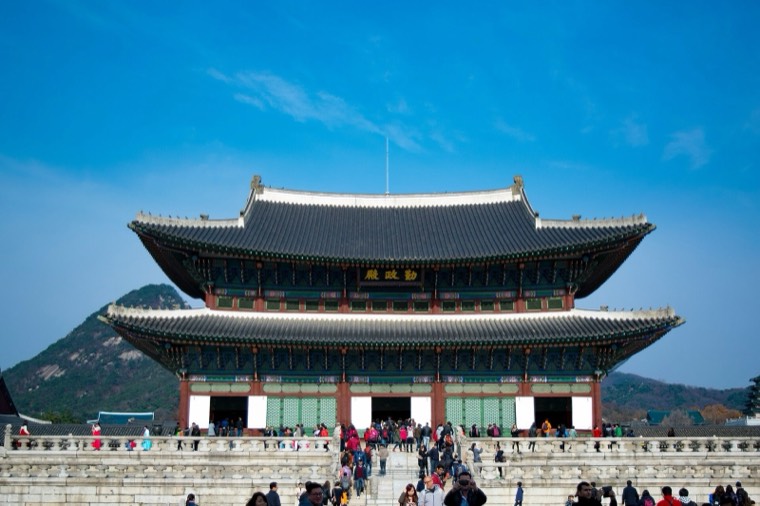
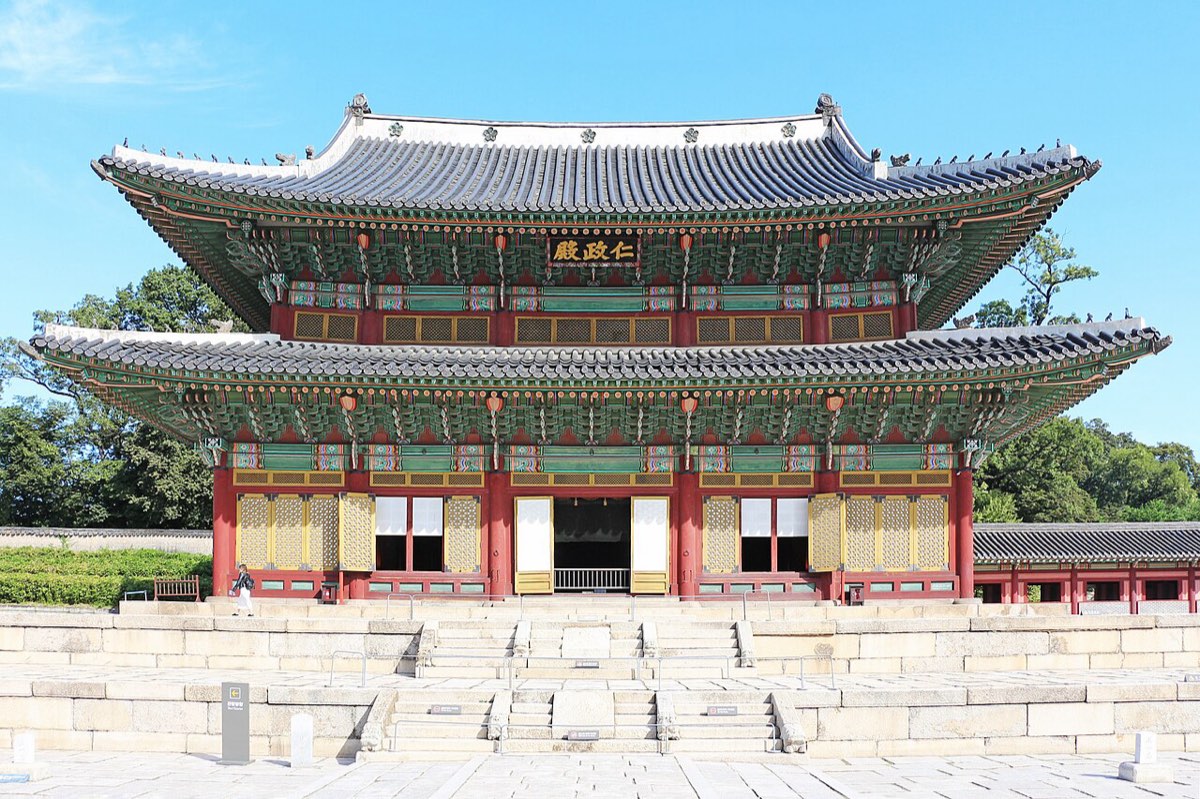
Injeongjeon (인정전), the throne hall, is the obvious first stop: rank stones and a two-tier platform like Gyeongbokgung's, but in a smaller, irregular courtyard. Just east is Seonjeongjeon (선정전), the king's office, roofed in blue-glazed tiles. Farther in, Huijeongdang (희정당) and Daejojeon (대조전), the royal living quarters, burned in 1917 and were rebuilt in 1920 with materials from Gyeongbokgung's Gangnyeongjeon and Gyotaejeon, which were dismantled for the purpose. One palace was taken apart to repair another, a small, telling detail of the colonial period.
At the east end, Nakseonjae (낙선재) is a compound King Heonjong built in 1847 in the restrained manner of a scholar's house, left unpainted where palace buildings are normally covered in color. It is also where the last members of the royal family lived out their lives: Empress Sunjeong returned here in 1960, and Princess Deokhye and Crown Princess Yi Bangja died here in 1989. If you want one quiet corner before the garden crowds gather, make it this one.
Free guided walks of the palace halls run in Korean, English, Japanese and Chinese with no booking; they start at the information board opposite Injeongmun gate and take 50 to 60 minutes. Korean citizens can join a foreign-language walk only with a foreign companion, two at most. One practical note: Donhwamun has been under repair since November 2024, and visitors enter through Geumhomun (금호문), the side gate beside it. Search 창덕궁 in Naver Map or Kakao Map; Anguk Station Exit 3 is about five minutes away.
How the Huwon tour actually works
The Huwon is a restricted-access area. Visitors gather at the garden entrance at a fixed time and go in with a heritage guide, and each session is capped at 100 people per language: 50 tickets sold online and 50 sold at the ticket office from 09:00 on the day. Foreign-language sessions are reserved for foreign visitors; Korean nationals may join only with a foreign companion, two at most. A ticket is valid only for its slot. Miss the entry time and you can neither get in nor get a refund.
English sessions run at 10:30, 11:30 and 14:30 from December to February, with a 15:30 departure added from March to November. Japanese runs at 13:30 on Wednesdays, Fridays and Sundays, Chinese at 12:30 on Tuesdays, Thursdays and Saturdays, and Korean sessions leave hourly from 10:00. The walk takes roughly 70 to 90 minutes. The palace's route map loops from the entrance past the Buyongji, Aeryeonji and Gwallamji ponds to Yeongyeongdang and back, and the palace notes that routes change with weather, repairs and sunset times.
Once inside, you may stay with the guide or look around the open sections at your own pace, but closed valleys stay closed. Expect real walking: level paths alternate with steep hillside stretches and unpaved earth that turns slippery after rain, and the palace warns that strollers and wheelchairs are risky on the slopes. Wear shoes with grip, carry water from April onward, and use the restroom before your entry time, since the walk runs well over an hour.
Getting a ticket: the online window or the 9 a.m. counter
Online sales open at 10:00 Korea time six days before your visit, not counting the visit day, and close the day before, first come, first served. Start at the Royal Palaces and Tombs Center site (royal.khs.go.kr), choose 통합예약 (reservations), then 창덕궁, then 후원관람예약 (Huwon booking), which hands you to the center's ticketing partner. You also need a palace-hall ticket, booked at the same time or covered by an integrated pass or a free-entry category. In spring and autumn, online seats go quickly, so be ready at the release minute.
Three money traps are worth knowing. The 6,000-won integrated palace pass covers Changdeokgung's halls but not the Huwon. The Wednesday Culture Day makes the halls free but not the garden. And while hanbok wearers and visitors aged 65 and over enter the halls free, neither appears on the Huwon's own free-entry list, so a 70-year-old in hanbok still pays 5,000 won for the garden. Children six and under go in free.
- Six days before, at 10:00 Korea time: open the Huwon booking page and choose your language and session.
- Add a palace-hall ticket (3,000 won) unless you hold the integrated pass or qualify for free hall entry; carry proof.
- Garden ticket: 5,000 won for 19 and over (no senior exemption), 2,500 won for ages 7–18, free for 6 and under.
- On the day: swap the booking for a paper ticket at a kiosk or the counter, or open the mobile ticket, which appears 30 minutes before entry.
- No online seat: queue at the Changdeokgung ticket office for the 50 on-site tickets per session, sold from 09:00.
- Be at the Huwon entrance before your slot; late arrivals are turned away without refund.
Reading Buyongji and Juhamnu: a library above a pond
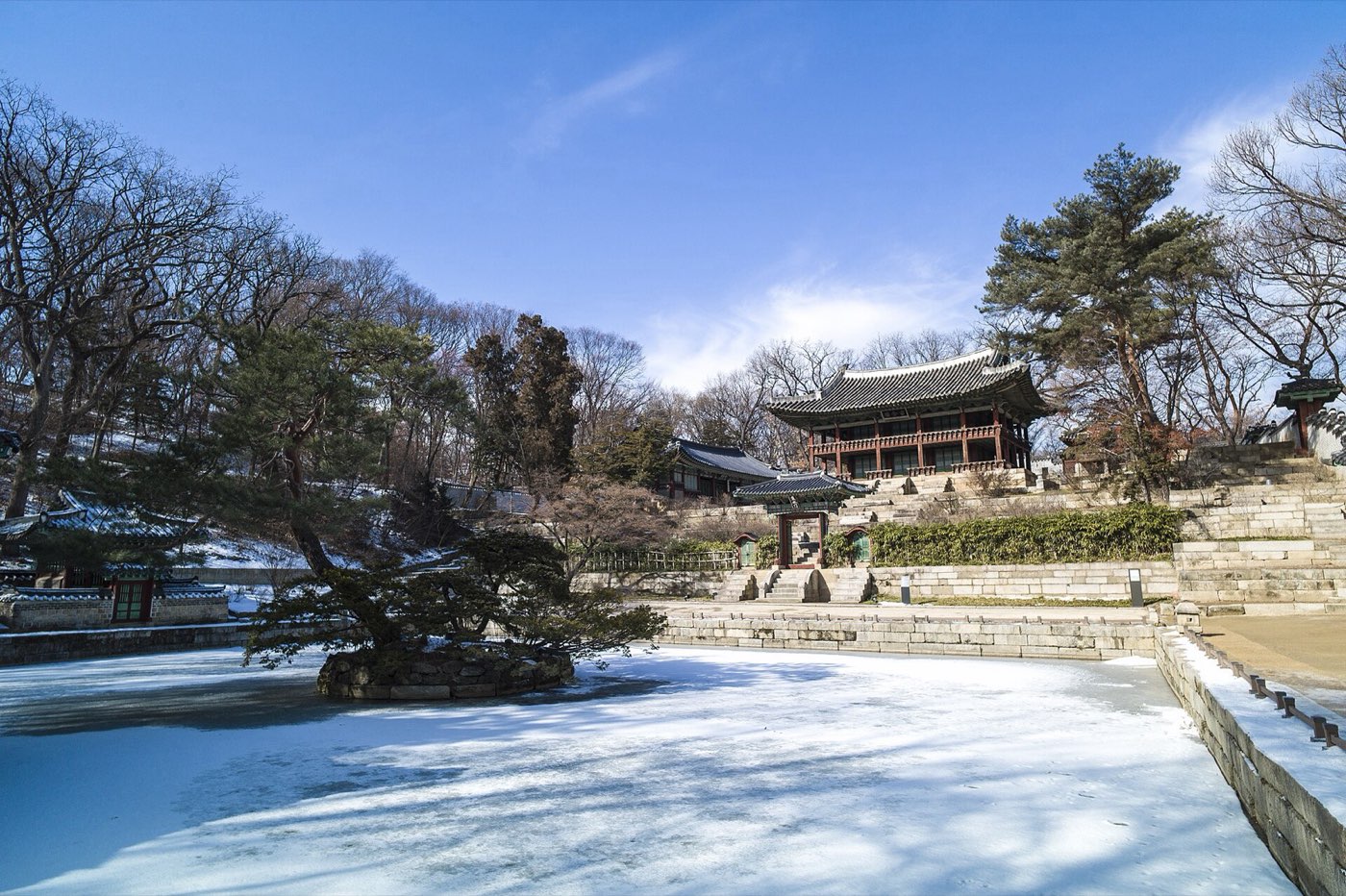
The first valley is the one on postcards. Buyongji (부용지) is a rectangular pond with a small round island planted with pine; the usual reading, rooted in East Asian cosmology, is that the square stands for earth and the circle for heaven. On its south bank the small pavilion Buyongjeong (부용정) stands partly over the water on stone pillars. Across the pond, up a flight of terraces, rises Juhamnu (주합루), built in 1776, the year King Jeongjo took the throne, with the royal library and research institute Gyujanggak (규장각) on its ground floor.
Jeongjo used Gyujanggak to gather promising young scholars around him, and the layout spells out the relationship. The small gate below Juhamnu, Eosumun (어수문), takes its name from fish and water: a ruler needs his officials as a fish needs water. Scholars climbed the terraces toward the library, and the king entertained them by the pond below. Stand at the north edge of the pond and look up the axis of gate, stairs and pavilion; few gardens make a political argument this clearly in so small a space.
Aeryeonji, Yeongyeongdang and the valleys farther in
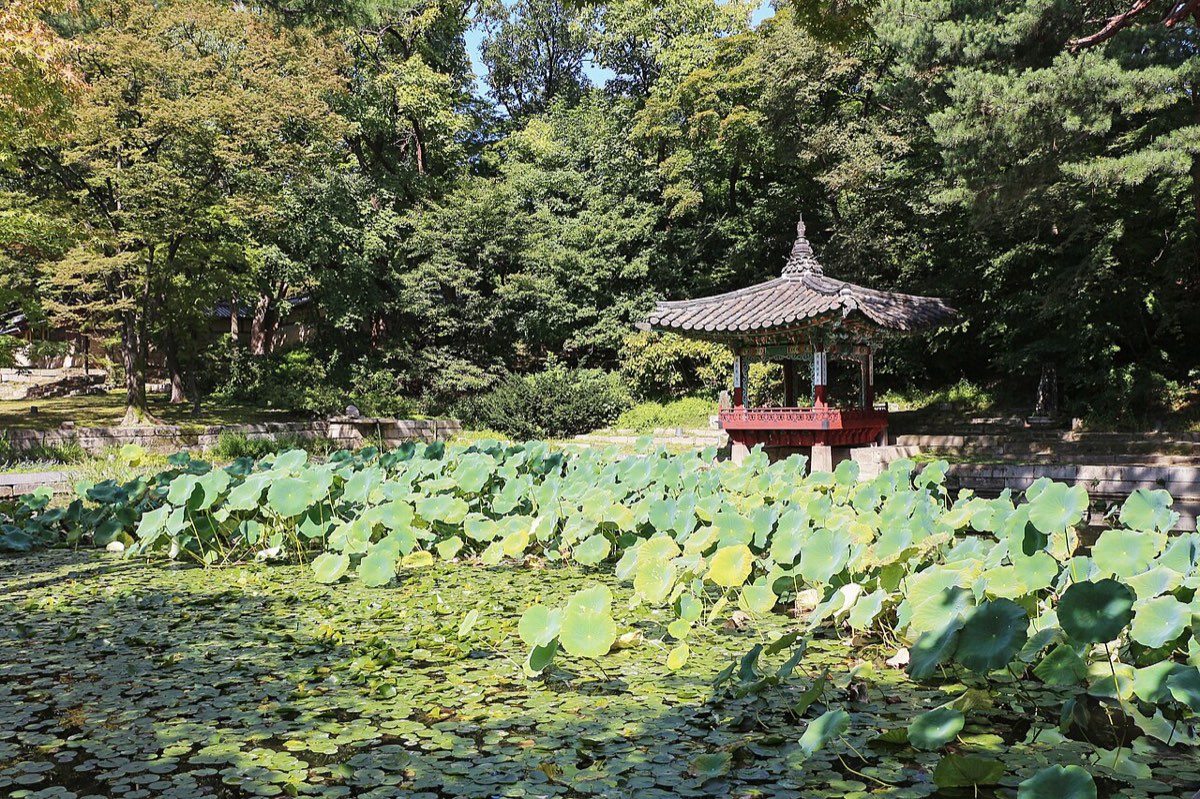
The second valley centers on Aeryeonji (애련지), the lotus pond, and Uiduhap (의두합), a small study beside it. Just beyond stands Yeongyeongdang (연경당), built in 1828 and modeled on the house of a scholar-official rather than a palace: unpainted timber, separate men's and women's quarters, and a plain gate. It shows the royal family cultivating the image of a cultured private household. To our eye it is the finest building in the garden precisely because it does so little, so leave time to look at its rooflines and courtyards slowly.
Gwallamji (관람지), a pond with a fan-shaped pavilion, lies on the standard loop. Deeper in, Jondeokjeong (존덕정) and Ongnyucheon (옥류천), the innermost valley developed from King Injo's reign in the 17th century, where a stream was channeled past small pavilions, appear on the palace's site map but not on its standard route line. Access to those areas has varied over the years. If they matter to you, ask at the ticket office which areas are open that day instead of assuming they are included.
What sets the Huwon apart from a formal European garden or a raked Japanese one is how little it imposes. There are no clipped hedges and no designed vistas leading the eye to a fountain; slopes, old trees and streams were largely left as they were, and pavilions were placed where a view already existed. The ponds are almost the only strict geometry. Read the garden as a series of small rooms for reading, poetry and quiet gatherings, each tucked into its own fold of hill, rather than as one composed landscape.
Which season and which slot to choose
The palace itself warns that Huwon tickets sell out quickly in April–May and October–November, exactly when the garden is at its best: flowering trees and fresh leaves in spring, maple color in autumn. If your dates are fixed in those months, treat the online release as your realistic chance and the morning queue as backup. Winter is quieter and the bare branches open up views of the pavilions, but English sessions drop to three a day; summer is green, hot and humid, so take a morning slot.
Morning slots are the safer choice. The 10:30 English session leaves time for the halls afterward, and if it is full you can still aim for 11:30 or 14:30 on the same day. The 15:30 session offered from March to November finishes late in the afternoon, close to the palace's last entry, so see the halls before it rather than after. Avoid Mondays entirely, and check the palace notice board for holiday closures and suspended sessions before you set an alarm for the booking release.
| Months | Palace hours | Last entry |
|---|---|---|
| February–May, September–October | 09:00–18:00 | 17:00 |
| June–August | 09:00–18:30 | 17:30 |
| November–January | 09:00–17:30 | 16:30 |
Walking on to Changgyeonggung through Hamyangmun
Changdeokgung and Changgyeonggung (창경궁) share a wall and a gate, Hamyangmun (함양문). You buy the next palace's ticket at the small Hamyangmun booth, there is no re-entry, and the gate stops admitting people at Changdeokgung's last entry time. It links the palace-hall area, not the garden, so you cannot walk from Changgyeonggung straight into the Huwon. In practice the best order is Changdeokgung's halls, then the Huwon session, then out through Hamyangmun into Changgyeonggung.
Changgyeonggung makes a calm finish. Admission is 1,000 won, it stays open until 21:00 with last entry at 20:00, and from late afternoon visitors are moved into an evening zone around the throne hall Myeongjeongjeon, the pond Chundangji and the white glasshouse Daeonsil (대온실). It closes on Mondays too. On Saturdays, Sundays, public holidays and Culture Day Wednesdays, a gate on the Yulgok-ro side also opens onto the restored path to Jongmyo Shrine, which needs its own ticket.
A sample half-day: enter Changdeokgung at 09:30 from Anguk Station Exit 3 and spend until 11:10 between Injeongjeon and Nakseonjae. Be at the Huwon entrance by 11:20 for the 11:30 English session, which returns you to the entrance around 13:00. Walk east to Hamyangmun, spend an hour around Myeongjeongjeon, Chundangji and the glasshouse, then leave by the main gate, Honghwamun (홍화문), for lunch toward Hyehwa or Jongno. Hyehwa Station Exit 4 on Line 4 is about 12 minutes from Changgyeonggung on foot.
Questions visitors ask
Can I visit the Secret Garden without a guide?
Not independently. You must enter with a timed session from the garden entrance. Once inside, the palace says you may follow the guide or look around the open sections at your own pace, but you cannot enter outside a session time, and areas closed that day stay closed.
What can I do if the English online tickets are sold out?
Each session keeps 50 tickets for sale at the Changdeokgung ticket office from 09:00 on the day, so arrive early, especially in April, May, October and November. The rules restrict Korean nationals from foreign-language sessions, not the reverse, so a Korean-language session is a fallback if you mainly want to see the garden.
Does the integrated palace pass include the Huwon?
No. The 6,000-won integrated pass covers one entry each to the four royal palaces and Jongmyo, but the Huwon is excluded. Pass holders still need a 5,000-won garden ticket, though they can book the garden online without buying a separate palace-hall ticket if they bring the pass.
Is the Secret Garden worth it in winter?
Yes, if you accept fewer English sessions and colder walking. Bare trees reveal the pavilions and the ponds' geometry more clearly than in leafy months, and tickets are easier to get. Wear shoes with grip, since paths can be icy, and choose the 11:30 session for the warmest part of the day.
How do I get from Changdeokgung to Jongmyo?
On Saturdays, Sundays, public holidays and Wednesdays, go through Hamyangmun into Changgyeonggung and leave by its Yulgok-ro gate, which connects to Jongmyo's north gate; you need a separate Jongmyo ticket. On other days, walk south to Jongno 3-ga. Remember Changdeokgung closes Mondays and Jongmyo closes Tuesdays.
Sources and method
Written for: Independent visitors who want the Secret Garden tour and need to know exactly how tickets, timing and the neighboring palaces fit together.
Method: Researched from the official sources listed below, checked on October 20, 2026. Hours, fees and booking rules can change; the linked official pages are the final word. Spotted something out of date? Tell us.
- Royal Palaces and Tombs Center (Korea Heritage Service) — Visiting hoursChangdeokgung seasonal hours and Monday closure; Huwon session times by language; 100 per session (50 online + 50 on site); Korean nationals in foreign-language sessions; Changgyeonggung hours and Yulgok-ro gate days.
- Royal Palaces and Tombs Center — Admission feesPalace and Huwon prices by age, Huwon free categories, integrated pass excluding Huwon, Wednesday Culture Day exclusion for Huwon, online booking window and 09:00 on-site sales.
- Royal Palaces and Tombs Center — Changdeokgung reservationsHuwon booking from 10:00 six days ahead (visit day excluded) to the day before; palace-hall ticket required unless holding the integrated pass or free status.
- Royal Palaces and Tombs Center — Changdeokgung FAQFree palace-hall guided walks (50–60 min, no booking), Huwon self-paced viewing of open areas, late-arrival rule, mobile ticket timing, terrain warning, Hamyangmun rules.
- Royal Palaces and Tombs Center — Changdeokgung Palace and its history (English)1405 founding, 1406 garden, 1610 rebuild, 270 years as main residence, 1776 Juhamnu and Gyujanggak, 1828 Yeongyeongdang, 1847 Nakseonjae, 1917 fire and 1920 rebuild, Donggwol, royal family history.
- Royal Palaces and Tombs Center — Changdeokgung Palace Complex, UNESCO World Heritage (English)Listed December 6, 1997 under criteria (ii), (iii), (iv); buildings follow the surrounding landscape.
- Royal Palaces and Tombs Center — Changdeokgung tour coursesHall route Donhwamun–Geumcheongyo–Injeongjeon–Nakseonjae; Huwon route Buyongji–Aeryeonji–Gwallamji–Yeongyeongdang; Jondeokjeong and Ongnyucheon shown on the site map.
- Royal Palaces and Tombs Center — Changdeokgung directionsAnguk Station Exit 3 (5 min), Jongno 3-ga Exit 7 (10 min); no parking.
- Royal Palaces and Tombs Center — Changgyeonggung directionsHyehwa Station Exit 4 (12 min); parking closure through Dec 31, 2026 citing Donhwamun repair work.
- Seoul Metropolitan Government Media Hub — Changdeokgung Huwon visiting tips (Apr. 17, 2025)Huwon guided walk takes about 70–90 minutes; online booking through the Royal Palaces and Tombs Center ticketing site.
- Royal Palaces and Tombs Center — October–November 2026 free admission and Changdeokgung entrance noticesFree admission October 29 to November 15, 2026, Secret Garden excluded. Related notices on the same board: Donhwamun repair with Geumhomun as the temporary entrance (October 26, 2024) and the Changgyeonggung night-viewing suspension for November 10–15, 2026.