In shortBuy a T-money card (about 3,000 won) at a convenience store or station machine, load it with cash, and tap it at every subway gate and on every bus, both boarding and leaving. The adult card fare is 1,550 won on the subway and 1,500 won on regular city buses, with free transfers inside a 30-minute window. If you will make two or more separate journeys a day for five days or longer, a Climate Card short-term pass usually costs less.
Key facts
- Subway fare (adult, card)
- 1,550 won for the first 10 km, +100 won per extra 5 km
- Single-journey ticket
- 1,650 won plus a 500 won refundable deposit
- City bus fare (blue/green, card)
- 1,500 won
- Transfer window
- 30 minutes (60 minutes from 9 p.m. to 7 a.m.), up to 4 transfers
- Climate Card short-term passes
- 1/2/3/5/7 days: 5,000/8,000/10,000/15,000/20,000 won, plus a 3,000 won card
- Foreign cards at station machines
- Single tickets and Climate Card passes only, about 3.7% fee
- Tapping a foreign bank card at gates
- Not available as of October 2026
- Owl (N) night buses
- 14 routes, about 11 p.m. to 6 a.m., 2,500 won
Checked Oct 20, 2026 against the official sources listed at the end of this guide.
Why a transit card beats a single-journey ticket
Seoul's subway lines, the Korail commuter lines that run through the city and its city buses share one distance-based fare system. Pay with a transit card and an adult subway ride costs 1,550 won for the first 10 km, plus 100 won for each further 5 km up to 50 km. A single-journey ticket, a contactless card you tap like T-money, costs 100 won more, and the machine also takes a 500 won deposit that you only recover by feeding the ticket into a refund machine at your destination. The bigger difference is that only cards earn transfer discounts, so a bus-plus-subway trip is priced as one journey instead of two.
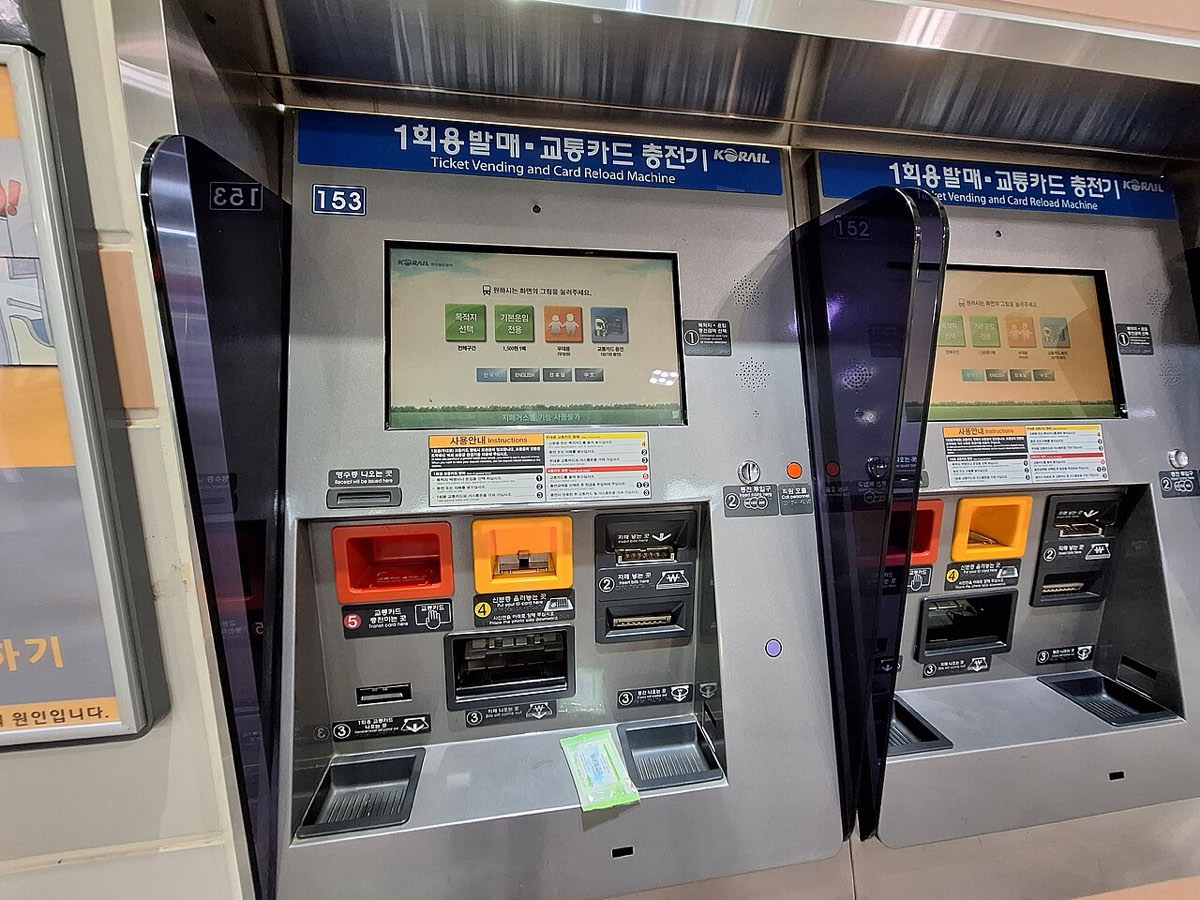
The card nearly everyone uses is T-money (티머니). It is a plain stored-value card: you load won onto it, tap it on the reader at the gate or beside the bus door, and the fare comes off the balance. Convenience stores such as GS25, CU, 7-Eleven and emart24 sell it, as do the vending machines in subway stations, for around 3,000 won before any balance; designer versions cost more. At a store counter, ask for a T-money card and name the amount you want loaded, and the clerk handles the rest.
Every traveler needs a card of their own, because the subway gate reads one card per passenger and a couple cannot share. Children and teenagers ride for less, but Visit Korea notes that travelers under 18 must have their date of birth registered to the card at a convenience store for the reduced fare to apply. One small bonus for early risers: tapping in before 6:30 a.m. takes 20 percent off the base fare, handy if you want a palace gate or a mountain trailhead before the crowds.
Topping up: keep some cash for this one job
Plan on cash for ordinary T-money top-ups. Since March 17, 2026, 440 newer ticket machines in 273 stations on Lines 1 to 8 accept foreign-issued credit and debit cards and several mobile payment apps, but Seoul limits that to buying single-journey tickets and buying or charging Climate Card short-term passes, with an average service fee of 3.7 percent. Topping up a regular T-money card is not on that list, and Tmoney's own visitor guide warns that some machines take cash only. Convenience store counters also charge cards; do not assume a store that takes your foreign card for snacks will accept it for a top-up.
The machine sequence is short. Choose English on the screen, pick the transit card top-up option, set the card on the reader pad, insert notes, and wait for the new balance before lifting the card. Tmoney suggests loading roughly 30,000 to 40,000 won for a three-night, four-day stay, which is a sensible ceiling. Leftover balances can be refunded at convenience stores, minus a small fee, but the card price is not refundable, and Visit Korea says balances above 50,000 won can only be refunded at Tmoney Town near Exit 10 of Seoul Station.
If you would rather not handle cash at all, WOWPASS is the main alternative. It is a prepaid card with a transit function, issued for 5,000 won through its app or at its own kiosks in airports, stations and hotels, and it requires a passport. You recharge it in won or several foreign currencies at those kiosks, and leftover balance comes back as won cash from a kiosk. The trade-off is dependence on finding one of its machines, whereas T-money can be topped up at almost any convenience store in the country.
Climate Card short-term passes: when unlimited rides pay off
Seoul's Climate Card (기후동행카드, Gihu Donghaeng Kadeu) is the city's unlimited-ride pass. The versions that suit visitors are short-term passes of one, two, three, five or seven days, priced at 5,000, 8,000, 10,000, 15,000 and 20,000 won and loaded onto a physical card that costs 3,000 won. A pass covers subway rides within Seoul and Seoul-licensed city, village, night and circular buses. It does not cover the Shinbundang Line, GTX, subway sections outside Seoul, red express buses, airport buses or buses licensed by neighboring cities.
Two rules decide whether it suits you. First, validity runs by calendar day: a pass starts on the day you charge it, from the first train, and ends with the last train of its final day, so a one-day pass charged at 1 p.m. is finished that night, and passes cannot be charged in advance. Second, a subway trip must begin and end inside the coverage area; ride out of Seoul and station staff charge the fare for the whole trip. One useful exception: you may board inside the zone and get off at Incheon Airport Terminal 1 or 2, though a trip cannot start there.
Now the arithmetic. On T-money, a transfer inside the time window costs nothing extra, so count journeys rather than rides. A three-day pass works out to about 3,333 won a day and beats card fares once you make three separate journeys daily. The five- and seven-day passes, at 3,000 and about 2,857 won a day, win at two journeys. The one-day pass needs four. Add the 3,000 won card and the verdict is clear: buy a five- or seven-day pass for a week of sightseeing, and stay on T-money for shorter stays. Refunds require a Korean bank account or a trip to Tmoney's headquarters, so treat the pass as spent.
Buy the pass at the newer vending machines in Line 1 to 8 stations, which accept foreign cards, or at the Myeongdong and Seoul Tourism Plaza tourist information centers, Line 1 to 8 customer service offices (cash only) and convenience stores near stations. Tmoney says the tourist pass is not sold at the airport, so your first ride into the city goes on T-money or a single ticket. Like T-money, a Climate Card is one card per person.
| Option | Cost (October 2026) | Best for | Watch out for |
|---|---|---|---|
| T-money | Card about 3,000 won; fares 1,550 won subway, 1,500 won bus | Short stays, irregular days, trips beyond Seoul | Top-ups mostly cash; card price not refundable |
| Climate Card short-term pass | 5,000 to 20,000 won for 1 to 7 days, plus a 3,000 won card | Five to seven days of steady sightseeing inside Seoul | Calendar-day validity; no Shinbundang, red or airport buses |
| WOWPASS | 5,000 won card; passport required | Travelers who want to avoid cash | Recharge and cash-out only at its kiosks |
| Single-journey ticket | 1,650 won plus 500 won deposit | A one-off ride | No transfer discount; deposit refund step at exit |
Your contactless bank card is not a ticket yet
Visitors used to tapping a Visa or Mastercard at a London or Singapore gate often try the same here. As of October 2026 it still does not work in Seoul. The city is moving toward EMV open-loop payments in stages through 2030, and in September 2026 Tmoney signed agreements with Visa, Mastercard, UnionPay, JCB and Hana Card, naming Seoul city buses as the first target for next year. The agreement set no date for the subway. Until a launch is announced, keep your bank card out of the same sleeve as your T-money card so the reader does not get confused.
You will see Seoul residents tapping what look like ordinary bank cards. Those are Korean-issued credit cards with a built-in transit function, billed monthly, which the subway operator accepts alongside prepaid cards. Foreign cards do not have that function yet. The one place a foreign card helps today is the newer station machine, where it buys a single-journey ticket or a Climate Card pass without cash, at the cost of the service fee.
Transfers: the 30-minute window and the tap people forget
Changing lines inside the subway is free as long as you stay behind the gates. Between subway and bus, or bus and bus, you get the transfer discount when you board the next vehicle within 30 minutes of tapping off the last one; from 9 p.m. to 7 a.m. the window stretches to 60 minutes. You can transfer up to four times, five rides in all, but reboarding the same bus route does not count. The combined trip is charged at the highest base fare among the modes you used plus distance charges beyond 10 km, and cash payers get no transfer discount at all.
On a bus you board at the front door and tap, then tap again on the reader by the middle or rear door before you step off. Tmoney calls forgetting that second tap the most common mistake foreign riders make: you lose the transfer discount and may be charged extra on your next ride. Bus colors tell you the type of route. Blue trunk buses run long distances on main roads, green branch buses connect neighborhoods to stations, yellow circular buses loop the center, and red express buses run to the suburbs for 3,000 won. Small green village buses (마을버스, maeul beoseu) cost 1,200 won.
For short hops between central sights, a bus that stops near a palace gate can beat a subway trip that involves long corridors, stairs and an exit climb, and you see the city on the way. For anything crossing the Han River or running more than a few kilometers through traffic, the subway's predictability wins, especially at rush hour. Your map app will compare both; when the times are close, take whichever leaves you nearer the entrance you actually want.
Exit numbers are the addresses that matter
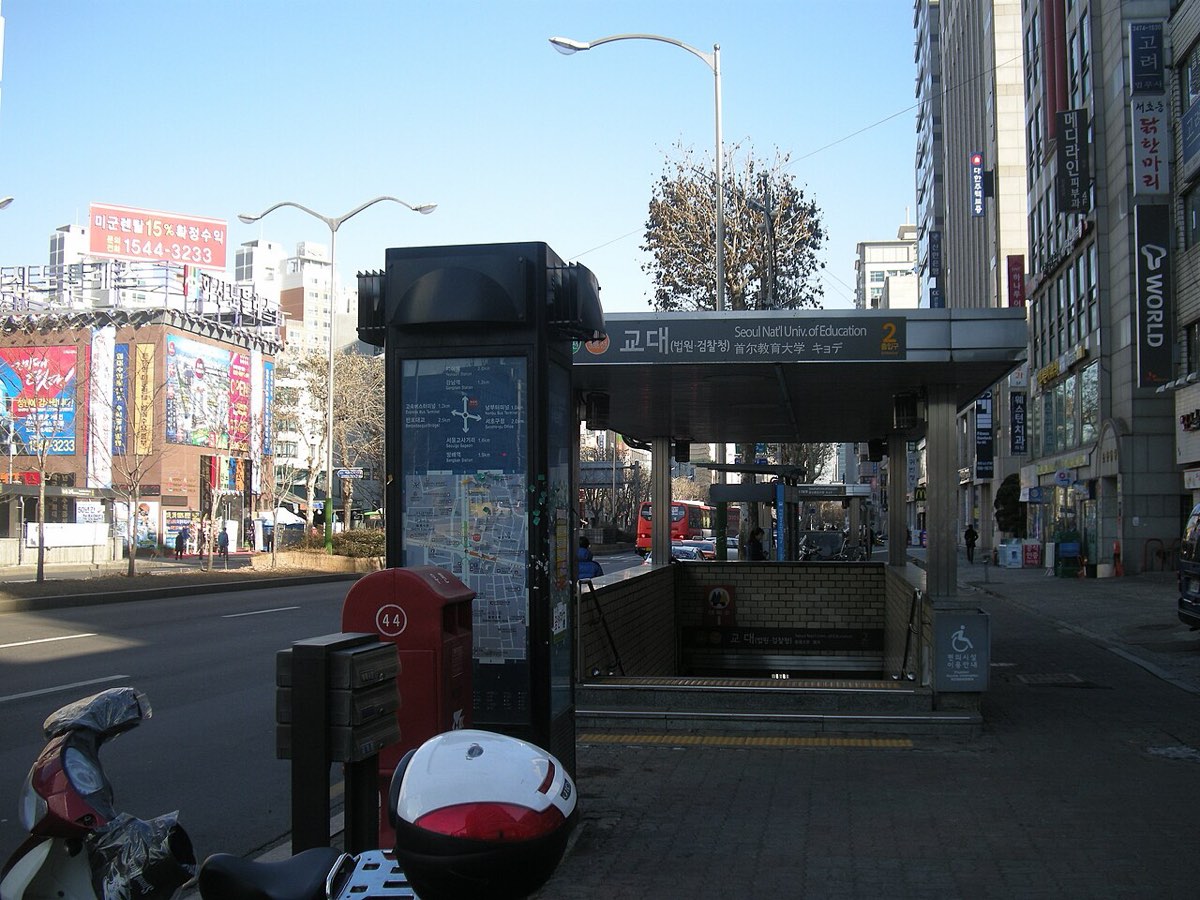
Koreans give directions as a station plus an exit number, and you should too. Every exit is numbered, signs inside the station point to them, and choosing the right one can spare you a long detour around a wide boulevard. The palace offices publish exits in their own directions: Gyeongbokgung Station (Line 3) Exit 5 for Gyeongbokgung, two minutes on foot; Anguk Station (Line 3) Exit 3 for Changdeokgung, five minutes; City Hall Station (Lines 1 and 2) Exit 2 for Deoksugung, two minutes; Jongno 3-ga Station Exit 11 or 8 for Jongmyo, five minutes; and Hyehwa Station (Line 4) Exit 4 for Changgyeonggung, about 12 minutes.
Decide on your exit before you tap out. Large interchange stations have a dozen or more exits spread across several blocks, and surfacing on the wrong side can mean an underpass or a long wait at a crossing. The neighborhood maps posted near the gates show which landmarks sit above each exit. When you arrange to meet someone, 'Anguk Station, Exit 3' is a complete, unambiguous address in Seoul; 'Anguk Station' on its own is the start of a phone call.
Worked example: Changdeokgung to Deoksugung by subway
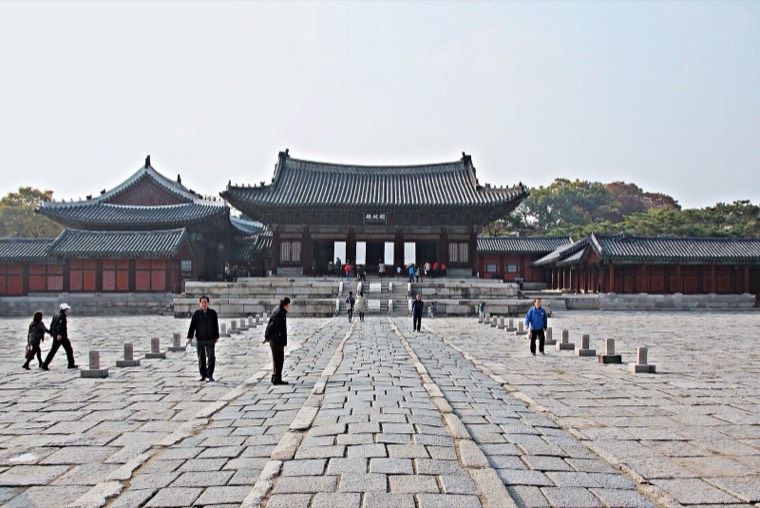
Suppose you leave Changdeokgung through its main gate, Donhwamun, at 11:40. You have two subway options. The obvious one is Anguk Station Exit 3, five minutes away, but from there you would ride Line 3 one stop and then change to Line 1 at Jongno 3-ga, adding a transfer to a short journey. The better move is to walk about ten minutes to Jongno 3-ga Station Exit 7, which the palace office lists as its second entrance option, and board Line 1 directly.
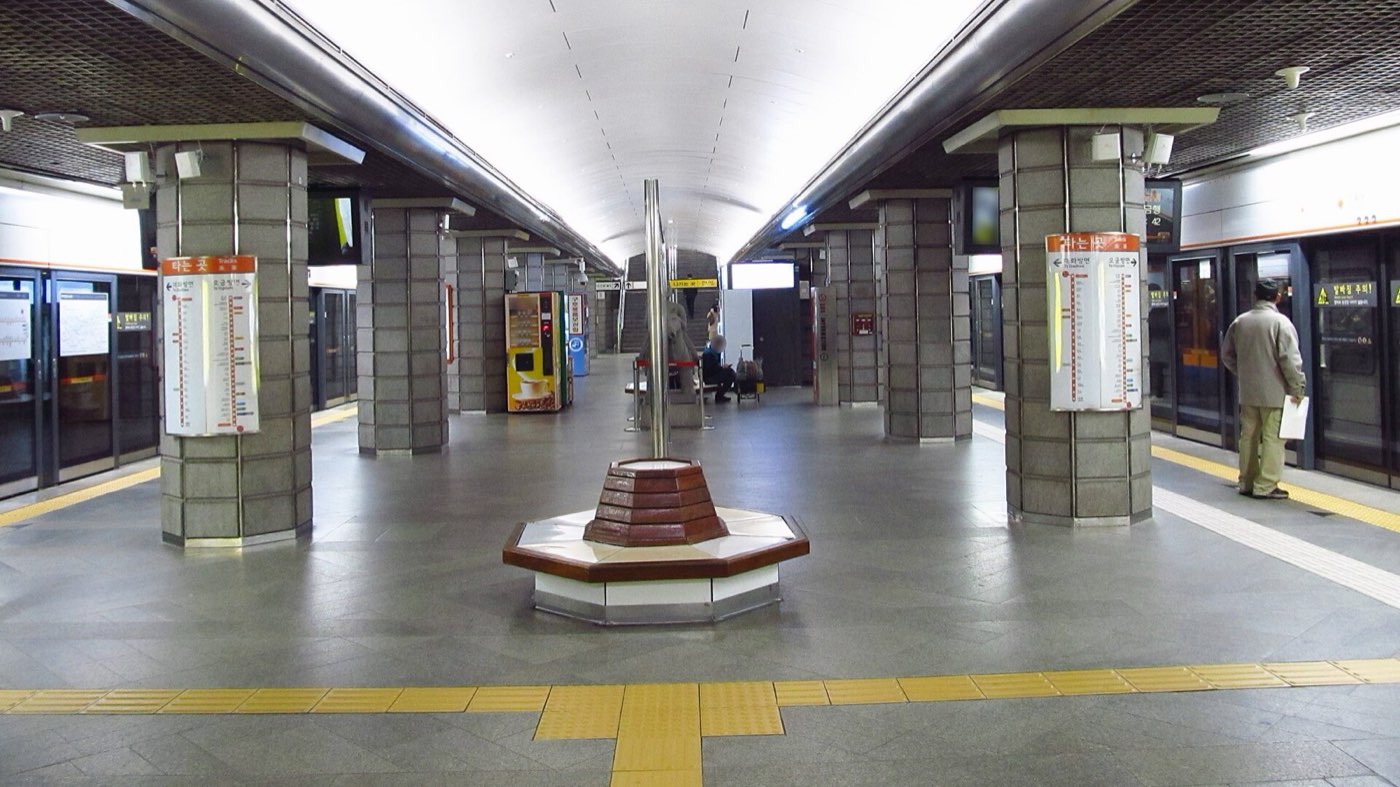
Inside Jongno 3-ga, tap in and follow the Line 1 signs to the platform for trains toward Seoul Station (서울역, Seoul-yeok). Ride two stops, past Jonggak, to City Hall (시청, Sicheong). The trip is well under 10 km, so the card fare is the 1,550 won base. Tap out, follow the signs for Exit 2, and Daehanmun, Deoksugung's main gate, is a two-minute walk away. Allow roughly 25 minutes door to door, which leaves room for lunch near City Hall before you go in.
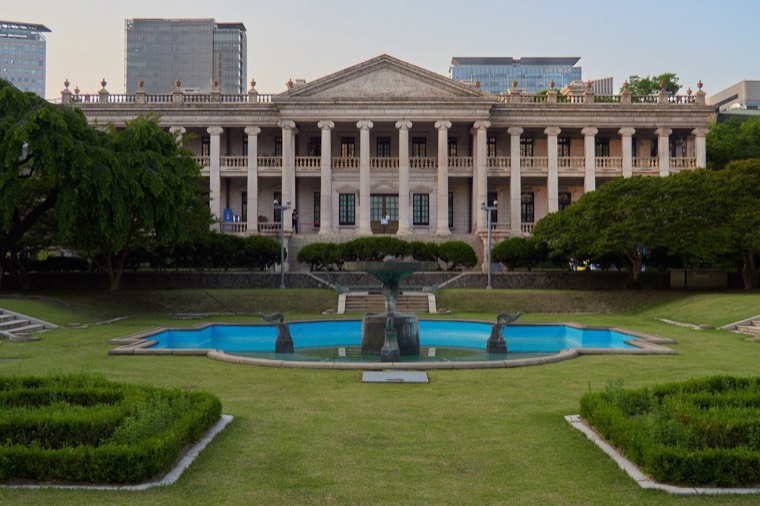
Two checks make this pairing work. Both palaces close on Mondays, so plan it for Tuesday to Sunday. And order matters: Changdeokgung closes between 5:30 and 6:30 p.m. depending on the season, with last entry an hour earlier, while Deoksugung's grounds stay open until 9 p.m. with last entry at 8 p.m. Doing Changdeokgung first means a long lunch or a slow afternoon costs you nothing, and Deoksugung's stone buildings look their best once the lights come on.
Last trains, Owl buses and small courtesies
The subway does not run all night. Last trains leave around midnight, and the exact time varies by line, direction and day of the week, so check the last departure from your station in your map app before an evening performance. After that, Seoul runs 14 overnight Owl bus routes, numbered with an N, from about 11 p.m. to 6 a.m., at 2,500 won by card. Seoul-licensed night buses are covered by the Climate Card, which makes a late return free if you hold a pass.
Etiquette on Seoul transit is mostly about space and noise. Let passengers off before you board and step clear of the doors. Seats at the ends of each car are set aside for older, disabled and pregnant riders, and many passengers leave them empty even when the car is full. Keep calls brief and quiet, take a large backpack off in a packed car, and hold on as soon as you board a bus, because drivers often pull away before everyone is seated.
Questions visitors ask
Can two people share one T-money card on the subway?
No. The subway gate reads one card per passenger, so each traveler needs a card. Children and teenagers should have their date of birth registered to their card at a convenience store, otherwise the reduced youth and child fares will not apply.
Can I tap my own Visa or Mastercard at the gate instead?
Not yet. As of October 2026, foreign contactless cards cannot be used at Seoul subway gates or on buses. Tmoney and the card networks plan to start with Seoul city buses in 2027, with no subway date announced. A foreign card can buy single tickets or Climate Card passes at the newer station machines, with a fee of about 3.7 percent.
Is a Climate Card pass worth it for a three-day trip?
Only if you make at least three separate journeys every day. The three-day pass costs 10,000 won plus a 3,000 won card, while three days of two daily journeys on T-money cost 9,300 won. Five- and seven-day passes are the better value, paying off at two journeys a day.
What happens if I forget to tap off when leaving a bus?
You lose the transfer discount for your next ride, and Tmoney warns you may be charged extra on that next trip. Tap the reader by the middle or rear door every time, even if you are not planning to transfer.
Can I ride to Incheon Airport on a Climate Card pass?
Yes, by rail, if you board at a station inside the pass's Seoul coverage area: getting off at Incheon Airport Terminal 1 or 2 is allowed. You cannot start a trip at the airport on the pass, and airport buses are excluded.
Sources and method
Written for: First-time independent visitors who will ride Seoul's subway and city buses to palaces, museums and old neighborhoods.
Method: Researched from the official sources listed below, checked on October 20, 2026. Fares, pass rules and payment options can change; the linked official pages are the final word. Spotted something out of date? Tell us.
- Seoul Metro: Passenger Transport Terms and ConditionsCard and single-ticket fares, distance charges, transfer window and four-transfer limit, tap-off rule, early-bird discount, Korean-issued credit transit cards.
- Seoul Metro: TicketsSingle-journey ticket 500 won deposit and refund machine at exit.
- Seoul Metropolitan Government: BusBus fares by type (1,500 / 3,000 / 1,200 / Owl 2,500 won), bus color system, transfer rules.
- Seoul Metropolitan Government Transport: Climate Card short-term pass (기후동행카드 단기권 소개)Pass prices, coverage and exclusions, Incheon Airport alighting exception, calendar-day validity, 3,000 won card, refund rule; page modified 2026-10-12.
- Seoul Metropolitan Government Transport: overseas cards at new ticket machines from March 17, 2026440 machines at 273 stations on Lines 1-8; foreign cards for single tickets and Climate Card passes only; average 3.7% fee.
- The Korea Herald: Foreign cards to work on Seoul buses from 2027 (September 18, 2026)Tmoney agreement with Visa, Mastercard, UnionPay, JCB and Hana Card; Seoul city buses first in 2027, then Incheon and airport buses; foreign cards cannot yet be tapped.
- Tmoney: Getting Around Korea After You ArriveCard price and sale points, cash-only machines, suggested load, refunds, tap-off mistake, one card per person, Climate Card sale points and no airport sales.
- VisitKorea: Transportation CardsUnder-18 birth-date registration, refund threshold and Tmoney Town location, WOWPASS details, Climate Card sale points.
- Seoul Metropolitan Government Transport: Owl buses (심야 올빼미버스)14 overnight routes, 140 buses, service 23:00-06:00, 2,500 won by card, route table with first and last departures; page modified 2026-03-20.
- Royal Palaces and Tombs (Korea Heritage Service): DirectionsOfficial station exits and walking times for Gyeongbokgung, Changdeokgung, Deoksugung, Jongmyo and Changgyeonggung.