In shortCentral Seoul usually colors from late October into early or mid-November, a little after Bukhansan, whose average peak is October 28; the first week of November is the safest bet. For one walk, book Changdeokgung's Secret Garden, then add Changgyeonggung's pond and Deoksugung's stone-wall road at dusk. Palace admission is free from October 29 to November 15, 2026, but the Secret Garden still needs a paid, timed ticket.
Key facts
- Usual color in central Seoul
- Late October to mid-November; downtown trails the mountains
- Bukhansan average (KMA)
- First color October 15, peak October 28; 2026 first color October 14
- 2026 forecast
- National peak October 30 (ginkgo) and October 31 (maples); Seoul area from late October
- Free palace entry
- October 29–November 15, 2026; closing days apply; Secret Garden still paid
- Secret Garden in November
- English sessions 10:30, 11:30, 14:30, 15:30; 5,000 won
- Open until 21:00
- Deoksugung and Changgyeonggung (Changgyeonggung to 17:30 on November 10–15, 2026)
- Map searches
- 창덕궁 · 창경궁 · 경복궁 · 덕수궁 · 남산 · 서울숲Naver Map
Checked Oct 28, 2026 against the official sources listed at the end of this guide.
Why the city center turns later than the mountains
Seoul gets its autumn color in two waves, and most disappointment comes from confusing them. The first wave is on the mountains. The Korea Meteorological Administration (KMA) tracks Bukhansan (북한산), the granite massif on the city's northern edge, and records first color when about a fifth of the mountain has turned from the summit down, and the peak when about 80 percent has. Its 1991–2020 averages put Bukhansan's first color on October 15 and its peak on October 28. In 2026 the first color arrived on October 14, a day ahead of the average.
The second wave is in the city itself: palace gardens, park groves and the ginkgo trees that line downtown streets. Nobody forecasts a palace pond, so treat the national outlooks as a frame. The Korea Forest Service's 2026 forecast, issued on September 22, puts the national peak, defined as half of a tree's leaves turned, at October 30 for ginkgo and October 31 for maples and oaks, slightly later than the five-year average. A foliage map released on October 8 by the Korea Tourism Organization and the Korea National Arboretum expects the Seoul metropolitan area to peak from late October.
Downtown trees usually lag behind the mountain. When Seoul published its list of autumn walking roads in October 2025, it expected the Bukhansan area to peak around October 25 and the city center from the end of October into early or mid-November. Our reading for 2026: between October 28 and November 12 the palaces should show strong color, and the first week of November is the safest bet for maples and street ginkgo together. After mid-November the show thins fast, and one night of wind and rain can strip a ginkgo avenue.
Changdeokgung's Secret Garden: book this one first
If you can take only one autumn walk in Seoul, make it the Huwon (후원), the royal garden behind Changdeokgung (창덕궁). Its maples grow in folded valleys around ponds and small pavilions that were placed where the views already were, so the color frames architecture rather than a lawn. The square pond Buyongji, the lotus pond Aeryeonji and the pond Gwallamji lie on the standard route. The walk involves real slopes and unpaved earth that turns slick after rain. Our Changdeokgung guide reads the garden building by building.
Entry is only by timed session, and autumn is when sessions sell out. Each language session takes 100 people: 50 tickets go on sale online at 10:00 Korea time six days ahead, and 50 are sold at the palace ticket office from 09:00 on the day. In November, English sessions start at 10:30, 11:30, 14:30 and 15:30; from December the 15:30 session is dropped. The garden ticket costs 5,000 won for adults. From November, Changdeokgung keeps winter hours of 09:00 to 17:30, with last entry at 16:30, and it closes on Mondays.
One trap catches visitors every year: free palace weeks do not include the garden. From October 29 to November 15, 2026, Changdeokgung's halls are free, but the Huwon keeps its paid, timed ticket, so book it exactly as you would in any other week. Skip the garden if stairs and uneven ground are a problem or if you cannot commit to a fixed time. Changgyeonggung next door gives you maples without either constraint.
Changgyeonggung's pond and Gyeongbokgung's island pavilion
Changgyeonggung (창경궁) shares a wall with Changdeokgung, and a connecting gate, Hamyangmun (함양문), lets you walk from one to the other. Its pond, Chundangji (춘당지), is the most relaxed foliage spot among the palaces: no booking, open ground around the water and maples leaning over the banks. The palace normally opens from 09:00 to 21:00, with last entry at 20:00, which makes it the place to watch the color fade into lamplight. One exception in 2026: from November 10 to 15, daytime visits end at 17:30 while a separately booked night program uses the grounds.
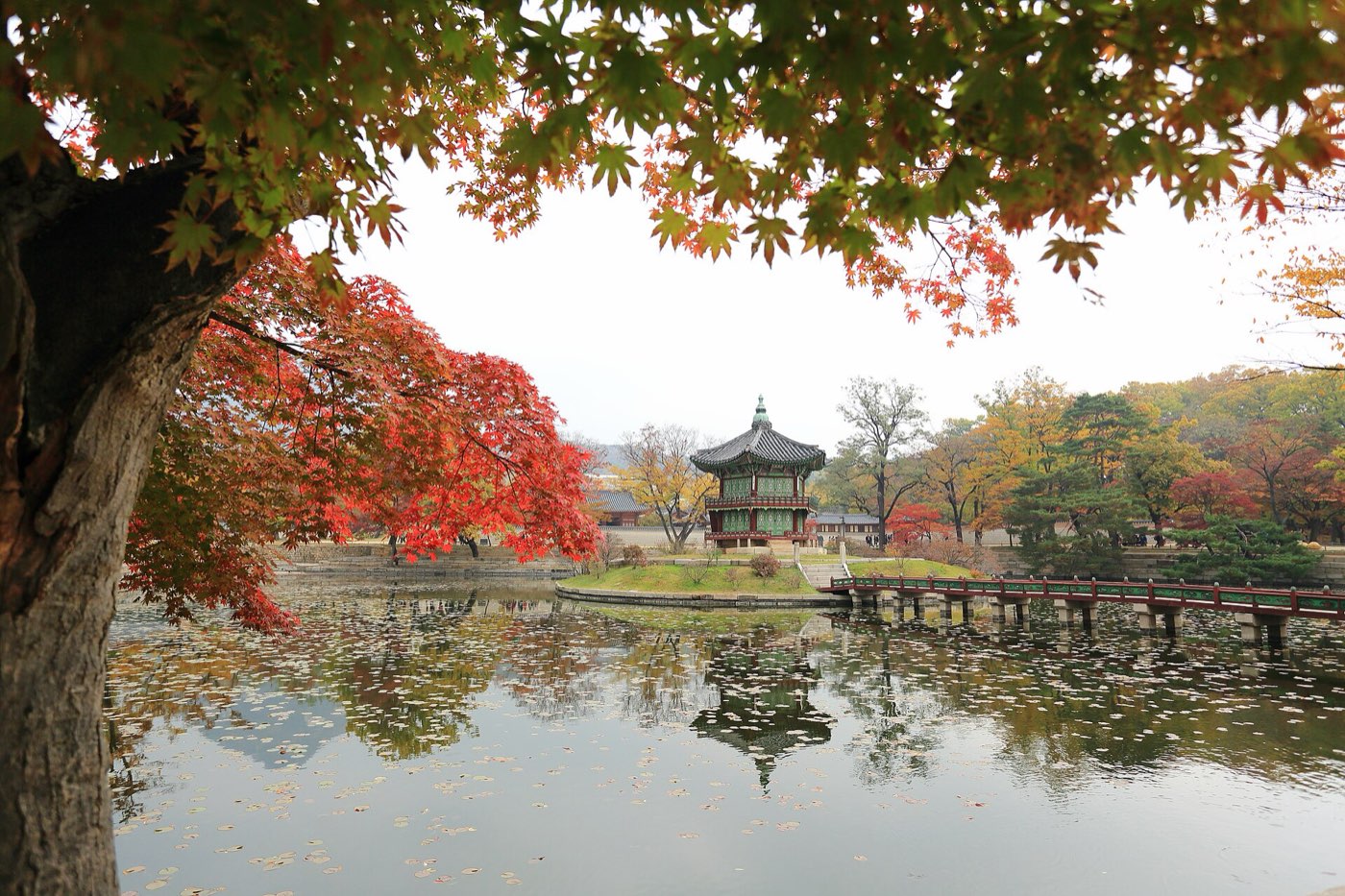
At Gyeongbokgung (경복궁), walk north past the throne hall to Hyangwonjeong (향원정), the small two-story hexagonal pavilion on an island in a square pond, reached by the wooden bridge Chwihyanggyo (취향교). King Gojong added it to his private garden in the 1870s, and in a good year the maples on the bank turn the water red around it. A restoration finished in 2021 moved the bridge back to the island's north side, so older photographs show it facing the other way.
Gyeongbokgung closes on Tuesdays, and from November 1 it switches to winter hours, 09:00 to 17:00 with last entry at 16:00, so the warm late light is short. It is also the busiest palace. Go at opening and head straight for the pond before the tour groups arrive, then come back to the throne hall. The front courtyards look much the same at 11:00 as at 09:00; the pond does not.
Namsan: mountain color without leaving the center
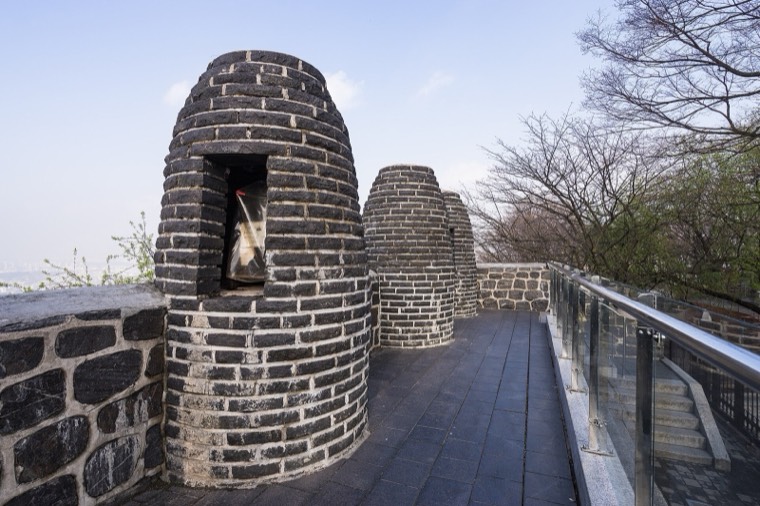
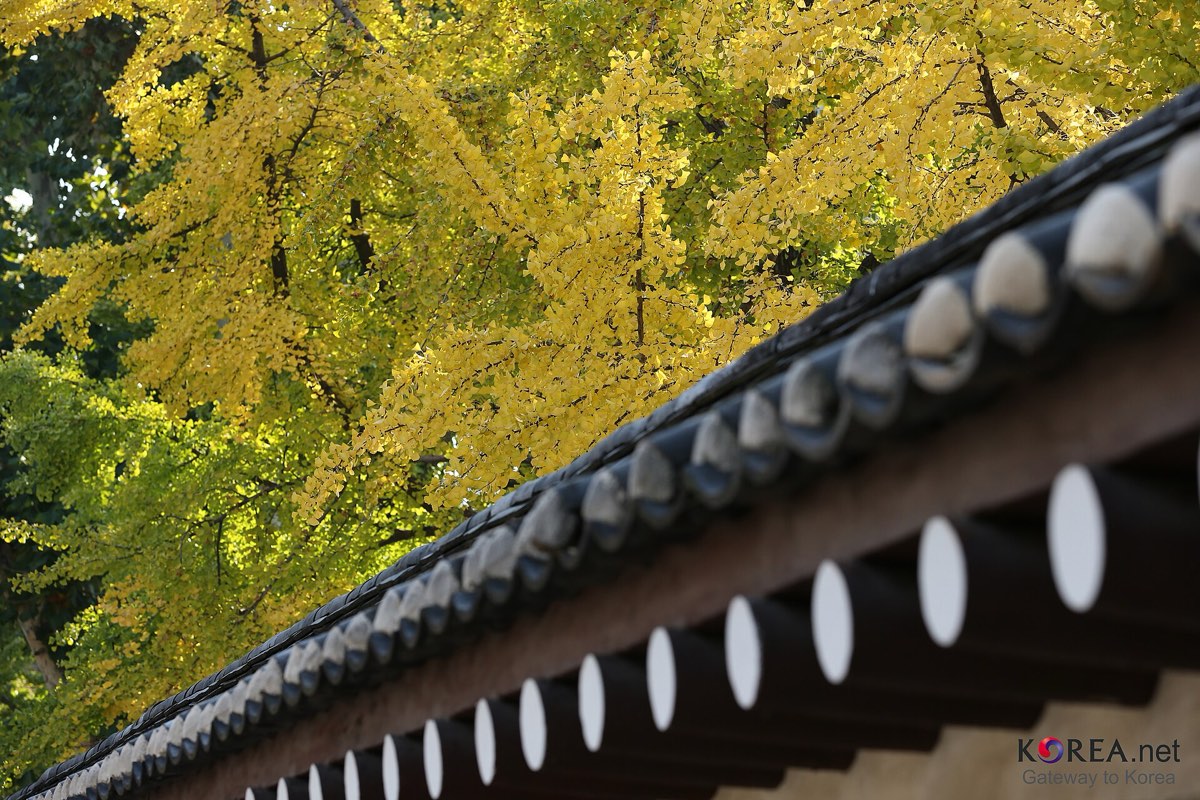
Namsan (남산) gives you mountain foliage inside the city. Its slopes carry mixed woodland, the Joseon-era city wall, Hanyangdoseong (한양도성), runs along its ridge, and N Seoul Tower stands at the top. Seoul lists Namsan Park among its autumn walking roads partly because its park roads carry no ordinary traffic, so you can follow the curves without dodging cars. Color here tends to follow the city center more than Bukhansan, which makes Namsan a good substitute on a day when the palace you wanted is closed.
Choose your direction by the light. Walking up from Namsangol Hanok Village in mid-afternoon puts the sun behind the maples as you climb, and you reach the summit for the long view over a city turning gold and gray at once. If your knees prefer it, ride up and walk down instead. Our Namsangol and Namsan guide gives the bus routes, the cable car and the official city-wall section, so you can pick the version that suits you.
Namsan is the wrong choice in haze or rain. Its appeal is the pairing of leaves and long views, and on a gray day you get damp stairs without either. Check the sky in the morning, and if visibility is poor, swap Namsan for Seoul Forest or a palace garden.
Seoul Forest: ginkgo gold without a ticket
Seoul Forest (서울숲) opened in 2005 on almost 50 hectares beside the Han River, and the city lists it among its autumn walks for a grove of about 600 ginkgo trees. It is a different experience from the palaces: no ticket, no closing day, no timed session and room for children to run. The park is open 24 hours and free. Seoul Forest Station on the Suin-Bundang Line is about 240 meters away from Exits 3 and 4, and Ttukseom Station on Line 2 about 540 meters from Exit 8.
Ginkgo is a different kind of autumn from maple. The yellow arrives almost at once, holds for a short spell and then drops in a carpet, often after a windy night. Female trees also shed seeds whose fleshy coats smell strongly when crushed, so watch where you step. Seoul Forest is our pick for a Monday, when Changdeokgung, Changgyeonggung and Deoksugung are all closed, and for families who would rather picnic than queue.
The park also sits beside Seongsu-dong, the former factory district now packed with cafés and design shops, so a morning among the ginkgo turns easily into lunch. Walk the wooded paths first, while the light is low and the grove is quiet, and keep the riverside edge of the park for later. Unlike the palaces, the park has no closing hour, so an early start costs you nothing.
Deoksugung and the stone-wall road after dark
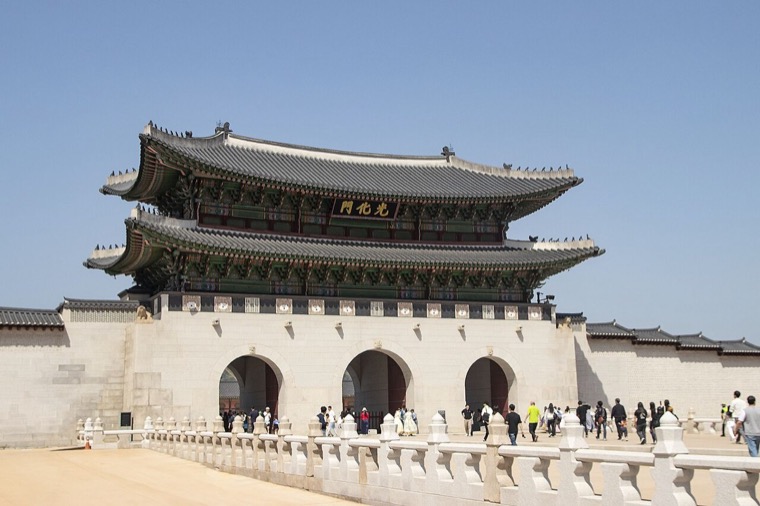
Deoksugung (덕수궁) is the palace for people who have spent the day elsewhere. It stays open until 21:00, with last entry at 20:00, closes on Mondays and normally costs 1,000 won, and its trees glow under the lamps in a way the morning palaces never show you. It is compact: an hour inside is enough unless you also want the guided interior of Seokjojeon, the stone hall of Emperor Gojong's Korean Empire.
Outside the wall, the road that curves along Deoksugung's stone wall toward Jeongdong-gil (정동길) is one of Seoul's classic autumn streets. The city includes Jeongdong-gil in its list of autumn roads for its ginkgo trees set against modern-era buildings, and from the palace's main gate to the Jeongdong crossroads is a short stroll. Both are public streets, open at every hour, so the walk still works after the palace has closed.
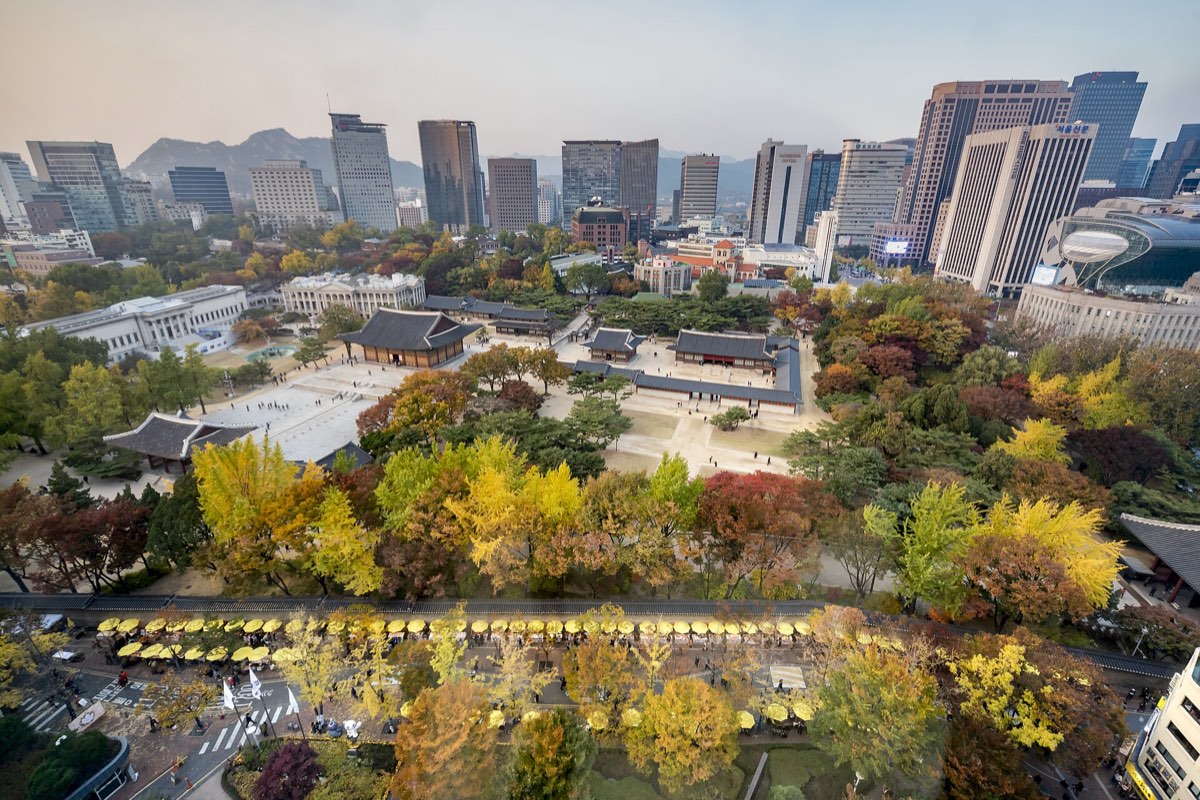
Our judgment: this is the best autumn plan for an evening and a poor one for a morning. The gray stone and yellow leaves need low light to look their best, and the palace grounds are calmer after 18:00 than at noon. Pair it with dinner near City Hall, and save it for the end of a day built around the other palaces.
Free entry, crowds and when to be where
From October 29 to November 15, 2026, admission is free for everyone at Gyeongbokgung, Changdeokgung, Changgyeonggung, Deoksugung, Jongmyo and the Joseon royal tombs during the Korea Grand Festival. Regular closing days still apply: Gyeongbokgung and Jongmyo close on Tuesdays and the other palaces on Mondays. The Secret Garden keeps its paid, timed tickets, and Jongmyo opens for self-guided visits on every open day of the period.
Free entry and peak color together bring the heaviest palace crowds of the year, especially on the three weekends inside the period. Three habits help. Arrive at 09:00, when the gates open, and go to the garden or pond before the courtyards. Put Gyeongbokgung and the Secret Garden on weekdays. And save Changgyeonggung and Deoksugung, the two palaces open until 21:00, for late afternoon, when the day visitors thin out.
Two calendar details are worth knowing. Every Wednesday is already a free Culture Day at the palaces except Gyeongbokgung and the Secret Garden, so the free period changes weekends far more than midweek days. And the period ends on Sunday, November 15, about when downtown color usually starts to fade; from November 16 normal fees return, 3,000 won at Gyeongbokgung and Changdeokgung and 1,000 won at Changgyeonggung and Deoksugung.
| Place | Best for | Closed | Hours in November | Ticket |
|---|---|---|---|---|
| 창덕궁 후원 Secret Garden | Maples in pond valleys | Monday | Timed sessions; English 10:30, 11:30, 14:30, 15:30 | 5,000 won, also during free weeks |
| 창경궁 Changgyeonggung | Maples around Chundangji | Monday | 09:00–21:00 (17:30 on Nov 10–15) | Free Oct 29–Nov 15; otherwise 1,000 won |
| 경복궁 Gyeongbokgung | Maples by Hyangwonjeong | Tuesday | 09:00–17:00, last entry 16:00 | Free Oct 29–Nov 15; otherwise 3,000 won |
| 덕수궁 Deoksugung | Ginkgo and evening walks | Monday | 09:00–21:00, last entry 20:00 | Free Oct 29–Nov 15; otherwise 1,000 won |
| 남산 Namsan | Slopes and skyline | None | Trails open at all hours | Free |
| 서울숲 Seoul Forest | Ginkgo grove | None | Park open 24 hours | Free |
Photographing leaves without becoming the obstacle
Palace rules are relaxed about ordinary photography: visitors' souvenir photos count as permitted. Commercial shoots for film, drama or advertising need a paid permit, character costumes and similar props need separate permission, and drone filming is limited to approved public-interest work, so leave the drone at the hotel. Staff can also restrict photography in particular spots to prevent crowding, which tends to happen at exactly the ponds this guide sends you to.
The rest is courtesy. Stay on paths and outside ropes, because closed areas need permission to enter. Do not shake branches for a falling-leaf shot or sweep leaves into piles; others are waiting for the same tree. The rules do not ban tripods outright, but on a narrow pond edge one blocks a whole line of people, so set it up only when the path is empty. In the Secret Garden, keep up with your group and step aside to shoot. And treat people in hanbok as fellow visitors, not props: ask before a close portrait.
For the pictures themselves, mornings give still water and reflections at Hyangwonjeong and Chundangji, while afternoon sun shining through maples gives the glowing red that photographs best. Shade under palace eaves is deep, so expose for the leaves rather than the roofs. In November the palaces that close early shut before the best evening light, one more reason to end the day at Deoksugung.
A half-day route for peak week
This version works from Tuesday to Sunday and takes about five hours. Six days ahead, at 10:00 Korea time, book the 10:30 English session of the Secret Garden. On the day, reach Changdeokgung at 09:00 from Anguk Station on Line 3 and spend an hour among the halls. At 10:30 join the garden session. Around midday, walk through Hamyangmun into Changgyeonggung for 40 minutes at Chundangji, then leave for lunch toward Jongno.
In the afternoon, take the subway or a taxi to City Hall and enter Deoksugung around 15:00. Walk the grounds as the light lowers, then leave by the main gate and follow the stone-wall road to Jeongdong-gil before dark. The only fixed appointment in the day is the garden session; everything else can slide by half an hour without harm.
On a Monday, when those three palaces close, switch the order: Gyeongbokgung at 09:00 and straight to Hyangwonjeong, then Seoul Forest for ginkgo in the afternoon. On a Tuesday, run the main route and add Namsan at the end instead of the evening walk if the sky is clear. If you have only one evening, skip the rest and go to Deoksugung from 17:00, then the stone-wall road.
Questions visitors ask
When is the best week to see autumn leaves in Seoul's palaces?
In most years, the first week of November. Bukhansan on the city's edge peaks first, with a KMA average of October 28, and palace gardens and street ginkgo downtown usually follow from the end of October into early or mid-November. The Korea Forest Service's 2026 forecast put the national peak at October 30 for ginkgo and October 31 for maples.
Is the Secret Garden free during the October 29 to November 15 free-entry period?
No. The free period covers palace admission at Changdeokgung, but the Huwon garden keeps its paid, timed tickets: 5,000 won for adults, with half of each session sold online from 10:00 six days ahead and half at the ticket office from 09:00 on the day. Book it as early as you would in any other autumn week.
Where can I see autumn leaves in the evening?
Deoksugung and Changgyeonggung stay open until 21:00, with last entry at 20:00, and both close on Mondays. In 2026 Changgyeonggung's visits end at 17:30 from November 10 to 15. The stone-wall road outside Deoksugung and Jeongdong-gil are public streets you can walk at any hour.
What should I change if it rains during peak foliage?
Light rain deepens the color and empties the palaces, so keep a palace plan and wear shoes with grip for the Secret Garden's slopes. Strong wind and heavy rain can strip ginkgo trees overnight, so if a storm is forecast, see Seoul Forest or the stone-wall road before it arrives. Drop Namsan on a day of low cloud.
If I have time for only one palace in autumn, which should it be?
Changdeokgung, if you can book the Secret Garden: its valleys of maples are the finest autumn walk in Seoul. Without a garden ticket, choose Changgyeonggung for its pond and evening hours, or Gyeongbokgung if you also want the throne hall and the Hyangwonjeong pavilion, remembering that it closes on Tuesdays.
Sources and method
Written for: Visitors in Seoul between late October and mid-November who want autumn color at the palaces, on Namsan or in a city park, and need to plan around tickets, closing days and crowds.
Method: Researched from the official sources listed below, checked on October 25, 2026. Foliage forecasts are estimates and hours, fees and booking rules can change; the linked official pages are the final word. Spotted something out of date? Tell us.
- Korea Forest Service — 2026 foliage peak forecast (press release, September 22, 2026)National peak in late October, defined as 50 percent coloring; ginkgo October 30, maples and oaks October 31; about 0.8 days later than the five-year average; no Seoul-specific date.
- Korea.kr (policy news) — KMA seasonal guide: how far has the foliage come? (October 14, 2026)KMA definitions (first color at about 20 percent from the summit, peak at about 80 percent) and 1991–2020 averages for Bukhansan: first color October 15, peak October 28; KMA 'famous mountains' foliage status page.
- Korea JoongAng Daily — Peak foliage arrives before Sunday's heavy rain (October 15, 2026)KMA observation: Bukhansan showed first color on October 14, 2026, one day earlier than average.
- Financial News — Korea Tourism Organization releases 2026 foliage map (October 8, 2026)KTO and the Korea National Arboretum expect the Seoul metropolitan area and Gangwon to peak from late October, based on citizen phenology observations.
- Seoul Metropolitan Government (Naeson-ane Seoul) — Seoul's 110 autumn foliage roads (October 29, 2025)Jeongdong-gil, Seoul Forest (grove of about 600 ginkgo trees) and Namsan Park, described as a pedestrian-only road, on the city's list; Bukhansan area expected around October 25 and the city center from late October to early or mid-November (2025 outlook).
- Royal Palaces and Tombs Center (Korea Heritage Service) — Visiting hoursChangdeokgung November–January hours and Monday closure; Secret Garden session times by language and 100 per session (50 online, 50 on site); Gyeongbokgung November–February hours and Tuesday closure; Deoksugung and Changgyeonggung 09:00–21:00, last entry 20:00.
- Royal Palaces and Tombs Center — Admission feesAdult fees (Gyeongbokgung and Changdeokgung 3,000 won; Changgyeonggung and Deoksugung 1,000 won), every Wednesday free as Culture Day except Gyeongbokgung and the Secret Garden, Secret Garden 5,000 won and its online booking window from 10:00 six days ahead, on-site sales from 09:00.
- Royal Palaces and Tombs Center — October–November 2026 free admission notice (September 22, 2026)Free admission October 29 to November 15, 2026 at the four palaces, Jongmyo and the royal tombs; closing days and the Secret Garden excluded; Jongmyo on self-guided viewing. The same notice board carries the Changgyeonggung notice of September 2, 2026 ending daytime visits at 17:30 on November 10–15.
- Royal Palaces and Tombs Center — Visiting rules (filming and conduct)Souvenir photography deemed permitted; commercial shoots need paid permits; costumes and props need separate permits; drone filming restricted; photography can be limited in crowded areas; closed areas need permission.
- Visit Seoul — Seoul ForestOpened 2005, about 495,868 square meters, open 24 hours, free; Seoul Forest Station Exits 3 or 4 (about 242 m) and Ttukseom Station Exit 8 (about 537 m).