In shortGive the National Museum of Korea three hours and three anchors: the Gyeongcheonsa pagoda in the first-floor central hall, the Silla gold crown in the ancient history galleries, and the two pensive bodhisattvas in the second-floor Room of Quiet Contemplation, then add the celadon and buncheong rooms (303 and 304) if you have energy left. The permanent galleries are free.
Key facts
- Korean name
- 국립중앙박물관 (Gungnip Jungang Bangmulgwan)Naver Map
- Admission
- Free for permanent galleries; some special exhibitions charge
- Hours
- 9:30–17:30; Wednesday and Saturday until 21:00
- Last entry
- 30 minutes before closing
- Closed
- Jan 1, Seollal day, Chuseok day; galleries shut first Monday of Mar, Jun, Sep, Dec (next: Dec 7, 2026)
- Subway
- Ichon Station (Line 4, Gyeongui-Jungang Line), Exit 2
- Map search
- 국립중앙박물관Naver Map
Checked Oct 20, 2026 against the official sources listed at the end of this guide.
Pick three objects, not three floors
The National Museum of Korea (국립중앙박물관, Gungnip Jungang Bangmulgwan) in Yongsan holds far more than a first-time visitor can absorb, and because its permanent galleries are free, it is tempting to walk every corridor. That approach usually ends in fatigue somewhere on the second floor, with the best objects reduced to a blur of glass cases. A better plan chooses a few works that each explain a different chapter of Korean history and gives each one real attention.
This guide uses three anchors. The Gyeongcheonsa pagoda tells a story that runs from fourteenth-century Goryeo through colonial-era removal to its return home. The Silla gold crown shows what royal display meant in a kingdom that buried its elite with extraordinary wealth. The two pensive bodhisattvas show how Buddhism shaped Korean sculpture in the Three Kingdoms period. The third-floor ceramic rooms are the optional fourth stop.
Who should ignore this plan? If you already know Korean art, or you have a whole day, follow your own interests through the Goryeo and Joseon history rooms and a special exhibition instead. If you have only one hour, see the pagoda and then go straight up to the Room of Quiet Contemplation, and leave everything else for another trip.
The 2026–27 gallery renovation: what is closed and what is not
Check the renovation notice before you build any route. On July 6, 2026 the museum closed several second- and third-floor galleries, and two more calligraphy and painting rooms followed on August 10. All of them are scheduled to reopen on January 29, 2027. Older blog itineraries that send you to the Buddhist Sculpture Gallery or the Metal Crafts Gallery will lead you to a closed door, so do not copy a highlights route written before mid-2026.
What stays open matters just as much. The Room of Quiet Contemplation is not on the closure list, and the museum's floor listing still shows it on the second floor. Celadon (Room 303) and Buncheong Ware and White Porcelain (Room 304) remain open on the third floor, as do Calligraphy and Painting Rooms 202-1 and 202-2. Short closures for exhibit changes also happen: the Central Asia Gallery, for example, shut from October 12 to 22, 2026 to install a new display. Read the notice board on the museum's English site in the week you go.
| Gallery | Floor and room | Status on October 20, 2026 |
|---|---|---|
| Calligraphy and Painting | 2F, Rooms 202-1 and 202-2 | Open |
| Calligraphy and Painting | 2F, Rooms 202-3 and 202-4 | Closed until January 28, 2027 |
| Buddhist Painting; Wood and Lacquer Crafts | 2F, Rooms 203 and 204 | Closed until January 28, 2027 |
| Room of Quiet Contemplation | 2F | Open (not on the closure list) |
| Buddhist Sculpture; Metal Crafts; Room of Senses | 3F, Rooms 301 and 302 and the Room of Senses | Closed until January 28, 2027 |
| Celadon; Buncheong Ware and White Porcelain | 3F, Rooms 303 and 304 | Open |
Reading the Gyeongcheonsa pagoda from the base up
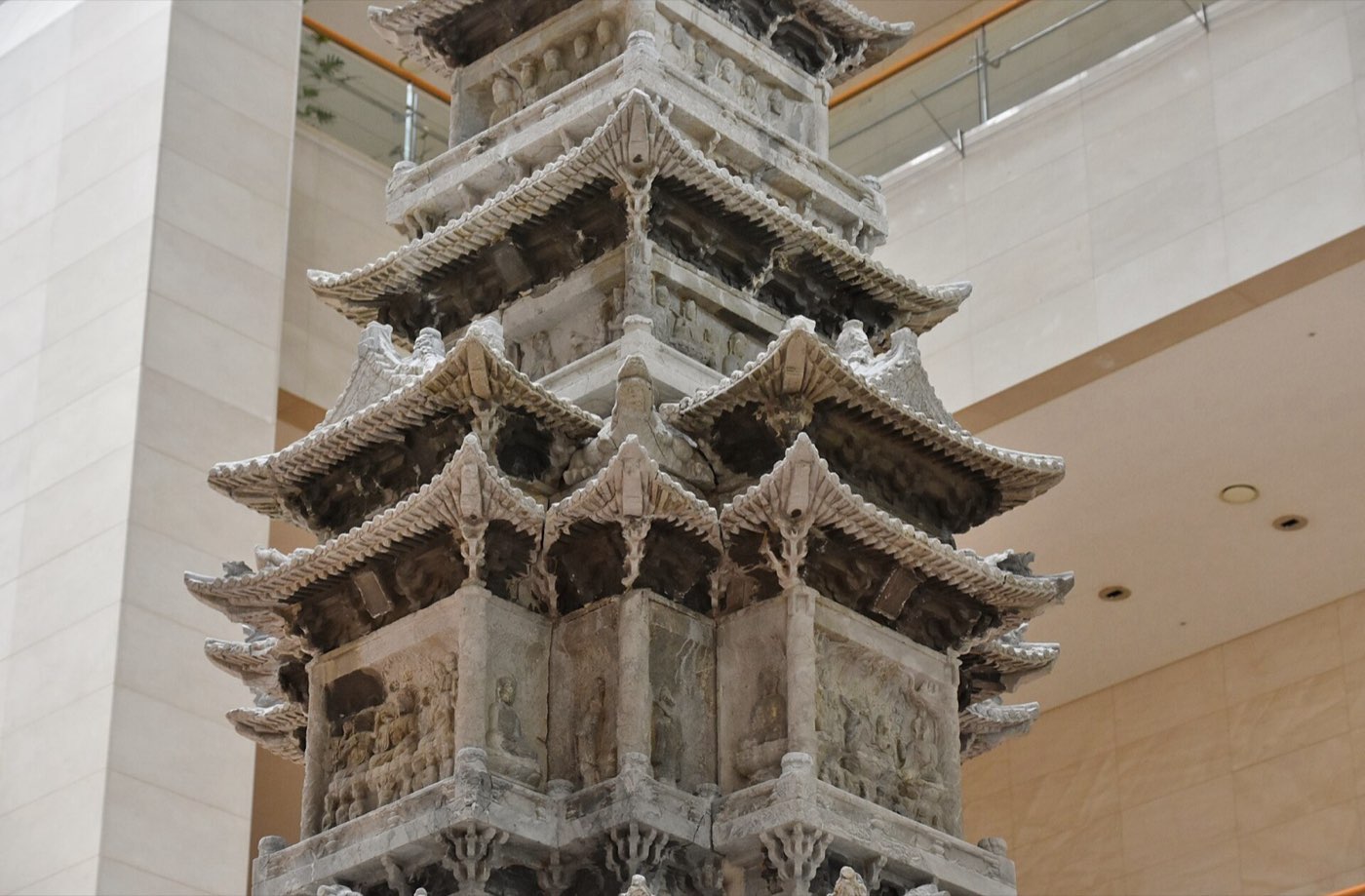
In the long central hall on the first floor, which the museum calls the Path to History (역사의 길), stands a ten-story marble pagoda 13.5 meters tall. Its inscription dates it to 1348, in the reign of the Goryeo king Chungmok, and it was made for Gyeongcheonsa (경천사), a temple whose site now lies in North Korea. The material is the first thing to notice. Most Korean pagodas are granite, and marble allowed carving of a density you rarely see on stone monuments outdoors.
Its modern journey explains why it stands indoors. In 1907 a Japanese official, Tanaka Mitsuaki, had it taken apart and shipped to Japan. International press campaigns associated with the journalists Ernest Bethell and Homer Hulbert helped force its return in 1918. It was reassembled at Gyeongbokgung Palace in 1960 and, after long conservation work, rebuilt inside the new Yongsan museum building in 2005, where it is finally protected from the weather that had worn its surfaces.
Read it the way it was carved, from the bottom. The base carries scenes from the Journey to the West story alongside lions, dragons and lotus motifs. The second to fourth stories show crowded scenes of Buddhist offerings, and the upper stories follow a bodhisattva's practice until, on the tenth story, the figure becomes a Buddha. Spend ten minutes close to the base, then walk to the far end of the hall and look back for the whole silhouette against the corridor.
Why does a single pagoda get the most prominent spot in the building? Because its biography mirrors the country's. It was made under Goryeo, taken during the years when Japan was tightening control over Korea, brought back after foreign journalists made its removal a public scandal, and rebuilt in the national museum that opened in Yongsan in 2005. For many Korean visitors it stands for recovered heritage as much as for Goryeo craftsmanship, which is worth keeping in mind as you look.
Silla gold: what the Hwangnamdaechong crown tells you
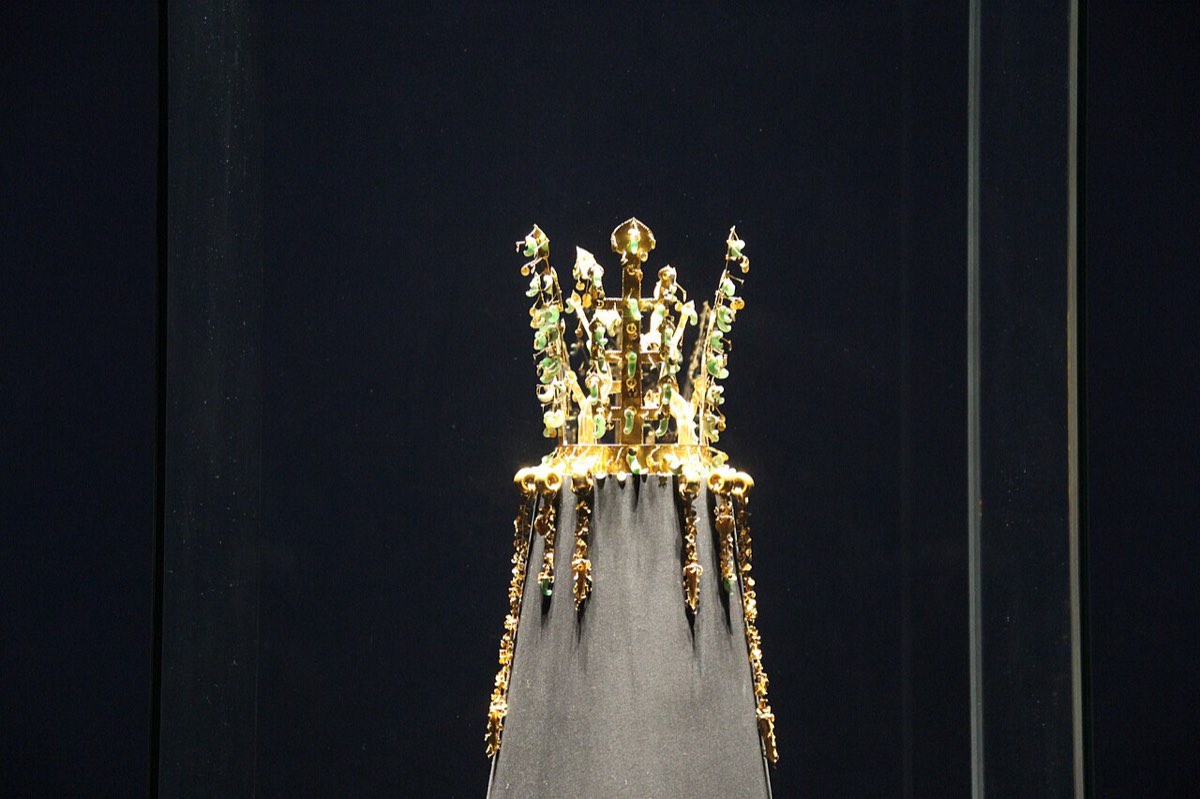
The first-floor Prehistory and Ancient History galleries run from the Paleolithic to Unified Silla and Balhae, and this is where to look for the museum's Silla gold. Its best-known piece is the gold crown from the north mound of Hwangnamdaechong (황남대총), a double tomb in Gyeongju. The museum lists the crown, National Treasure No. 191, among the works on view in its permanent exhibition. Korea JoongAng Daily gives its height as 27.5 centimeters and counts 77 blue jade ornaments.
Look at the shapes before reading the label. Three uprights at the front, which the JoongAng Daily describes as shaped like the Chinese character for mountain, carry 16 of those jade pieces; two antler-like branches at the sides carry nine more, and 11 hang from the headband. Small round gold discs cover the whole frame and would have trembled with every movement. The gold is thin, which is one reason such crowns are usually described as ceremonial or funerary objects rather than everyday regalia.
The context makes it more interesting still. The north mound of Hwangnamdaechong is commonly interpreted in Korean scholarship as the burial of a queen, while the larger south mound is thought to hold a king, and it was the north mound that yielded the gold crown. Major objects are sometimes lent to other museums, so if the crown is the reason for your visit, confirm at the information desk that it is on view that day.
To reach the crown efficiently, walk briskly through the Paleolithic and Bronze Age rooms and slow down once you reach the Three Kingdoms. Then look at Silla's gold beside what its neighbors left behind in the adjoining rooms. The contrast between kingdoms is a more useful takeaway than any single date, and it prepares you for the Buddhist sculpture upstairs, which belongs to the same Three Kingdoms period.
The Room of Quiet Contemplation: why two statues get a whole room
The Room of Quiet Contemplation (사유의 방, Sayu-ui Bang) holds just two gilt-bronze statues of a bodhisattva seated with one leg crossed over the other knee and a hand raised toward the cheek. The pose is called bangasayu (반가사유), roughly 'half-cross-legged in contemplation', and both are catalogued as images of Maitreya (미륵), the Buddha of the future. They are long known as National Treasures No. 78 and No. 83. The Korea Herald dates the left figure to the late sixth century and the right to the early seventh.
Their modern histories are telling. The left statue was donated to the Japanese Government-General's museum in 1916; the right one was bought by the Yi Royal Family Museum in 1912. Since November 2021 they have shared one 439-square-meter room created with architect Choi Wook. The floor tilts by about one degree, the walls are finished in reddish earth, the lighting is low, and the statues are not set exactly parallel. Everything about the space is meant to slow you down before you reach them.
Use the room as designed. Walk the full circle around the platform instead of photographing from the doorway: from behind, the slim backs and falling drapery show how the casters balanced so much bronze on a single seat. Then compare the two faces and crowns, one tall and ornate, the other a low three-lobed band above a nearly bare torso. Keep your voice down; quiet is the point. Ten unhurried minutes here are worth more than an hour of skimming elsewhere.
Ceramics in Rooms 303 and 304, if you have energy left
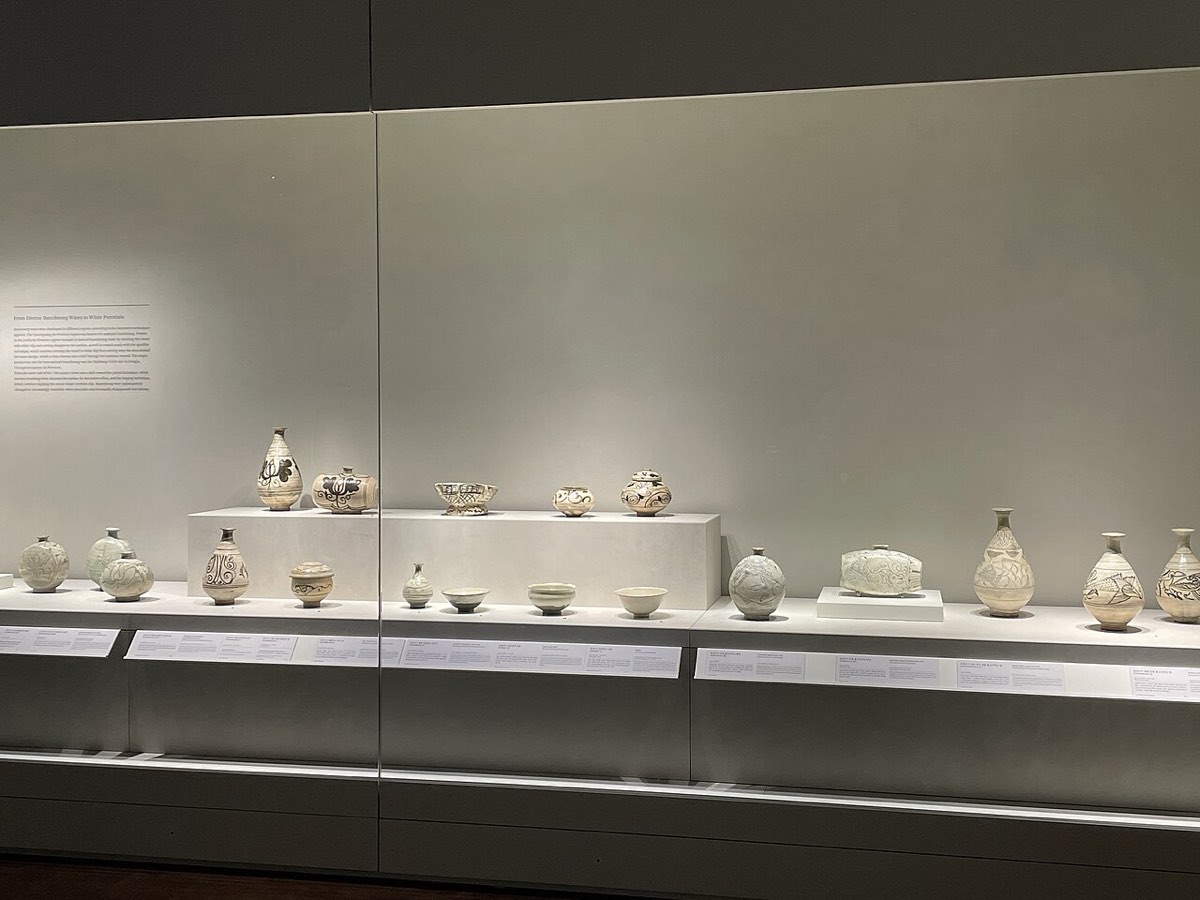
Go up to the third floor, where Celadon (Room 303) and Buncheong Ware and White Porcelain (Room 304) remain open during the renovation. Our first-day culture guide walks through these two rooms in detail, comparing glaze, slip and decoration, so the short version will do here: look at celadon for Goryeo's jade-toned glaze and inlay, then at buncheong for the freer slip-covered stoneware of early Joseon, then at white porcelain for the restraint that later Joseon elites prized.
With the Buddhist Sculpture and Metal Crafts galleries next door closed, the third floor is shorter than usual, so the ceramic rooms fit easily into a three-hour visit. If you have to drop something, drop this stop rather than the bodhisattvas. These rooms reward slow comparison of one bowl against another, and twenty rushed minutes give you less than a focused visit on a different day.
A three-hour route for a Wednesday or Saturday evening
The museum stays open until 21:00 on Wednesdays and Saturdays, with last entry at 20:30, which lets you spend the day elsewhere and still see the essentials. The route below starts at 17:45 and assumes you arrive by subway. On other days, when the galleries close at 17:30 and entry ends at 17:00, start the same route by 14:00 at the latest.
One date trap is worth knowing. On the first Monday of March, June, September and December the museum closes its permanent and special exhibition halls for maintenance while the outdoor area stays open, and the next of these closures falls on December 7, 2026. Combined with the regular closures on January 1, Seollal and Chuseok, those are the only days this plan does not work.
- 17:45 Walk in from Ichon Station Exit 2 or the underground Museum Nadeulgil path; pass the security check and put any backpack in a first-floor locker, as the museum requires.
- 18:00 Gyeongcheonsa pagoda in the central hall: base carvings close up, then the full view from the far end (20 minutes).
- 18:20 First-floor ancient galleries: head for the Silla section and the Hwangnamdaechong crown, skimming earlier rooms on the way (40 minutes).
- 19:00 Second floor, Room of Quiet Contemplation: one slow circuit of the platform (20 minutes).
- 19:20 Break at the museum café or restaurant, after checking their own closing times.
- 19:50 Third floor, Rooms 303 and 304: celadon first, then buncheong and white porcelain (40 minutes).
- 20:35 Museum shop on the way out if it is still open; staff begin guiding visitors out ten minutes before 21:00.
Getting there, getting in, and the bodhisattva miniature
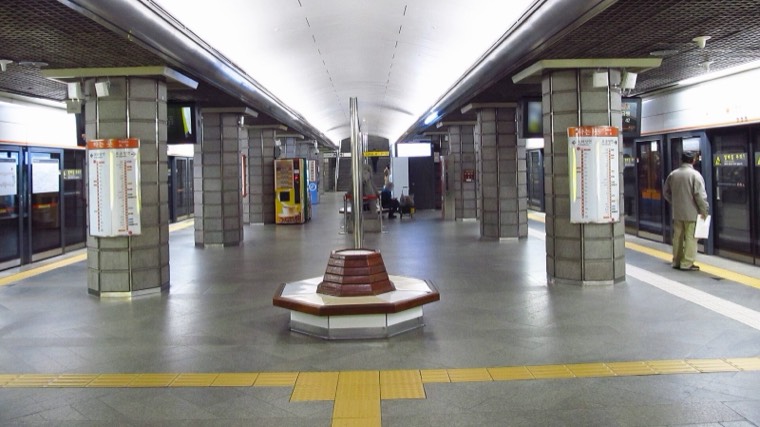
Take Line 4 or the Gyeongui-Jungang Line to Ichon Station (이촌역) and use Exit 2; the museum puts the walk at about 150 meters toward Yongsan Family Park. An underground walkway, Museum Nadeulgil, links the station and the museum from 7:00 to 23:00, which helps in rain or summer heat, and there are elevators near Exits 1 and 2. In Naver Map or Kakao Map, search 국립중앙박물관.
Hours are 9:30–17:30 on Monday, Tuesday, Thursday, Friday and Sunday and 9:30–21:00 on Wednesday and Saturday, with entry closing 30 minutes earlier. The permanent galleries need no ticket. Paid special exhibitions sell tickets at the booth in front of Special Exhibition Hall 1, and the free Children's Museum runs on timed reservations. School groups of 30 or more must book ahead; individual visitors simply walk in.
The museum shop sells goods under the MU:DS (뮷즈) brand, and its best seller is a miniature of the gilt-bronze pensive bodhisattva. The National Museum Cultural Heritage Foundation reported about 12,000 sold in the first half of 2026 and roughly 61,000 in total, with interest boosted after BTS member RM was reported to own one. Stock of popular items varies, so treat it as a likely find rather than a certainty, and buy it on your way out instead of carrying it through the galleries.
Next door: skip the Hangeul Museum for now
The National Hangeul Museum (국립한글박물관) stands beside the National Museum at 139 Seobinggo-ro, and many older itineraries pair the two. Do not plan on it at present. Its homepage says it is closed for fire-damage restoration and extension work until the second half of 2028, and its exhibitions are running at partner venues instead, including the National Museum of Korean Contemporary History near Gwanghwamun. Some of its English pages still list ordinary opening hours, so trust the closure banner over them.
Use the museum grounds instead. The outdoor garden is open 7:00–22:00 every day, and the outdoor exhibition area stays accessible even on the quarterly maintenance Mondays. On a mild evening, a slow walk past the pond and the outdoor displays is a calm way to end the visit before you head back to Ichon Station.
Questions visitors ask
Is the Room of Quiet Contemplation open during the 2026–27 renovation?
Yes, as of October 20, 2026. The renovation notice closes Rooms 202-3, 202-4, 203, 204, 301, 302 and the Room of Senses until January 28, 2027, and the Room of Quiet Contemplation is not on that list. The museum's floor listing still shows it on the second floor. Check the notice board before you go, because short closures for exhibit changes do happen.
Do I need a ticket or reservation for the National Museum of Korea?
Not for the permanent galleries, which are free and need no ticket. Paid special exhibitions sell tickets at the booth in front of Special Exhibition Hall 1. The Children's Museum is free but works on timed reservations, and school groups of 30 or more must book in advance.
How long should I spend at the National Museum of Korea?
Three hours covers the pagoda, the Silla crown, the Room of Quiet Contemplation and the two ceramic rooms without rushing. With one hour, see only the pagoda and the bodhisattvas. A full day lets you add the Goryeo and Joseon history galleries and a special exhibition.
Is the museum open on Mondays?
Usually, yes, from 9:30 to 17:30. The exception is the first Monday of March, June, September and December, when the permanent and special exhibition halls close for maintenance while the outdoor area stays open. The next such closure is December 7, 2026.
Can I visit the National Hangeul Museum next door on the same day?
Not at present. The National Hangeul Museum says it is closed for fire-damage restoration and extension work until the second half of 2028, with its exhibitions held at partner venues in the meantime. Use the National Museum's outdoor garden and exhibition area instead.
Sources and method
Written for: First-time visitors to Seoul who want to see the National Museum of Korea's essential works in one afternoon or evening without walking into closed galleries.
Method: Researched from the official sources listed below, checked on October 20, 2026. Hours, fees and booking rules can change; the linked official pages are the final word. Spotted something out of date? Tell us.
- National Museum of Korea — English home page (visiting hours)Opening hours, Wednesday and Saturday late opening, last admission, free admission, current notice list.
- National Museum of Korea — 관람안내 (Korean visitor information)Holiday closures, quarterly maintenance Mondays (2026: June 1, Sept 7, Dec 7), outdoor garden hours, Children's Museum reservations, ticket booth, school-group booking rule.
- National Museum of Korea — Notice of temporary closure (posted June 15, 2026)Closed rooms 202-3, 202-4, 203, 204, 301, 302 and Room of Senses; reopening January 29, 2027; rooms 202-1, 202-2, 303, 304 open.
- National Museum of Korea — Permanent exhibition floor listingRoom of Quiet Contemplation listed on 2F; gallery status by room; Silla gold crown (National Treasure No. 191) on display in permanent exhibitions.
- National Museum of Korea — Directions by subwayIchon Station Exit 2, 150 m walk, Museum Nadeulgil underground path 7:00–23:00, elevators near Exits 1 and 2.
- Korea Herald — Room of Quiet Contemplation featureOpening in November 2021, 439 m², architect Choi Wook, one-degree floor tilt, statue dates and acquisition history.
- Korea Herald — Gyeongcheonsa ten-story pagoda1348 inscription, marble, 13.5 m, carvings by story, removal in 1907, return in 1918, reassembly in 1960, indoors since 2005.
- Korea JoongAng Daily — Gold Crown from the North Mound of Hwangnamdaechong TombHeight of 27.5 cm, front ornaments, antler-shaped branches and the count of 77 jade pieces.
- Segye Ilbo — MU:DS museum goods sales, first half of 2026Pensive bodhisattva miniature as best seller: about 12,000 sold in H1 2026, about 61,000 in total (figures from the National Museum Cultural Heritage Foundation).
- National Hangeul Museum — homepage closure noticeClosed for fire-damage restoration and extension work until the second half of 2028; exhibitions at partner venues.