In shortYou can see the DMZ from Seoul in a day, but not the Joint Security Area: the Ministry of Unification's Panmunjom tour site still lists public tours as suspended since July 18, 2023, with no reopening date. What is open is Paju City's DMZ Peace Tour from Imjingak, a roughly three-hour shuttle loop to the Third Tunnel, Dora Observatory and Unification Village, Tuesday to Sunday, with your original passport.
Key facts
- Korean names
- 비무장지대 (bimujang jidae, DMZ) · 판문점 (Panmunjeom, JSA)Naver Map
- JSA public tours
- Suspended since July 18, 2023; no reopening date (checked Oct 20, 2026)
- What is open
- Paju DMZ Peace Tour (DMZ 평화관광) from Imjingak, about 3 hours
- Closed
- Mondays, weekday public holidays, Seollal and Chuseok days
- Ticket window
- 09:00–14:30 at 148-57 Imjingak-ro, Munsan-eup, Paju
- Adult fare
- ₩12,200 with tunnel monorail, ₩9,200 on foot
- Bring
- Original, unexpired passport (no copies or phone photos)
- Cameras
- Photo and video, including drones, banned on the tour course
Checked Oct 20, 2026 against the official sources listed at the end of this guide.
A ceasefire that never became peace
The border you can visit from Seoul exists because the Korean War stopped without ending. On July 27, 1953, at Panmunjom, Lieutenant General William K. Harrison Jr. of the United Nations Command and General Nam Il, for the Korean People's Army and the Chinese People's Volunteers, signed an armistice. It was a purely military document: South Korea did not sign it, and no peace treaty has ever replaced it. The agreement fixed a Military Demarcation Line and pulled each side back two kilometers, creating the 비무장지대 (bimujang jidae), the Demilitarized Zone, a four-kilometer buffer across the peninsula.
South of that buffer runs a second boundary that visitors meet in practice: the 민간인통제선 (mintongseon), the Civilian Control Line. The land between it and the DMZ is farmed and lived in, but you enter only through military checkpoints. Dora Observatory and Unification Village both sit inside this controlled belt, which is why Paju checks the ID of every passenger before it sells a single ticket, and why the rules on cameras and conduct are stricter than anywhere else you will go in Korea.
Panmunjom (판문점, Panmunjeom), the village where the armistice was signed, is better known abroad as the Joint Security Area. It sits directly on the demarcation line: of the seven prefabricated huts that straddle the line, the sky-blue one, T2, is the Military Armistice Commission's main conference room. It is also where Moon Jae-in and Kim Jong Un planted a tree together, using soil from Hallasan and Baekdusan, the mountains at either end of the peninsula.
The Joint Security Area in October 2026: still shut to visitors
Settle this first, because many listings still use the JSA as a hook. The Ministry of Unification's 판문점견학지원센터 (Panmunjom Tour Support Center) states on its home page, checked October 20, 2026, that tours have been provisionally suspended since a US soldier crossed into North Korea on July 18, 2023, and that dates will be posted only after the ministry has consulted the UN Command and other agencies. There is no calendar to watch and no target date. News photos of officials or delegations at Panmunjom do not mean public tours are back.
Even when the ministry's program runs, it is not designed for foreign travelers. Its guidance page limits applications to South Korean citizens aged 8 and over, says groups and foreigners cannot apply, and allows one visit per person per year after a background check, on Tuesdays, Wednesdays, Fridays and Saturdays only. The conduct rules it publishes still describe the zone's expectations well: no sleeveless tops, shorts, short skirts, slippers, sandals or camouflage prints; no drinking that day; no tripods, selfie sticks or action cameras; no photos with military facilities in the frame.
If a company sells a "DMZ plus JSA" day, ask in writing what you will see if JSA access is refused and whether the price changes. Under the current notice, a tour built honestly around the Third Tunnel and Dora Observatory is worth more than a promise nobody can keep.
Paju's DMZ Peace Tour, from ticket window to checkpoint
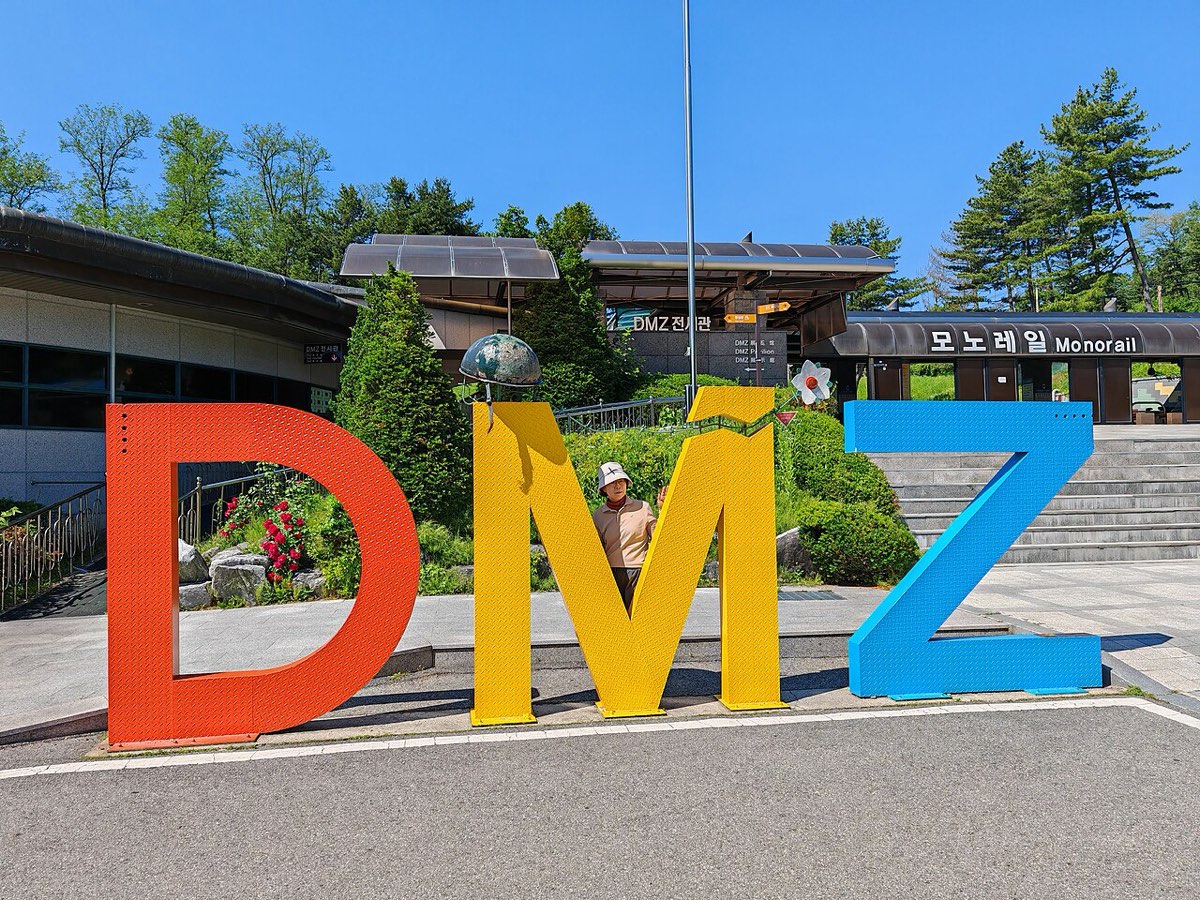
The tour nearly everyone takes, directly or through an operator, is Paju City's DMZ Peace Tour (DMZ 평화관광), running since 2002. It starts at the ticket office in the Imjingak area, 148-57 Imjingak-ro, Munsan-eup. You buy a ticket, board a city shuttle bus, pass the checkpoint and loop through the Third Tunnel, Dora Observatory and Unification Village before returning to Imjingak, about three hours in all. Course A visits the tunnel first; course B starts at the observatory. There is no guide on board, and organized groups bring their own.
The window sells tickets from 09:00 to 14:30, Tuesday to Sunday. Paju closes the tour on Mondays, on public holidays that fall on weekdays, and on the day of Seollal and Chuseok itself, while the rest of those holiday periods operate. Each shuttle seats 44; on most departures only 14 seats can be reserved online, and the rest are sold at the window that day. The city warns that tickets often sell out before closing time, so arrive early on weekends.
Bring your original passport. Paju refuses photocopies, phone photos and expired passports, and sells tickets only to people standing at Imjingak, so your whole party must arrive before anyone buys. Minors enter with an adult guardian. The booking site is in Korean only; its English version is marked as in preparation, which is the main reason foreign visitors hand the job to operators. Paju's notice also says foreign visitors are not eligible for its fee reductions, so foreign seniors should expect the standard fare.
Only some departures use the tunnel monorail, which the city calls a shuttle elevator. On weekdays these leave at 9:20, 11:30, 13:00 and 14:00, plus 10:30 on course A or 10:00 on course B; the others walk. If the monorail breaks down, the tour switches to walking. The monorail ticket price includes a 3,000-won lift charge on top of 5,000 won in facility fees and 4,200 won for the bus. Paju lists children 6 and under with a guardian as free, but files that under the reductions foreigners do not receive, so confirm at the window.
| Individual ticket (won) | Adult | School-age (elementary to high school) |
|---|---|---|
| Third Tunnel by monorail | 12,200 | 9,500 |
| Third Tunnel on foot | 9,200 | 7,000 |
A tunnel, a telescope and a village beyond the line
제3땅굴 (Je-3 Ttanggul), the Third Tunnel, began with a tip. In September 1974 a North Korean defector, Kim Bu-seong, told the South he had surveyed tunnels under the DMZ. Nothing was found for almost four years, until June 10, 1978, when water burst out of a test borehole. The tunnel is 1,635 meters long and about 2 meters high and wide, and the point where it was found is 52 kilometers from Seoul and 12 from Munsan. Paju's own description says it could have moved 30,000 troops an hour.
The walk down is a steep, narrow slope, and Paju may refuse entry to visitors who are frail or elderly, have high or low blood pressure or breathing problems, or have been drinking. Wheelchair users may not be able to enter at all. If knees or lungs are a concern, buy a monorail departure rather than hoping to manage the incline, and wear shoes with real grip whichever way you go down.
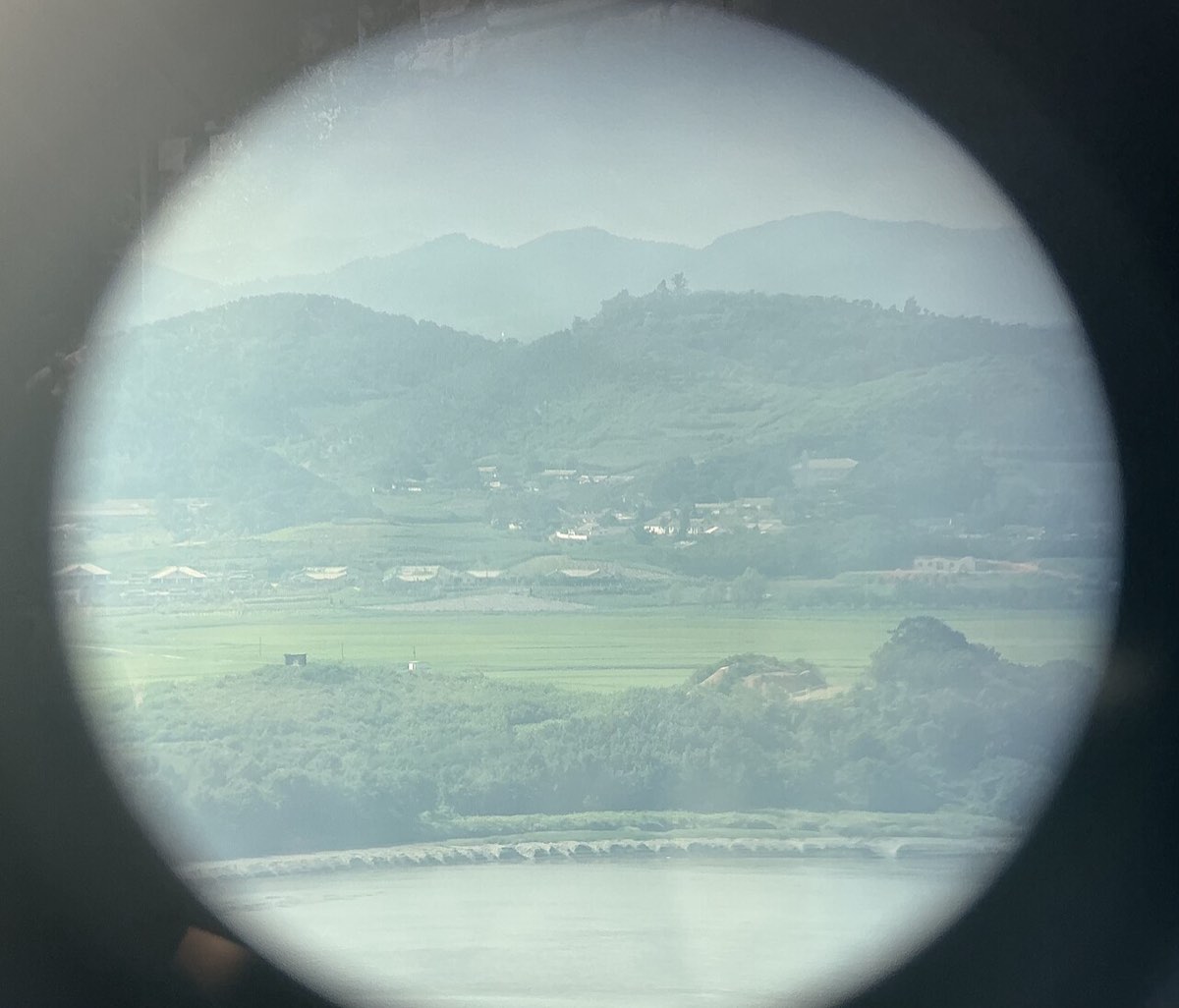
도라전망대 (Dora Jeonmangdae), Dora Observatory, replaced an older post that was closed and is described by Paju as the South's northernmost observatory for viewing the North. It opened to the public in January 1987 and moved into a new building in October 2018. Through the telescopes you can pick out Songaksan above Kaesong, a statue of Kim Il-sung, the village of Gijeong-dong and the edge of Kaesong city; on a clear day the Kaesong Industrial Complex is visible too.
통일촌 (Tongilchon), Unification Village, is a working farm village inside the Civilian Control Line, settled by 40 households of discharged soldiers and 40 households of original residents displaced by the war. The stop is short. Look for the telescope in the village center and the shelter beside it, and for the air-raid bunkers and armory that residents kept up for decades.
Imjingak, where families come to bow north
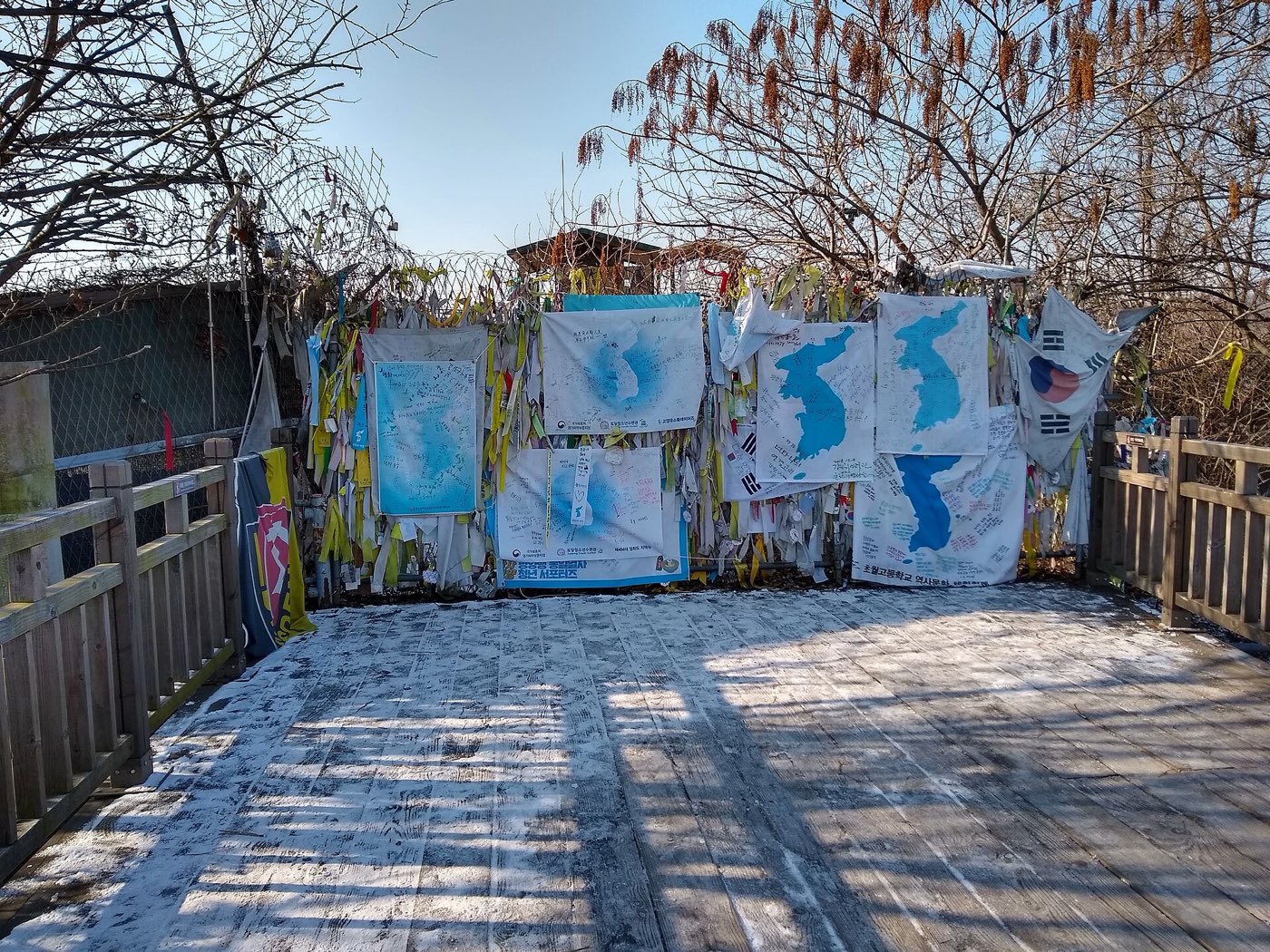
임진각 (Imjingak) lies outside the checkpoint, so it needs no tour ticket. Paju frames it around the grief of the war and the division that followed: there are battle memorials, and a train that once ran north to Sinuiju now stands where the line stops. The heart of the site is 망배단 (Mangbaedan), a permanent altar built in September 1985 after years in which displaced northerners set up temporary altars here each Chuseok. Seven granite screens carry scenes of the five northern provinces and the unrecovered parts of Gyeonggi and Gangwon.
On the mornings of Seollal and Chuseok, after official rites by the Ministry of Unification and the offices of the five northern provinces, families take turns bowing toward homes they cannot reach. Behind the altar is 자유의 다리 (Jayuui Dari), the Freedom Bridge. Nearby, the 망향의 노래비 song monument plays "Lost 30 Years" (잃어버린 30년), the theme of KBS's 1983 broadcast searching for separated families. Coming on those holidays shows you the place as it is meant to be used, but the shuttle tour is closed that day.
The 임진각 평화 곤돌라 (Imjingak Peace Gondola) runs 850 meters across the Imjin River and over the Civilian Control Line to two observation decks facing the Jangdan Peninsula, the Freedom Bridge and Dokgae Bridge. It is a useful fallback if the shuttle sells out. Keep your passport on you for it as well, since it crosses into controlled ground. The lawns of 평화누리 (Pyeonghwa Nuri) park, part of the same Imjingak grounds, suit a slower walk before the train home.
Odusan and Dorasan: two other windows on the North
오두산통일전망대 (Odusan Unification Observatory), in Tanhyeon-myeon, is the simplest way to look at North Korea from the Seoul area, with no checkpoint ticket or tour. Admission has been free since January 1, 2024. It opens 09:30 to 17:30 from March to October (last entry 17:00) and 10:00 to 17:00 from November to February (last entry 16:30), and closes on Mondays, or on Tuesday when Monday is a public holiday. From the fourth-floor deck you look over the meeting of the Han, Imjin and Jogang rivers to the Gwansan Peninsula in North Korea; on clear days Songaksan is visible to the north.
By public transport, the observatory suggests Line 3 to Daehwa (대화) Station, exit 4 or 5, then bus 900 to its terminus at 통일동산 (Tongil Dongsan), about 50 minutes, and the free shuttle up the hill (weekdays 10:00 to 16:00 every 30 minutes; weekends and holidays 13:00 to 16:30 every 15 minutes) or a 1.4-kilometer path of about 20 minutes. On weekends, come in the morning: the observatory warns of parking waits of an hour or more in the afternoon. Half-hour talks on the view start at 13:30 and 15:00 on Saturdays and Sundays in the third-floor viewing room.
도라산역 (Dorasan Station) is not on the Paju shuttle loop. Built under the rail reconnection agreed after the 2000 inter-Korean summit, it is South Korea's northernmost station. The DMZ Peace Link Train (DMZ 평화이음 열차) from Seoul Station resumed on April 10, 2026, after a suspension that began in 2019. Korea.net reported Friday departures, four a month from June, up to 120 passengers, with booking through Korail, Korail Tourism Development and the Paju DMZ site, and visits from the station to Dora Observatory and Unification Village. Confirm the current month's dates before planning around it.
Coach tour or city shuttle: how to choose
Take the city shuttle if you are comfortable with Seoul's trains, can read or translate a Korean booking page, and want control of your day. It is the cheapest way in, you can linger at Imjingak or add Odusan, and you are not tied to a group's lunch stop. The trade-offs are real: no commentary beyond the signs, a long ride out to reach the window early, and the risk that walk-up seats are gone on a busy Saturday.
Take an operator tour if this is your first trip to Korea, you have one free day, or you are traveling with children or older relatives. Operators that bring 30 or more people in their own 45-seat coach buy group tickets, usually collect passport details ahead of time, and supply the English commentary the city tour lacks, which matters more here than at a palace because the sites mean little without the story. Some routes also add Dorasan Station or other stops the shuttle skips. Prices vary by company; compare what is included rather than the headline number, using the questions below.
- Is the Third Tunnel monorail included, or will the group walk the slope?
- Does the day start at the tunnel or the observatory, and how long is the stop at Imjingak?
- Are passport details collected in advance, and must you carry the original on the day?
- What happens if the military closes the area that morning: refund, rebooking or a substitute route?
- If the listing mentions the JSA, what will you see when access is refused?
Days the border says no
Paju's own rules state that every schedule can stop because of a security threat in the DMZ, bad weather or a safety situation, and that emergencies can close access and cancel advance bookings without notice. This is not boilerplate. In 2019 and 2020, African swine fever shut Paju's DMZ tourism for months: by July 2020, Kyeonggi Ilbo reported that it had been suspended for about nine months and would reopen only after disinfection facilities were upgraded. Do not schedule the DMZ for your last day before a flight; give yourself a second possible date.
Safety here is a matter of following a short list of rules calmly. The shuttle runs fixed routes, and Paju describes everything off the designated roads as unconfirmed minefield, so stay with the group and on paved paths. Weapons, alcohol and fishing gear are banned, and so are picking wild plants and littering. Photography and video, including drones, are prohibited along the whole course, and CCTV watches the area. If tensions are in the news, read the 공지사항 (notices) page of the Paju DMZ site the evening before, or ask your operator directly.
Fitting the DMZ into a Seoul week
To reach the ticket office on your own, Paju points visitors to 임진강역 (Imjingang Station) on the Gyeongui-Jungang Line, then about 20 minutes on foot or village bus 058A or 058B from the station stop. Before you set off, check in Naver Map or Kakao Map if your train runs through to Imjingang or ends at 문산 (Munsan), where you would change. Type the address, 임진각로 148-57, rather than a place name; it lands you at the ticket office rather than somewhere else in the large Imjingak grounds.
A workable independent day, Tuesday to Sunday: leave central Seoul around 07:30 so you reach the window close to 09:00, when sales open, and take the earliest seat available, choosing a monorail departure if the tunnel slope worries you. The loop brings you back about three hours later. Spend the early afternoon at Mangbaedan, the Freedom Bridge and the gondola, then head back for dinner in Seoul. If the window sells out, Odusan is the fallback, though it is a separate trip to the other side of Paju.
Monday is the wrong day: the shuttle tour and Odusan are both closed. Tuesday works well: Gyeongbokgung and Jongmyo Shrine close that day while the border tour runs, as our palace comparison explains. Avoid the actual day of Seollal or Chuseok unless Mangbaedan's rites are your reason for going. Keep the evening light, since the round trip and the checkpoint routine are more tiring than the three hours on the timetable suggest.
Questions visitors ask
Can I book a JSA or Panmunjom tour as a foreigner right now?
No. The Ministry of Unification's Panmunjom tour site, checked October 20, 2026, says tours have been suspended since July 18, 2023 and that dates will be announced only after consultation with the UN Command. The ministry's own program, when it runs, is open only to South Korean citizens aged 8 and over.
Do I need a tour company to visit the DMZ?
No. Paju sells walk-up tickets at its Imjingak window to foreign passport holders, and its online system holds back some seats for advance booking. The catch is that the booking site is in Korean, there is no guide on the shuttle, and you must reach Imjingak early on your own. Operators trade a higher price for transport, paperwork and English commentary.
Can I take photos at the Third Tunnel and Dora Observatory?
Paju's rules prohibit photography and video, including drones, along the whole DMZ Peace Tour course, and the area is covered by CCTV. Put your phone away when staff or soldiers ask, and do not photograph military facilities anywhere near the border.
Is it safe to visit the DMZ?
The tours run on fixed routes inside a military-controlled area and are halted when security, weather or safety conditions require it, sometimes without notice. Stay with your group, keep to paved paths, since Paju treats ground off the roads as unconfirmed minefield, and follow instructions immediately. Leave a spare day in case your date is cancelled.
Can I see the DMZ on a Monday?
Not the main sites. Paju's DMZ Peace Tour closes every Monday, and Odusan Unification Observatory does too, closing on Tuesday instead when Monday is a public holiday. Use Monday for Seoul and move the border trip to any day from Tuesday to Sunday.
How do I get to Dorasan Station?
It is not on the Paju shuttle loop. The DMZ Peace Link Train from Seoul Station resumed in April 2026, running on Fridays with booking through Korail, Korail Tourism Development and the Paju DMZ site. Check the current month's dates before you plan, or choose an operator tour that lists Dorasan.
Sources and method
Written for: Independent visitors in Seoul deciding whether, how and on which day to see the DMZ, and whether the Joint Security Area at Panmunjom is possible.
Method: Researched from the official sources listed below, checked on October 20, 2026. Hours, fees and booking rules can change; the linked official pages are the final word. Spotted something out of date? Tell us.
- Ministry of Unification, Panmunjom Tour Support Center — home page and 견학 안내 (tour guidance) pageHome page notice: tours provisionally suspended since the July 18, 2023 crossing, dates to be announced after consultation with the UN Command and other agencies; T2 hut on the demarcation line; Moon–Kim tree planting with Hallasan and Baekdusan soil. Linked 견학 안내 page (/nlgn/pblc/guidance/lnbnsGuidance.do): Korean citizens 8+ only, no groups or foreigners, once a year, Tue/Wed/Fri/Sat, background check, dress, camera and conduct rules.
- Paju City DMZ Peace Tourism — 관람안내 (visiting information)Closed Mondays, weekday public holidays and Seollal/Chuseok days; ticketing 09:00–14:30, frequent early sell-outs; ID rules for foreigners (original passport, no copies or expired passports); whole party must be present; minors with guardian; tunnel entry restrictions; minefield warning off roads; ban on photo, video and drones; CCTV; no guide; foreigners not eligible for fee reductions; suspension for security, weather or safety.
- Paju City DMZ Peace Tourism — 이용요금 (fees) and 코스별 시간표 (timetable) pagesIndividual fares (₩12,200 monorail / ₩9,200 on foot for adults; ₩9,500 / ₩7,000 school-age) and their breakdown; free for children 6 and under with a guardian. Linked timetable page (/Home/H20000/H20300/html): courses A and B, about 3 hours, departure times, monorail departures, 44 seats with 14 bookable online, group coach rules.
- Paju City DMZ Peace Tourism — DMZ 평화관광 안내 (about the tour)Tour running since 2002; Third Tunnel history (1974 tip from Kim Bu-seong, June 10, 1978 detection, 1,635 m, 2 m by 2 m, 52 km from Seoul, 30,000 troops an hour); Dora Observatory history and views; Unification Village settlement.
- Paju City DMZ Peace Tourism — 찾아오시는 길 (directions) and 주변관광지 (nearby sights) pagesTicket office address 148-57 Imjingak-ro; Imjingang Station on the Gyeongui-Jungang Line about 20 minutes on foot; village buses 058A/058B. Linked nearby-sights page (/Home/H10000/H10400/html): Imjingak memorials and the train that ran to Sinuiju; Peace Gondola, 850 m across the Civilian Control Line.
- Paju City — 실향민과 이산가족의 그리움이 담긴 곳 (Mangbaedan and the Song of Longing monument)Mangbaedan built September 1985; granite screens; Seollal and Chuseok rites by the Ministry of Unification and the northern provinces offices; Freedom Bridge behind the altar; 'Lost 30 Years' monument and the 1983 KBS broadcast.
- Odusan Unification Observatory — 관람안내 (visiting information), with 오시는 길 and floor guide pagesFree admission since January 1, 2024; seasonal hours and last entry; Monday closure (next day if Monday is a holiday); weekend parking waits; weekend talks. Linked pages: /introduce/introduce05.asp and /information/info03.asp (Line 3 Daehwa exit 4 or 5, bus 900, free shuttle times, 1.4 km path); /facilities/facilities05.asp (fourth-floor view of the Han, Imjin and Jogang rivers and the Gwansan Peninsula).
- Korea.net — Tourist train service going to station near NK border resumed (April 10, 2026)DMZ Peace Link Train resumed April 10, 2026 after a 2019 suspension; Friday runs, four a month from June, up to 120 passengers; booking via Korail, Korail Tourism Development and dmz.paju.go.kr; Dorasan Station's origin and status as the northernmost station.
- US National Archives — Armistice Agreement for the Restoration of the South Korean State (1953)Signing at Panmunjom on July 27, 1953; signatories Harrison and Nam Il; South Korea not a signatory; purely military agreement, not a peace treaty; two-kilometer withdrawal from the Military Demarcation Line.
- Kyeonggi Ilbo — Paju DMZ peace tourism to resume after ASF suspension (July 8, 2020)Paju DMZ peace tourism suspended for about nine months because of African swine fever, with resumption tied to upgraded disinfection facilities.