In shortStart at Daehanmun for the 11:00 guard ceremony, see Junghwajeon and the stone hall Seokjojeon inside Deoksugung, then walk the stone-wall road to Jeongdong-gil, Jungmyeongjeon and the Russian legation tower. Allow about four hours. The palace opens 09:00 to 21:00 and closes on Mondays; Seokjojeon is entered only on guided sessions, with English at 11:50 and 14:50.
Key facts
- Korean names
- 덕수궁 (Deoksugung), 정동길 (Jeongdong-gil), 중명전 (Jungmyeongjeon)Naver Map
- Palace hours
- 09:00–21:00, last entry 20:00; closed Mondays
- Admission
- 1,000 won adults; free every Wednesday; free for everyone October 29–November 15, 2026
- Guard ceremony
- 11:00 and 14:00 at Daehanmun, about 25 minutes; none on Mondays
- English palace tour
- 10:45 and 13:30, Tuesday–Sunday, about 45 minutes, no booking
- Seokjojeon in English
- 11:50 and 14:50; book online a week ahead or register on site, first come
- Jungmyeongjeon
- 09:30–17:30, last entry 17:00
- Nearest station
- City Hall (Lines 1 and 2)
Checked Oct 31, 2026 against the official sources listed at the end of this guide.
1897: why an emperor chose a cramped palace
Deoksugung (덕수궁) began as an emergency. In 1593, with the capital's palaces burned during the Japanese invasion, King Seonjo held court in the private manor of Grand Prince Wolsan, and in 1611 King Gwanghae made it an official palace named Gyeongungung (경운궁). For almost three centuries afterward it was a minor palace. What made it matter was the neighborhood that grew up around it in the 1880s and 1890s, when Western legations and missions settled in Jeong-dong (정동).
On February 11, 1896, months after the assassination of his queen, King Gojong slipped away to the Russian legation on the hill behind the palace and governed from there for a year. On February 20, 1897 he returned not to Gyeongbokgung but to Gyeongungung, and later that year he proclaimed the Korean Empire, 대한제국 (Daehan Jeguk), with himself as emperor. Our reading: a palace surrounded by foreign legations was a choice as much as a necessity, a court placing itself in full view of the powers it hoped would guarantee its independence.
The empire lasted 13 years. A great fire destroyed many buildings in 1904; Japan forced Gojong to abdicate in 1907, after which the palace was renamed Deoksugung; and under colonial rule from 1910 it shrank, lost most of its halls and was folded into a public park project. What survives is a fragment, which is why the streets outside the walls are as much a part of this story as the palace itself.
Daehanmun and Junghwajeon: the ceremonial front
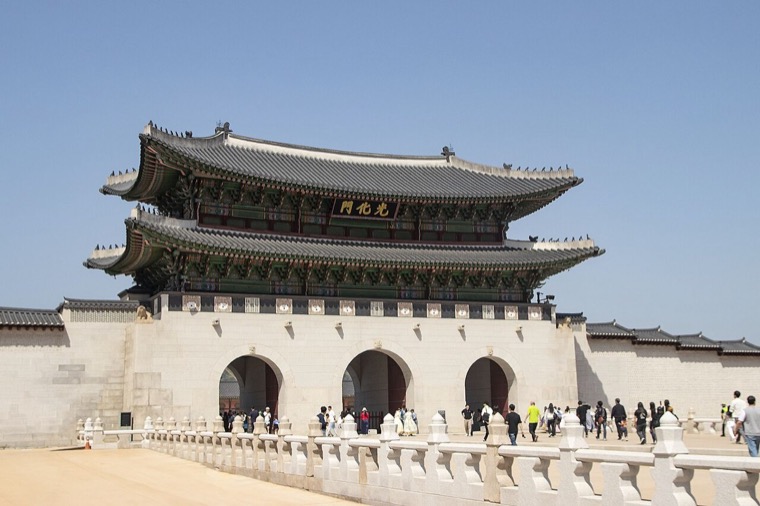
You enter through Daehanmun (대한문), the main gate facing City Hall. It was called Daeanmun until repairs in 1906 gave it its present name. In front of it, the Seoul Metropolitan Government stages a Royal Guard Changing Ceremony at 11:00 and 14:00 every day except Monday. Each performance lasts about 25 minutes, costs nothing, takes place outside the ticket gate and can be cancelled in bad weather, so arrive ten minutes early for a clear view from the plaza side.
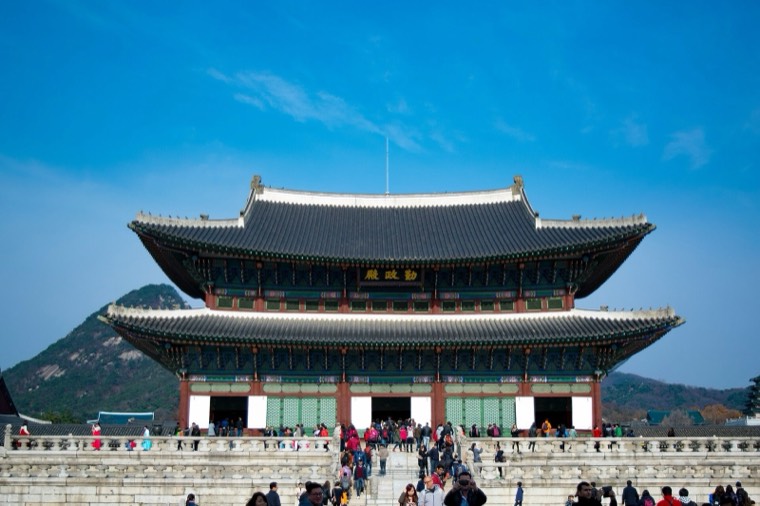
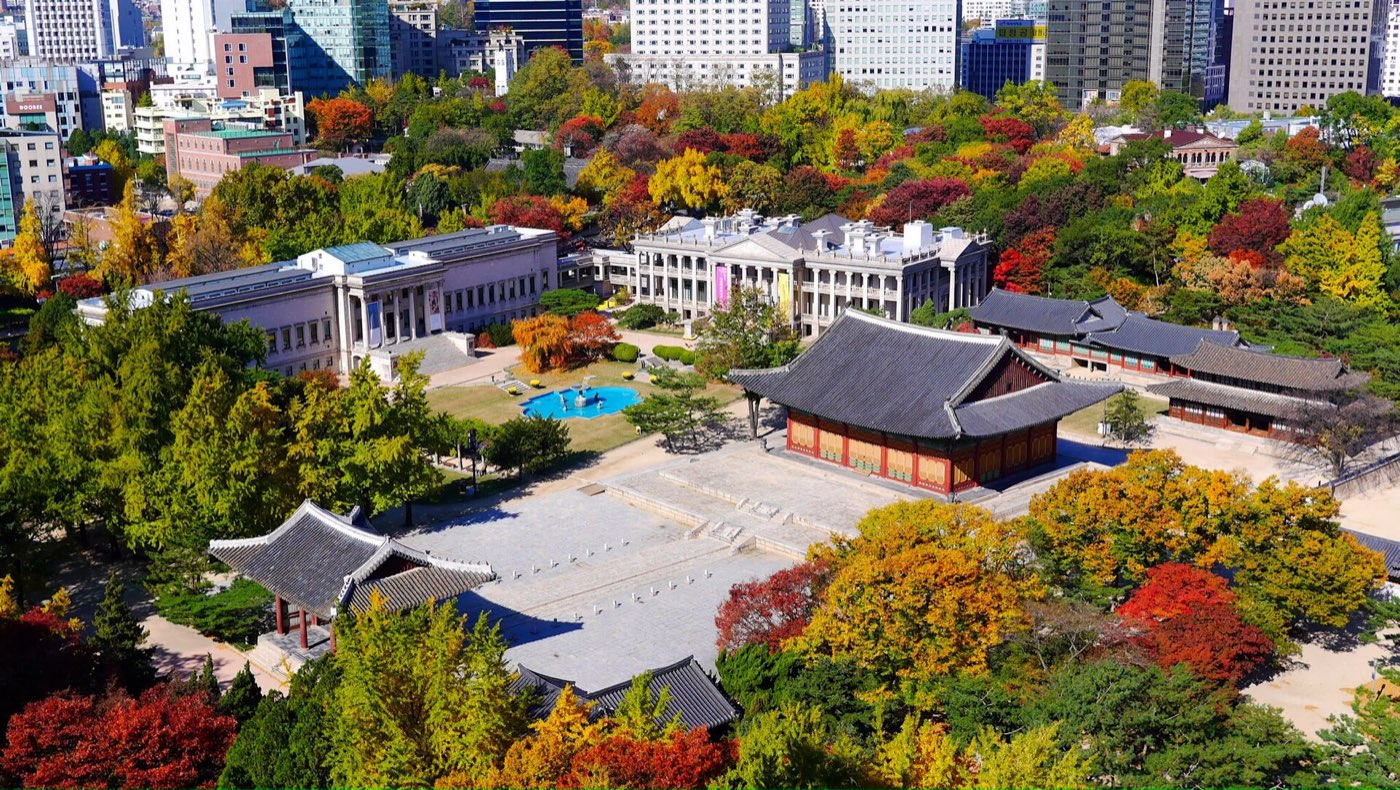
Inside, a short path leads to Junghwajeon (중화전), the throne hall. It went up in 1902 as a two-story building modeled on Changdeokgung's throne hall, burned in the 1904 fire and was rebuilt as the single-story hall you see by 1906. Compare it with Gyeongbokgung's throne hall if you have seen that one: a lower roof in a tighter courtyard, built in a hurry by a court with little money and less room. The rank stones in the courtyard still mark where officials stood by grade.
Behind it, Jeukjodang (즉조당) served as the palace's main hall before Junghwajeon existed, and Hamnyeongjeon (함녕전) was Gojong's bedchamber. He died there on January 21, 1919, more than a decade after losing his throne. These traditional halls are modest, and their interest lies in what they witnessed rather than in their carpentry, so a few minutes at each is enough unless you are following a guide.
Seokjojeon, Jeonggwanheon and the empire's Western face
The building that stops most visitors is Seokjojeon (석조전), a neoclassical stone hall designed by a British architect named Harding, begun in 1900 and finished in 1910, the year the empire ended. Gojong used it as an office and audience hall. In 1946 and 1947 it hosted the US–Soviet Joint Commission that met over Korea's future, and since 2014 it has housed the Daehan Empire History Museum (대한제국역사관).
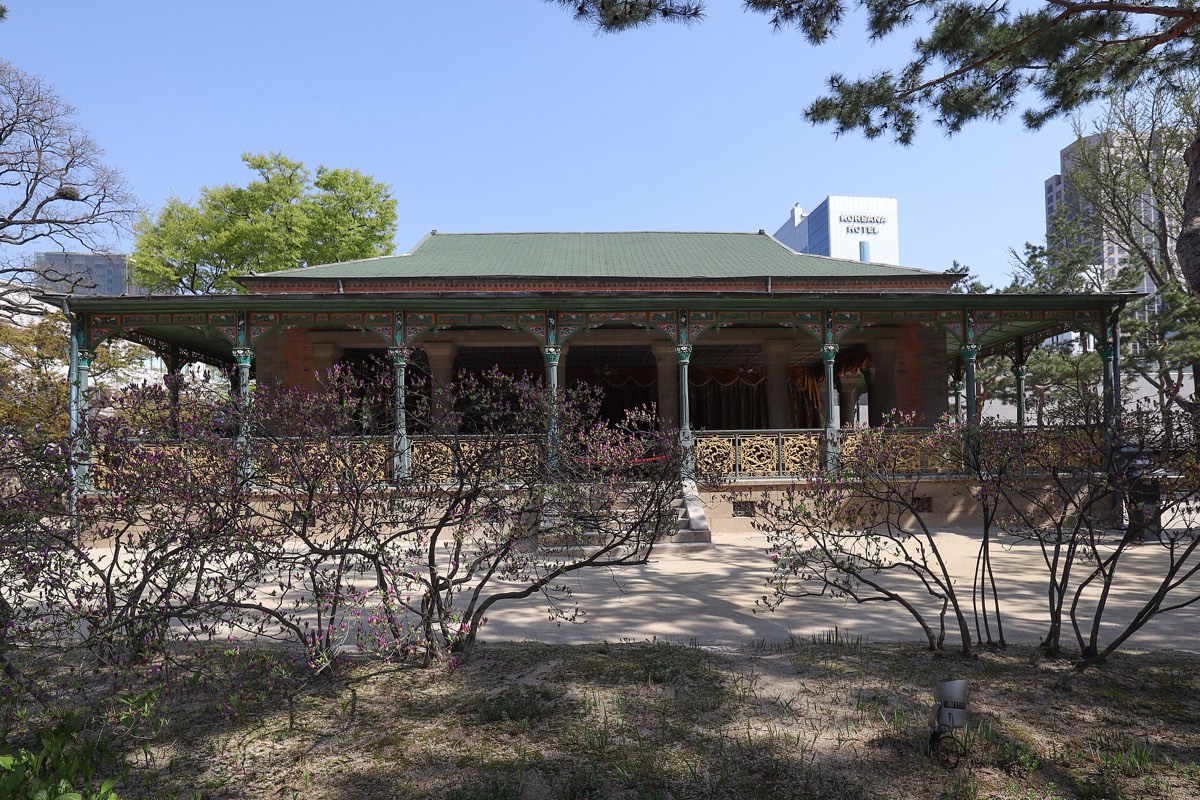
Jeonggwanheon (정관헌), behind Hamnyeongjeon, is a pavilion that wraps a Korean-style building in a Western colonnade, with decorative railings of deer and pine motifs between slender columns. Guides like to say that Gojong drank coffee here with foreign diplomats; treat that as a popular story rather than documented fact. The building's real interest is how openly it mixes two architectural vocabularies. Nearby, Dondeokjeon (돈덕전), a rebuilt Western-style reception hall, now holds rotating exhibitions.
These interiors keep shorter hours than the grounds. Seokjojeon opens from 09:30 to 17:30 and can be entered only on a guided session, the last at 16:30. Dondeokjeon opens from 09:00 to 17:30, with last entry at 17:00, and it closes between exhibitions, so check the Deoksugung notice board at royal.khs.go.kr if it is the reason for your visit. After 17:30, plan on the grounds and on seeing these buildings from outside.
Tickets, free days and the two English tours
Deoksugung opens from 09:00 to 21:00 every day except Monday, with last entry at 20:00. When a Monday is a public holiday the palace opens and closes on the next non-holiday instead. Adults aged 19 to 64 pay 1,000 won. Foreign visitors aged 18 and under or 65 and over enter free with proof of age, and so does anyone in qualifying hanbok. Every Wednesday is a free Culture Day, and in 2026 the heritage service made entry free for everyone from October 29 to November 15.
Two English tours run, and they are separate services. The free palace commentary starts at 10:45 and 13:30 from Tuesday to Sunday, takes about 45 minutes and needs no booking for groups of fewer than ten; meet at the information map about 10 meters inside Daehanmun. The Seokjojeon interior tour in English runs at 11:50 and 14:50. Online booking opens a week ahead, and both English sessions also take foreign visitors first come at the museum's information desk, up to 20 people, with a passport or alien registration card.
Watch two clashes. The 10:45 palace tour overlaps the 11:00 guard ceremony, so choose one or take the 13:30 tour. And Seokjojeon tours can be restricted from 13:30 to 16:30 on the last Wednesday of each month, when the hall hosts concerts. Entry to each session opens three minutes before it starts, and latecomers can be refused.
| Place | Hours | How you get in |
|---|---|---|
| Palace grounds | 09:00–21:00, last entry 20:00; closed Monday | Ticket at Daehanmun, 1,000 won |
| 석조전 Seokjojeon | 09:30–17:30, last session 16:30 | Guided only; English 11:50 and 14:50 |
| 돈덕전 Dondeokjeon | 09:00–17:30, last entry 17:00 | Exhibitions; closes between shows |
| 중명전 Jungmyeongjeon | 09:30–17:30, last entry 17:00 | Separate building off Jeongdong-gil |
| Guard ceremony | 11:00 and 14:00, about 25 minutes; not Monday | Free, outside Daehanmun |
The stone-wall road and its unlucky reputation
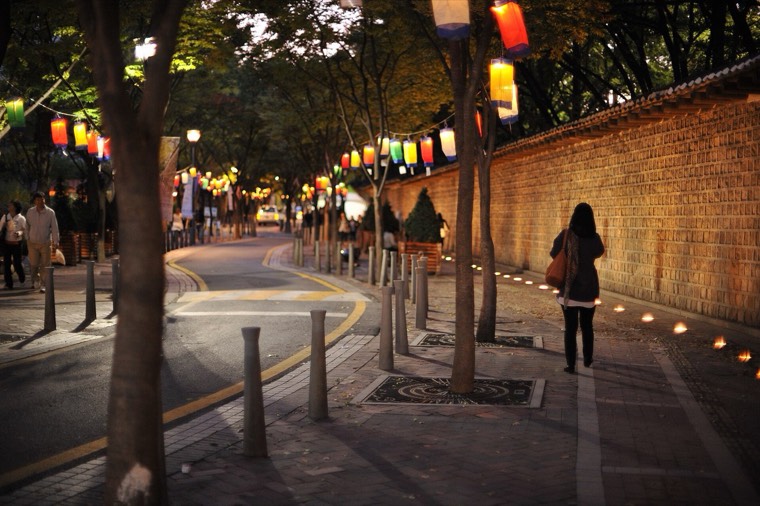
Back outside Daehanmun, face the gate and follow the wall to your left along Deoksugung-gil (덕수궁길), the road that runs beside the palace's stone wall. Seoul's tourism office points out that it is a one-way street that winds deliberately to slow traffic, with the roadway and the pavement at the same height, which is why it feels like a pedestrian lane even though cars still use it. In autumn its ginkgo trees turn yellow against the gray stone. Keep to the edge when you stop for photographs.
Seoul residents joke that couples who walk this road together will break up. The usual explanation points to the courts that once stood here: the Gyeongseong Family Court stood beside the road, on the site of today's Seoul City Hall annex, and the old Supreme Court building, now the Seoul Museum of Art, stood just above it. The story goes that for decades couples on their way to a divorce hearing walked exactly this route.
The full wall road runs about 1,100 meters around the palace, and for decades part of it was blocked by the British Embassy, which has held its site since 1883; Seoul began reopening that stretch in 2017. For this walk you need only the open section from Daehanmun past the art museum to the small rotary where Jeongdong-gil (정동길) begins. From there Jeongdong-gil winds on between churches, schools and embassies.
Jungmyeongjeon, where the empire signed away its diplomacy
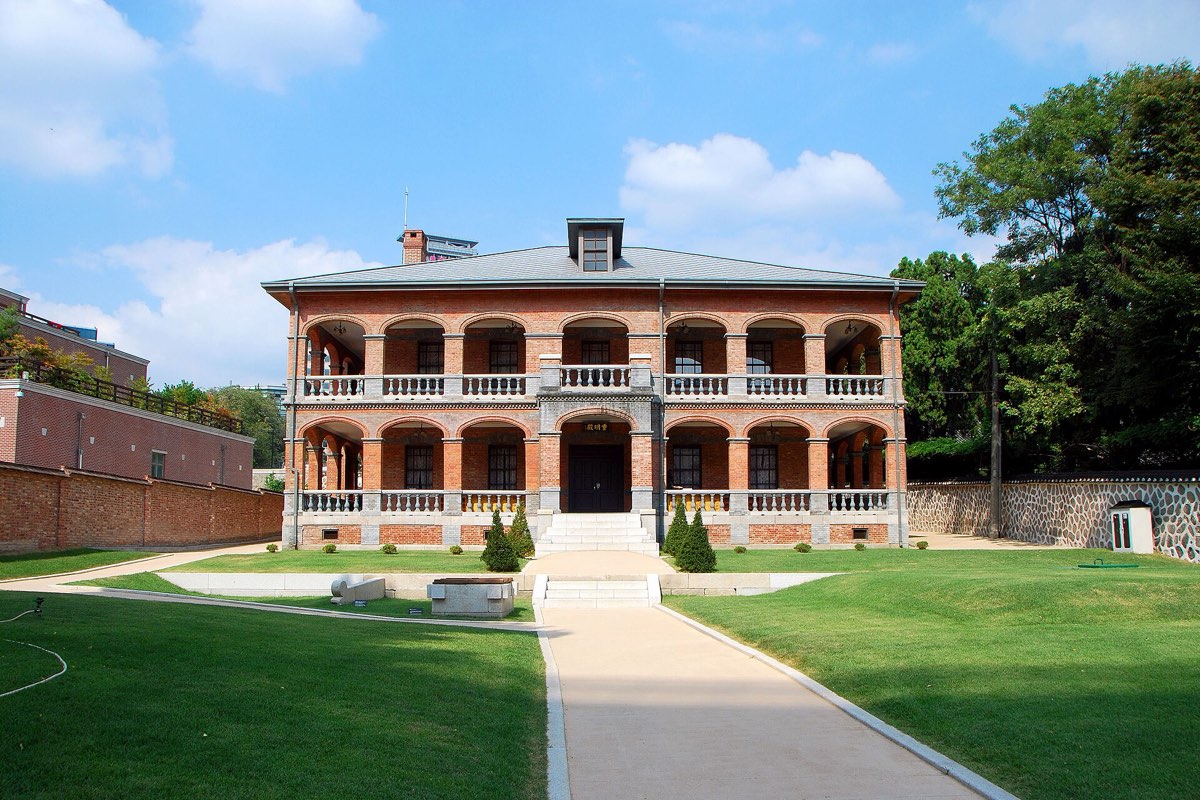
Up a short lane off Jeongdong-gil stands Jungmyeongjeon (중명전), a brick building with arcaded verandas that began as an imperial library called Suokheon (수옥헌). After the 1904 fire Gojong moved in, and in 1905 it was renamed Jungmyeongjeon. On November 17, 1905, under Japanese coercion, the treaty that stripped Korea of its diplomatic rights was signed here, the agreement Koreans call the Eulsa Treaty (을사늑약), using a word that marks it as forced.
In 1907 Gojong sent envoys from here in secret to the peace conference at The Hague to protest the treaty, and Japan used the mission as its pretext to force his abdication. The building reopened to the public in 2010 after restoration. It opens from 09:30 to 17:30, with last entry at 17:00, and it is small enough to see in half an hour. Search 중명전 in Naver Map or Kakao Map, because the lane entrance is easy to walk past.
If you visit only one building outside the palace walls, make it this one. Seokjojeon shows the empire as it wanted to be seen, a modern state receiving guests in a stone hall; Jungmyeongjeon is where that image failed. Seeing both on the same afternoon is the clearest history lesson Jeong-dong offers, and it explains why Koreans still treat this neighborhood as a place of memory rather than simply a pretty street.
Gojong's Road and the Russian legation tower
From the stone-wall road, a gated lane of a little over 100 meters, Gojong's Road (고종의 길), climbs toward Jeong-dong Park. Seoul laid it out for the 120th anniversary of the 1896 refuge, which fell in 2016, and opened it in 2018. It runs between high walls, so walk it in daylight; if it is closed when you arrive, reach the park from Jeongdong-gil instead.
At the top, Jeong-dong Park holds what is left of the Russian legation: a white three-story tower on a small rise. The main building was destroyed during the Korean War. This is where Gojong lived and governed from February 1896 to February 1897, and it was from here that he returned to Gyeongungung to remake it as an imperial palace. In a map app, search 정동공원 (Jeong-dong Park) or 구 러시아공사관 (former Russian legation).
The tower itself takes five minutes. The point of the detour is to stand where a king spent a year as a guest of a foreign legation, a few hundred meters from the palace he then chose to rebuild. It makes the geography of the empire concrete in a way no museum panel does, and it is free and nearly always quiet.
A red-brick church, a mission school and a courthouse turned museum
Jeongdong First Methodist Church (정동제일교회) was founded in 1885. Its red-brick Bethel Chapel, dedicated on December 26, 1897, is a simplified Gothic building that was enlarged in 1916 and 1926, wrecked in the Korean War and restored, and it is designated Historic Site No. 256. Korea's first pipe organ was installed inside. It is a working church, so look in quietly on a weekday and leave Sunday mornings to its congregation.
Nearby, the red-brick Appenzeller/Noble Memorial Museum occupies a 1916 building that was the east hall of Paichai Hakdang (배재학당), the school the American Methodist missionary Henry Appenzeller started in 1885. Along Jeongdong-gil, the National Jeongdong Theater (국립정동극장), opened in 1995, recalls Wongaksa, often described as Korea's first modern theater; our traditional performances guide covers its programs.
Up a short slope from the wall road, the Seoul Museum of Art (서울시립미술관) keeps the arched Renaissance-style facade of the 1928 Gyeongseong Courthouse, later home to Korea's Supreme Court for almost 50 years, in front of a modern gallery. Admission is free except for special exhibitions. It opens 10:00 to 20:00 from Tuesday to Thursday, to 21:00 on Fridays, and to 19:00 in summer or 18:00 in winter on weekends and holidays, and it closes on Mondays and January 1.
For a view down onto the palace roofs, the Jeong-dong Observatory is on the 13th floor of the Seoul City Hall Seosomun Building beside the palace; take elevator No. 3. The city lists it as open from 13:30 to 17:30 on weekdays and from 09:00 to 17:30 at weekends. The same city page lists a two-hour guided Jeong-dong walk that starts at the Deoksugung ticket booth and ends at Hwangudan (환구단), the imperial altar near City Hall.
A walking order, from the 11:00 ceremony to dusk
This sequence fits Tuesday to Sunday and takes about four hours plus lunch. 10:45: arrive at Daehanmun from City Hall Station on Lines 1 and 2 and find a spot for the 11:00 guard ceremony. 11:30: buy a ticket, walk to Junghwajeon and the halls behind it, and register at Seokjojeon's information desk for the 11:50 English session, or for 14:50 if 11:50 is full. 12:45: Jeonggwanheon, then out through Daehanmun for lunch near City Hall.
14:00: walk the stone-wall road, step up to the Seoul Museum of Art for half an hour, then continue to the rotary and along Jeongdong-gil past the Methodist church and the Paichai building. 15:15: Jungmyeongjeon. 15:45: Jeong-dong Park and the Russian legation tower, then down Gojong's Road to the wall road. 16:30: on a weekday, go up to the Jeong-dong Observatory before it closes at 17:30 for the view back over the palace.
If you booked the 14:50 Seokjojeon session instead, swap the order: walk Jeong-dong in the late morning after the ceremony and return to the palace at 14:30. On a Monday the palace, the guard ceremony and the art museum are all off, so walk only the outside route and come back another day for the halls. In the evening Deoksugung is at its calmest, and its grounds stay open until 21:00.
Questions visitors ask
How long do I need for Deoksugung and Jeong-dong?
About an hour for the palace grounds, 45 minutes for a Seokjojeon session and roughly two hours for the Jeong-dong walk with Jungmyeongjeon and the Russian legation tower. Four hours covers everything at a relaxed pace. With only one hour, walk the palace grounds and the stone-wall road.
Can I visit Seokjojeon without booking ahead?
Yes, on the English sessions at 11:50 and 14:50, which take foreign visitors first come at the museum's information desk, up to 20 people, with a passport or alien registration card. All other sessions need an online booking, which opens a week ahead. The hall is open from 09:30 to 17:30, with the last session at 16:30.
Is the Deoksugung guard ceremony the same as Gyeongbokgung's?
No. Deoksugung's ceremony is staged by the Seoul Metropolitan Government in front of Daehanmun at 11:00 and 14:00, every day except Monday, for about 25 minutes. Gyeongbokgung runs its own ceremony at different times; our five-palace comparison covers both. Either is free to watch, and weather can cancel them.
Do couples really avoid the Deoksugung stone-wall road?
Mostly as a joke. The saying that couples who walk it together will split up is usually traced to the family court that stood along the road and the Supreme Court above it, which couples passed on the way to divorce hearings. Plenty of couples walk it, especially in autumn.
Can I visit Deoksugung in the evening?
Yes. The grounds are open until 21:00, with last entry at 20:00, every day except Monday. Seokjojeon, Dondeokjeon and Jungmyeongjeon close at 17:30, so an evening visit is for the courtyards, Junghwajeon from outside and the stone-wall road, which is a public street.
Sources and method
Written for: Visitors who want to understand the Korean Empire of 1897 to 1910 on foot, combining Deoksugung's halls with the buildings of the surrounding Jeong-dong neighborhood in a half day.
Method: Researched from the official sources listed below, checked on October 25, 2026. Hours, fees, tours and ceremony times can change; the linked official pages are the final word. Spotted something out of date? Tell us.
- Royal Palaces and Tombs Center (Korea Heritage Service) — Deoksugung Palace and its history (English)1593 temporary palace in Grand Prince Wolsan's manor, 1611 Gyeongungung, 1897 return and the Korean Empire, 1904 fire, 1907 renaming, 1910 Seokjojeon, colonial-era shrinkage and park project, 1946–1947 US–Soviet Joint Commission.
- National Archives of Korea — Records of Korea: Deoksugung (덕수궁)Agwan Pacheon dates (February 11, 1896 to February 20, 1897); Junghwajeon built 1902, burned 1904, rebuilt single-story; Jeukjodang as the original main hall; Hamnyeongjeon and Gojong's death on January 21, 1919; Daeanmun renamed Daehanmun in 1906; Seokjojeon by Harding, 1900–1910, museum from 2014; Jungmyeongjeon (Suokheon), the November 17, 1905 treaty, the 1907 Hague envoys, reopening in 2010; the 1,100 m wall road, the British Embassy site since 1883 and the 2017 reopening.
- Royal Palaces and Tombs Center — Visiting hoursDeoksugung 09:00–21:00, last entry 20:00, closed Mondays, holiday rule; Seokjojeon 09:30–17:30 (last session 16:30, advance booking, guided); Dondeokjeon 09:00–17:30 (last entry 17:00); Jungmyeongjeon 09:30–17:30 (last entry 17:00).
- Royal Palaces and Tombs Center — Admission feesDeoksugung adult fee 1,000 won (foreign visitors 19–64); free for foreign visitors 18 and under or 65 and over and for hanbok wearers; every Wednesday free as Culture Day.
- Royal Palaces and Tombs Center — Deoksugung guided toursEnglish palace commentary Tuesday–Sunday 10:45 and 13:30, about 45 minutes, meeting point inside Daehanmun, no booking under 10 people; Seokjojeon English sessions 11:50 and 14:50 with on-site first-come registration (foreigners, up to 20, passport or alien registration card), online booking from one week ahead, entry from three minutes before, last-Wednesday concert restrictions.
- Royal Palaces and Tombs Center — October–November 2026 free admission notice (September 22, 2026)Free admission for everyone at the four palaces, Jongmyo and the royal tombs from October 29 to November 15, 2026.
- Seoul Metropolitan Government — Jeong-dong Observatory and Deoksugung guard ceremony (English)Royal Guard Changing Ceremony at Daehanmun 11:00 and 14:00, 25 minutes, closed Mondays, weather cancellation; observatory on the 13th floor of the Seosomun Building, elevator No. 3, weekdays 13:30–17:30 and weekends 09:00–17:30; two-hour guided Jeong-dong walk from the Deoksugung ticket booth to Hwangudan.
- Visit Seoul — A Tour of Seoul's Streetside Architecture (7): Jeongdong-gilStone-wall walkway as a winding one-way road with roadway and walkway at one level; Gyeongseong Family Court site, now a City Hall annex; Appenzeller/Noble Memorial Museum (1916, Paichai Hakdang founded 1885); National Jeongdong Theater (1995, Wongaksa); Russian legation tower; Gojong's Road built for the 120th anniversary and opened in 2018.
- Encyclopedia of Korean Culture (Academy of Korean Studies) — 정동제일교회 (Jeong-dong First Church)Founded 1885; Bethel Chapel dedicated December 26, 1897, Gothic style, enlarged 1916 and 1926, destroyed in the Korean War and restored; Historic Site No. 256 (1977); Korea's first pipe organ.
- Seoul Museum of Art — Visiting SeMA SeosomunHours (Tue–Thu 10:00–20:00, Fri to 21:00, weekends and holidays to 19:00 in summer and 18:00 in winter), closed Mondays and January 1, free except special exhibitions; 1928 Gyeongseong Courthouse, Supreme Court for almost fifty years, Renaissance facade preserved.